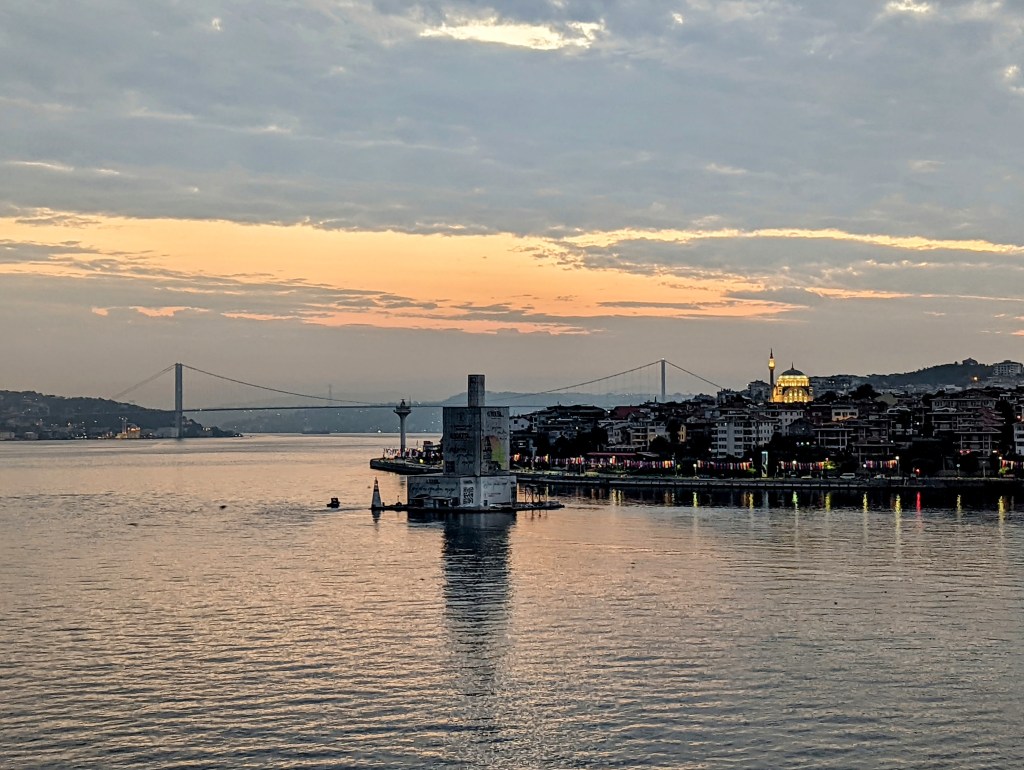
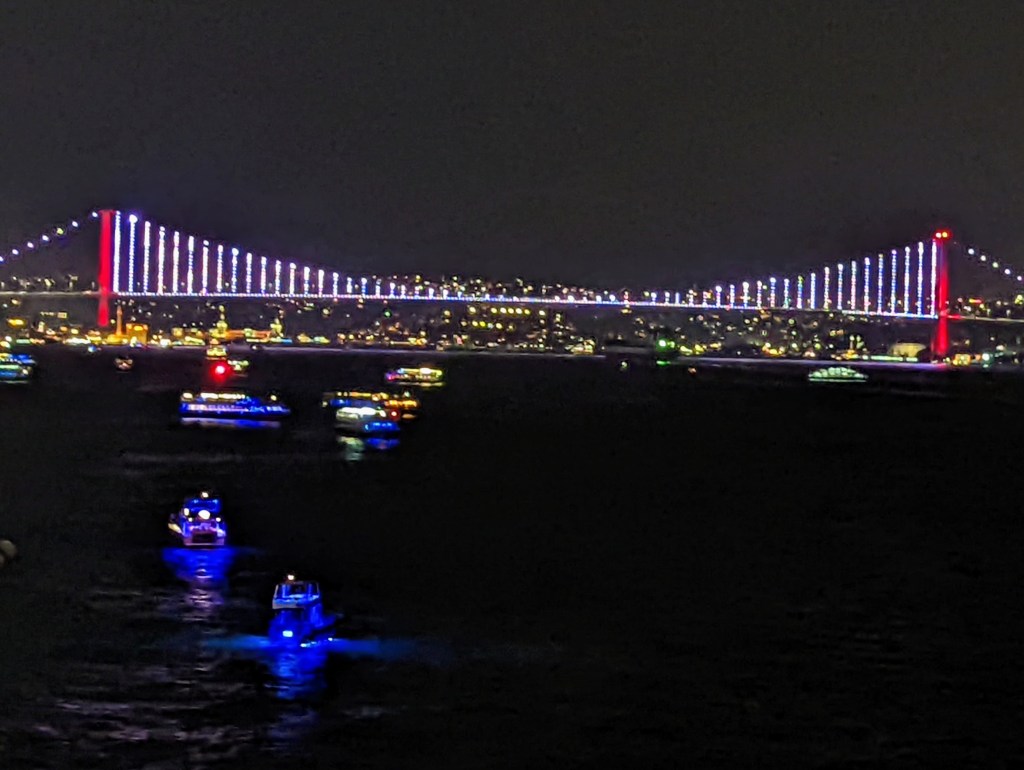
Early morning sail-in to Istanbul Evening view of Galata TowerLate night view of the Bosphorus Bridge
From early morning until late at night, Istanbul offers breathtaking views! As the last of four incredible days in Istanbul winds down, we are still in awe of this amazing place! An assault, in the best way possible, on all five senses, Istanbul will leave an imprint on our hearts for a long time to come. We will try to share a bit of what we experienced here, with strong recommendations to come and experience it for yourself!
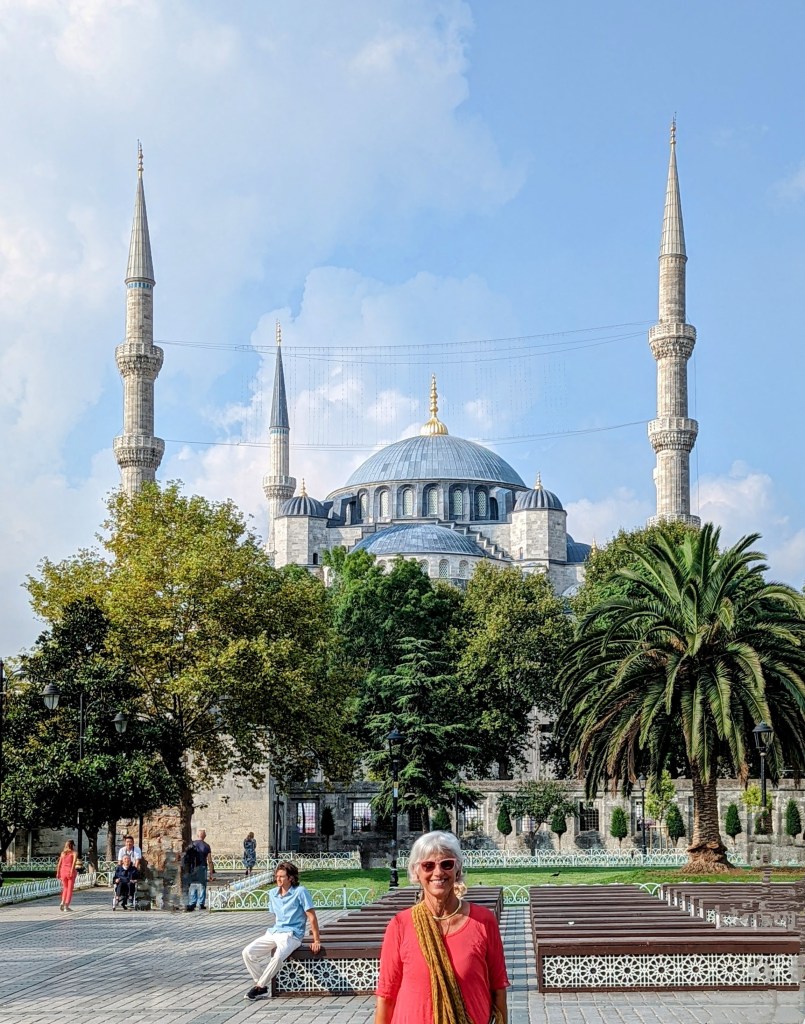
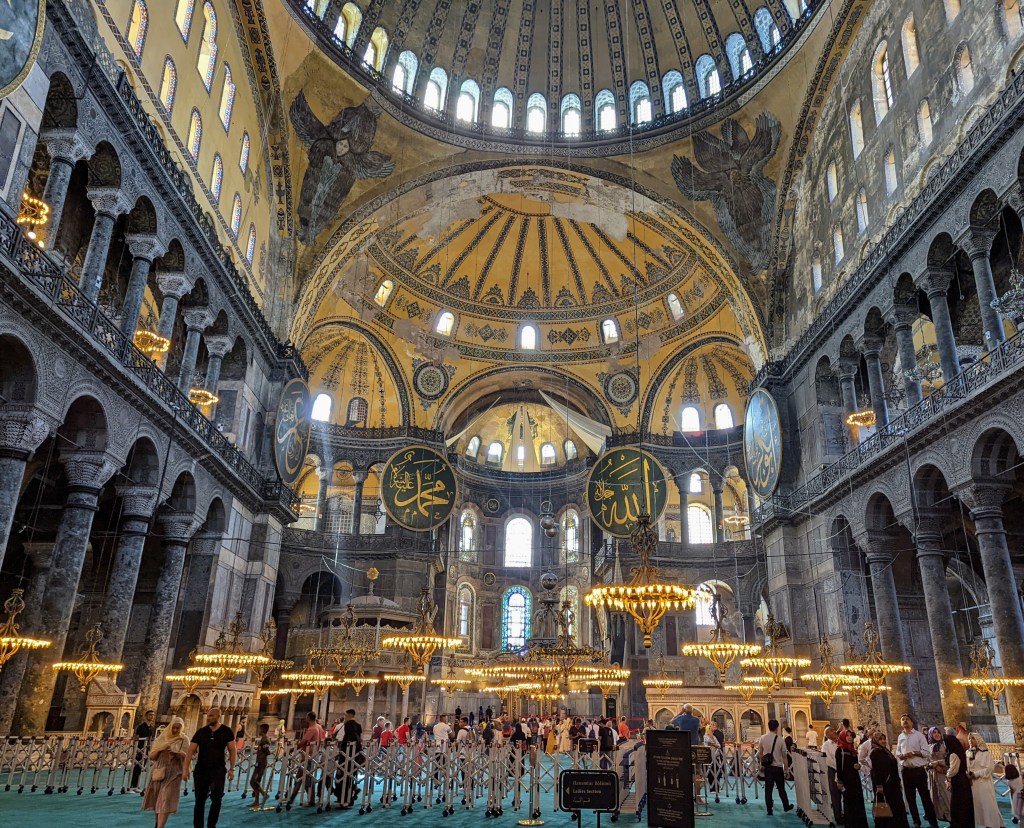
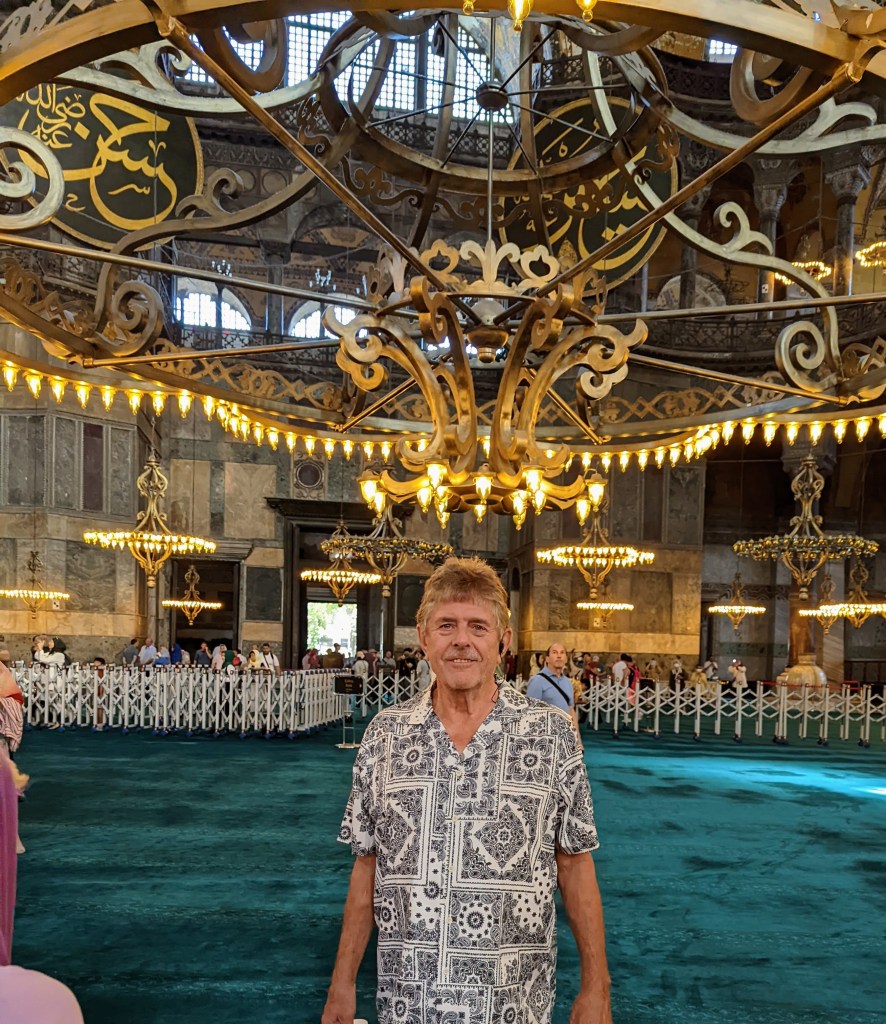
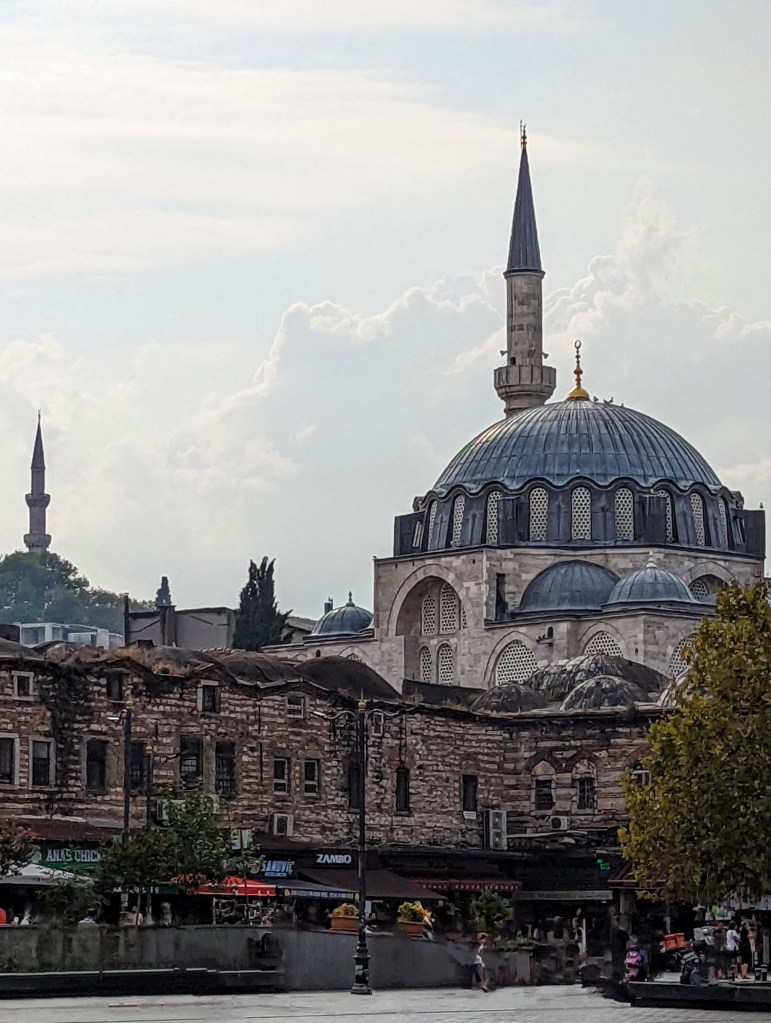
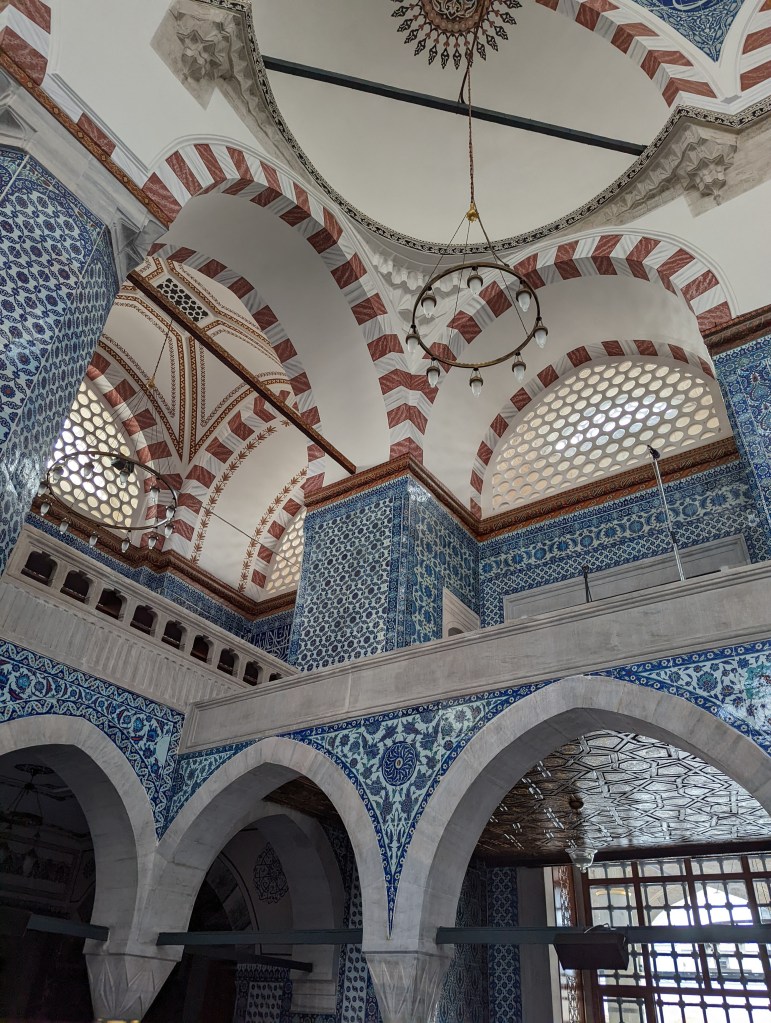
Home to some 3,000 mosques, we had the chance to enter only three: the Blue Mosque, Hagia Sophia, and Rustem Pasha Mosque.
The Blue Mosque, aka Sultan Ahmet Mosque, was built in the 1600s and is one of Istanbul’s many iconic landmarks.Although it is largely covered due to extensive renovation, glimpses of its delicate Ottoman tiles can be seen behind the scaffolding and drapes. It is open for prayer and visitation during the renovation.The magnificent Hagia Sophia, aka Ayasofya meaning “Shrine of Holy Wisdom,” was built as a Christian church in 537. Minarets were added when it became a mosque in the 15th century. It became a museum in 1935, and was converted back to a mosque in 2020. Hagya Sophia’s enormous domed sanctuary was an architectural innovation and masterpiece for its time.Rustem Pasha Mosque is a small mosque built in 1563. It sits on a high terrace behind the old city walls, and was built over a complex of shops originally intended to provide financial support for the mosque complex.The mosque was re-opened in 2021 after extensive renovations to bring the beautifully designed tile walls and ceilings back to their former glory.Other mosques dot the skylines throughout Istanbul.
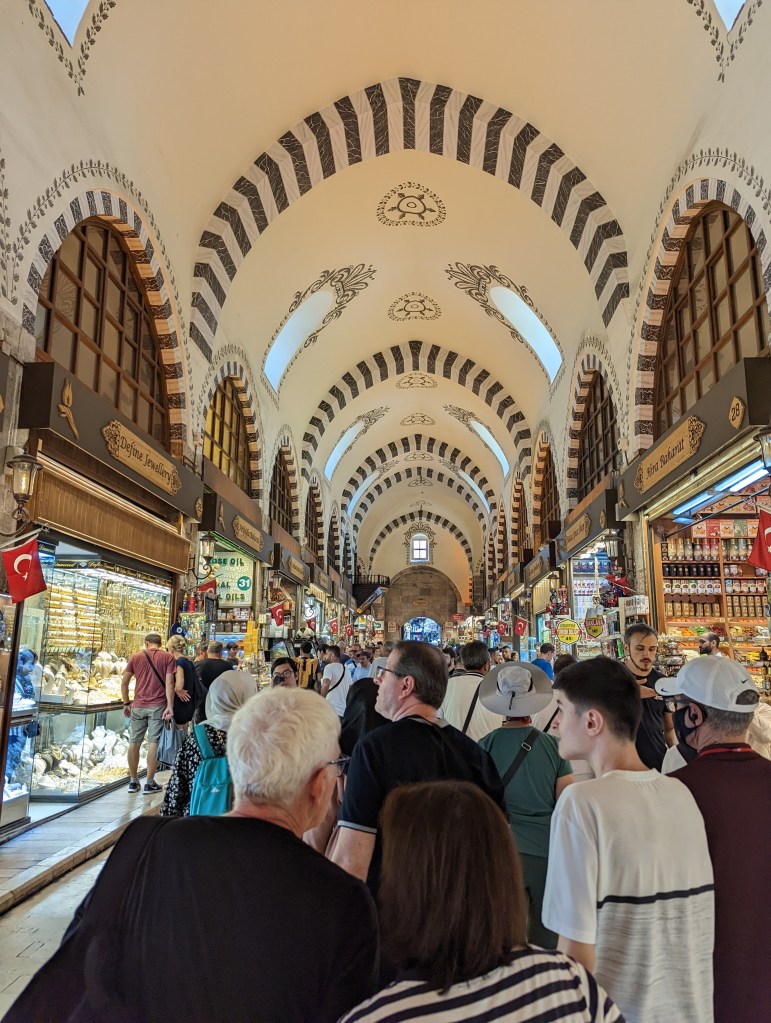
Istanbul is a shopper’s paradise. Bazaars of all types and sizes offer everything from sweets to carpets to jewelry. The bazaars are also popular meeting places for a talk, a smoke, and a cup of thick, rich Turkish coffee.
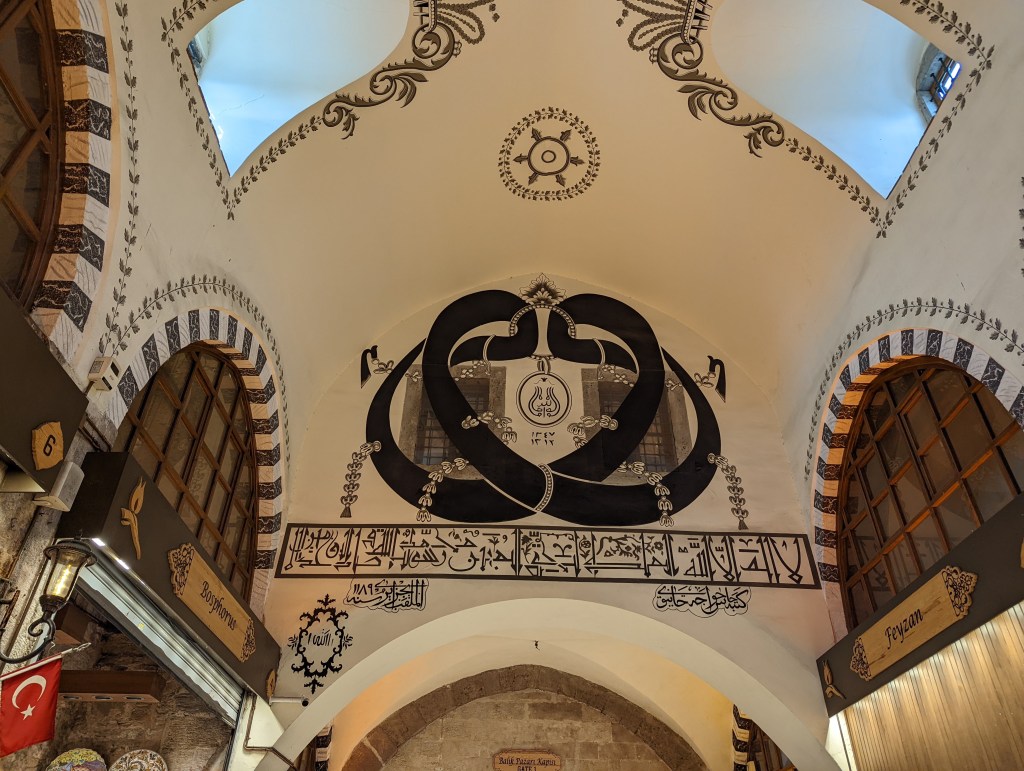
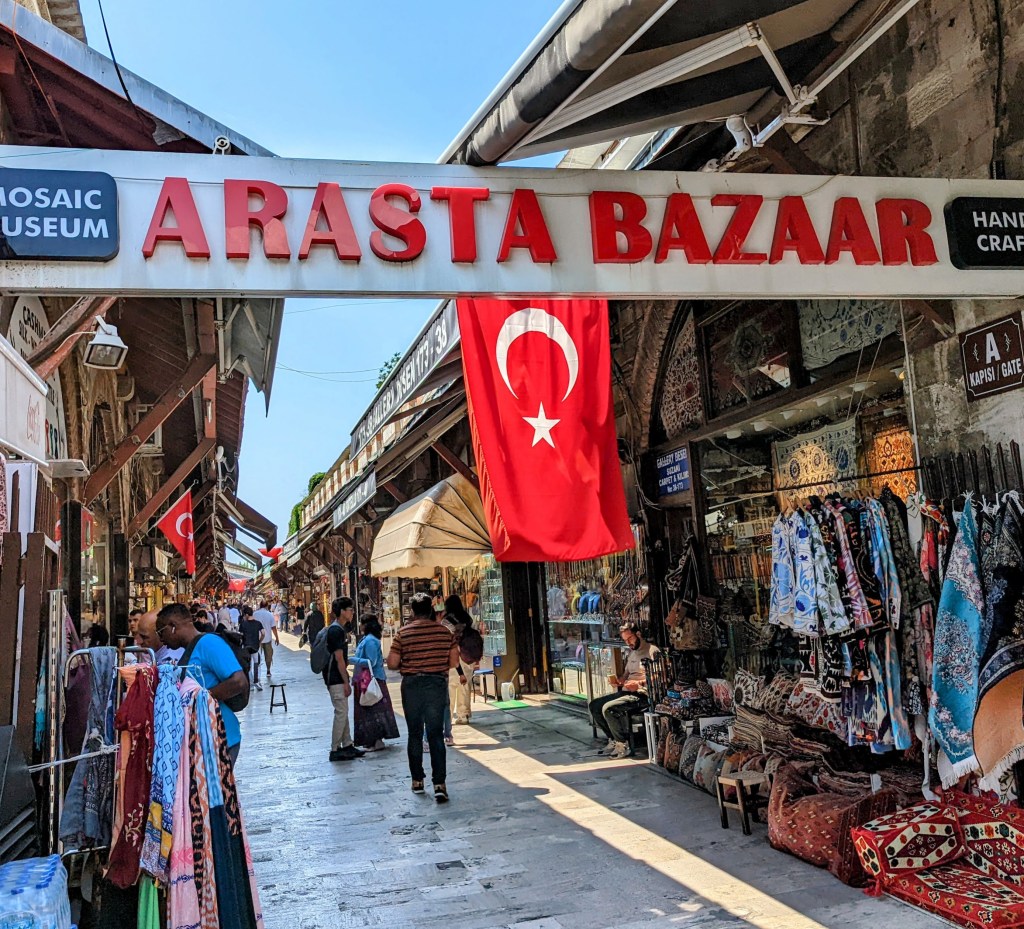
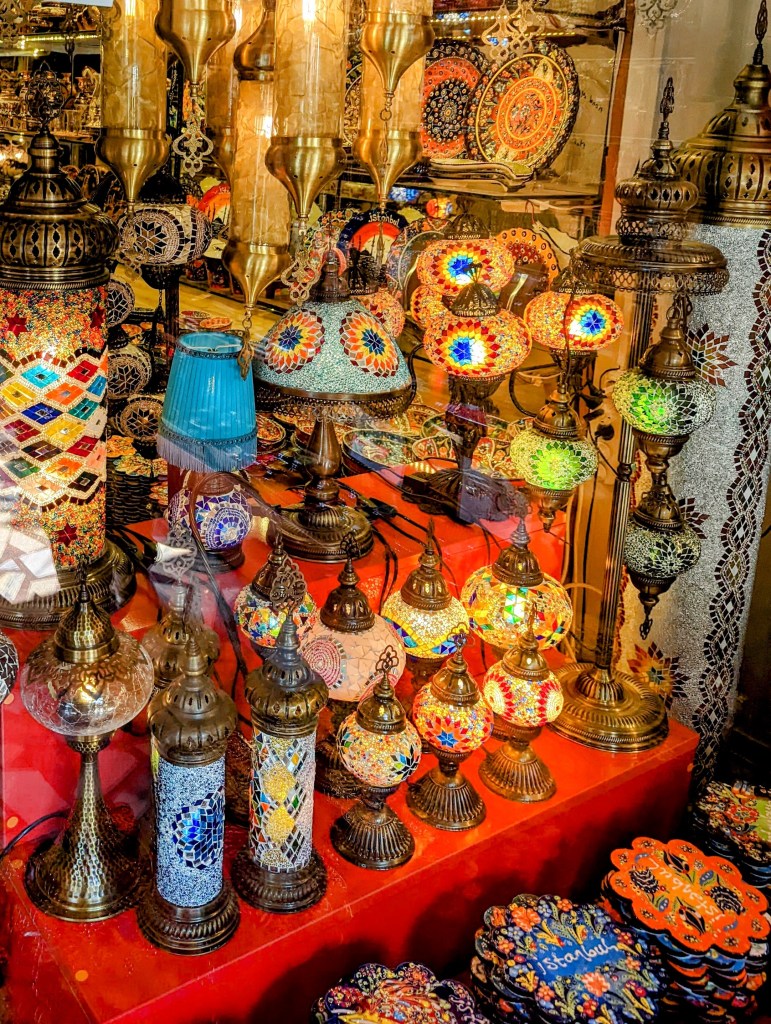
Busy entrance to the Grand BazaarOutdoor stalls sell different foodsIndoors, one can find every kind of souvenir!Entrance to the Spice Bazaar The Spice Bazaar is much smaller, offering mostly food items ranging from MANY flavors of Turkish Delight to exotic spices and essential oils. We opted for some saffron and argan oil at a fraction of what we would pay at home. And religious symbols aboundThe Arasta Bazaar has a more upscale feel, with high quality goods and more of a local feeling.Beautiful Turkish items are offered indoors and out.
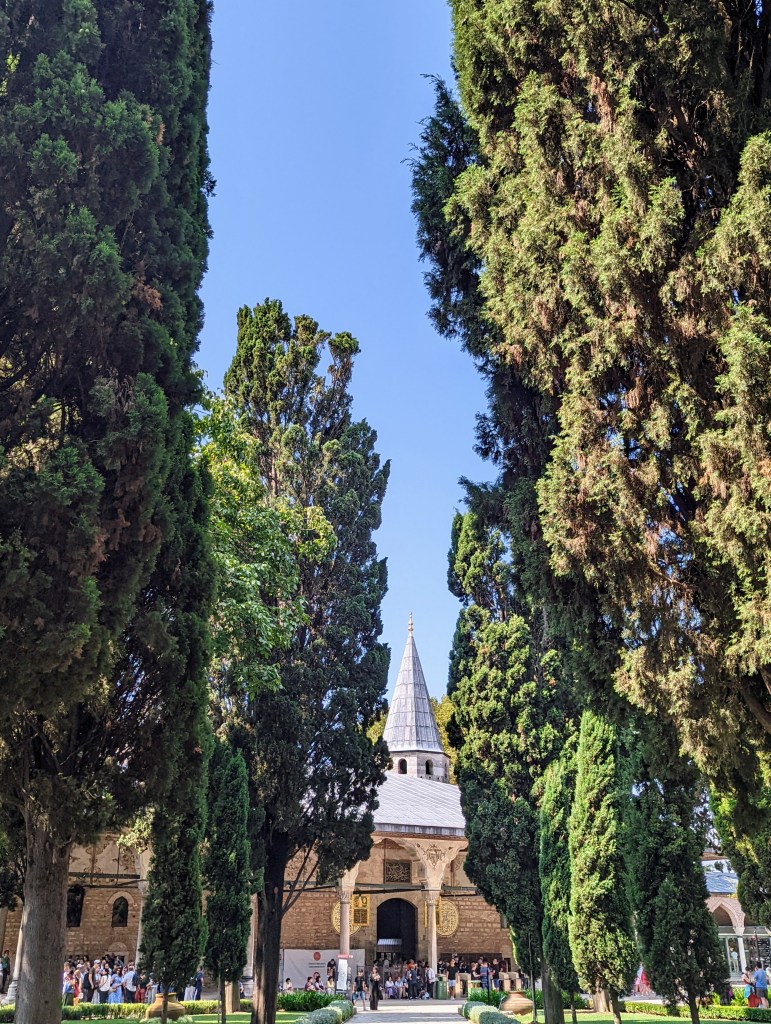
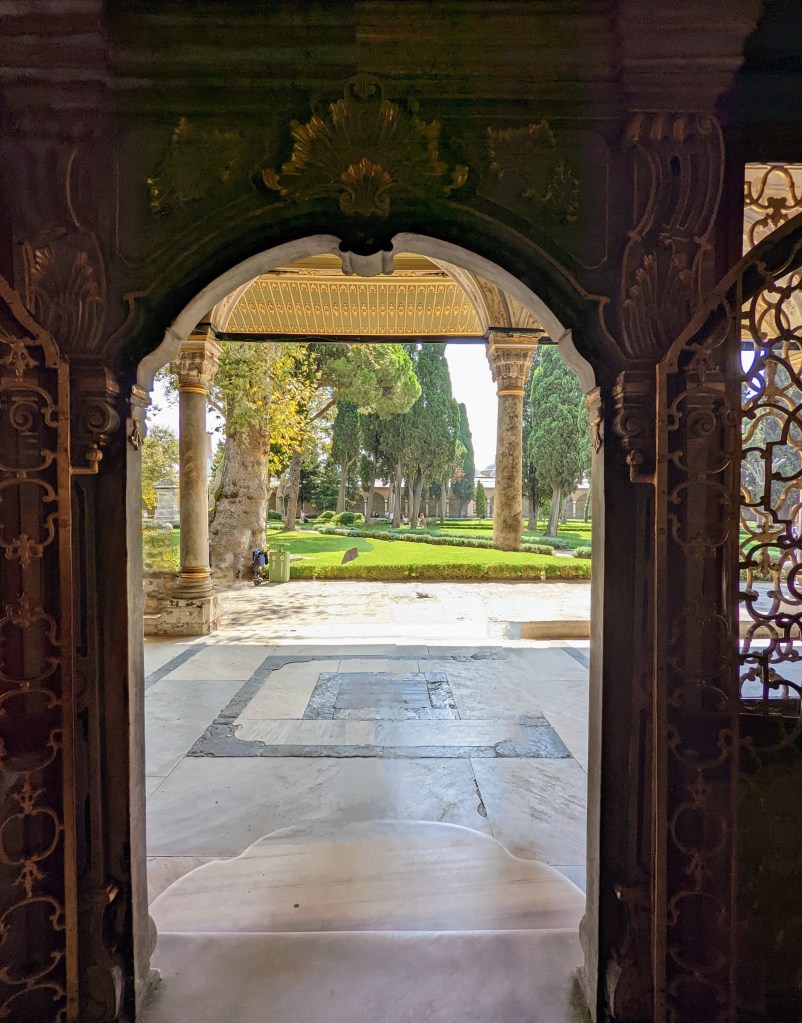
Topkapi Palace was the Imperial residence of the Ottoman Sultans from the 15th to the 19th centuries. Amid the lovely courtyards with towering cypress trees and lush gardens, visitors can imagine what life might have been like during this time.
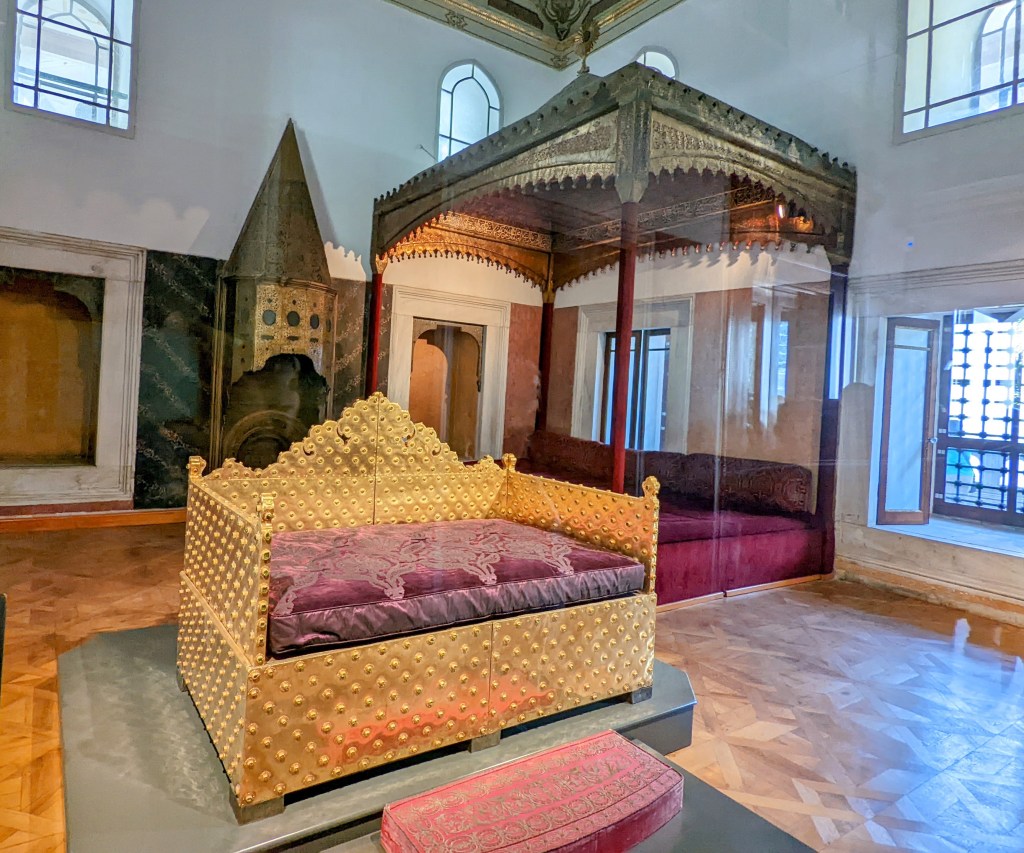
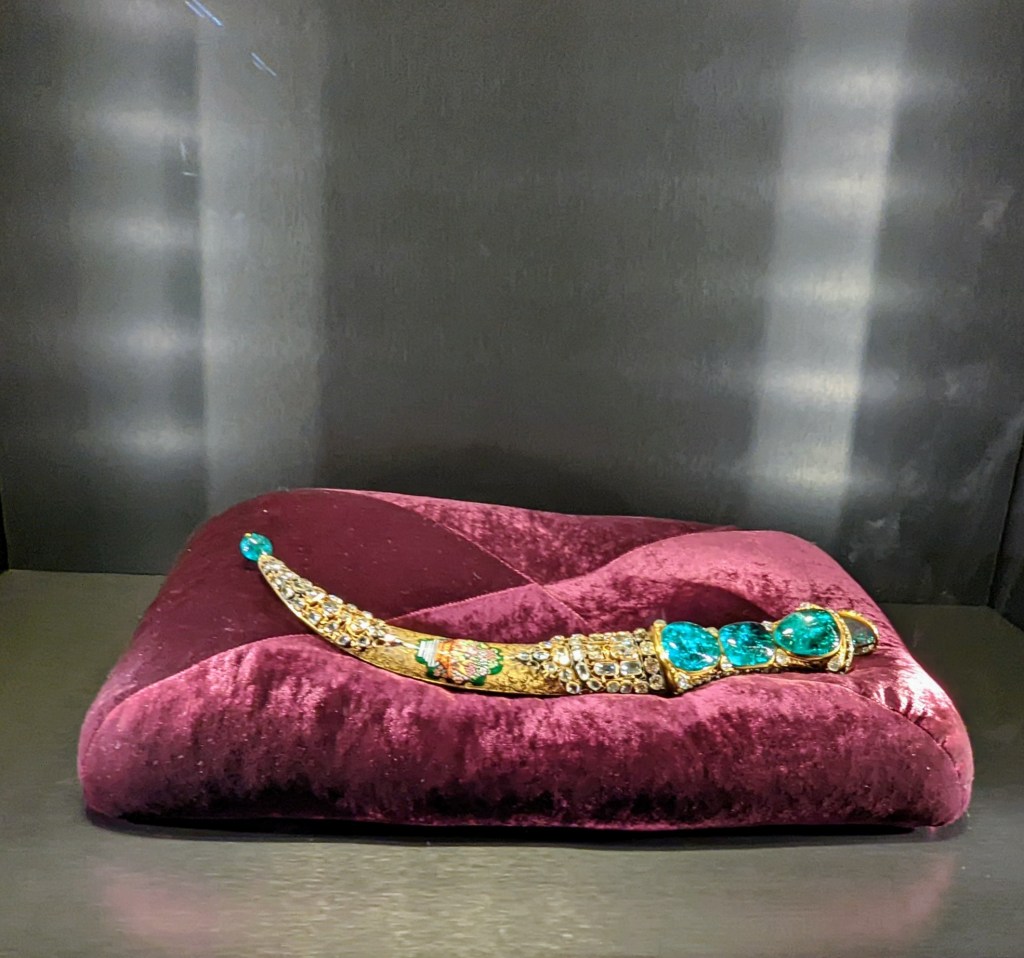
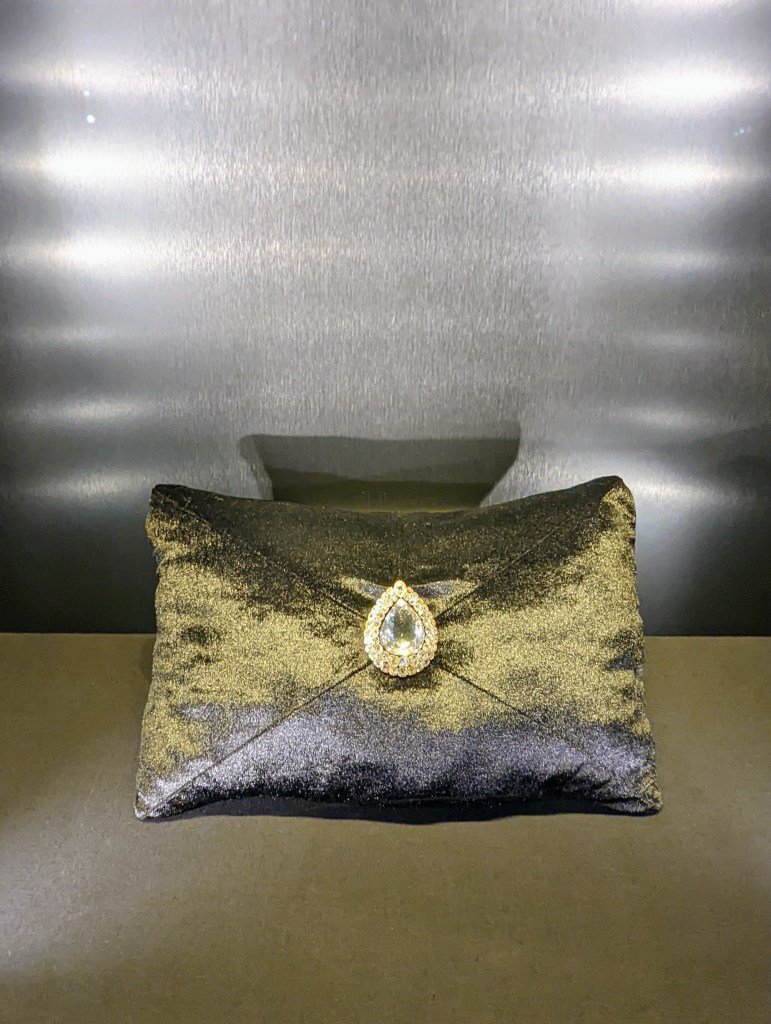
Palace GateRestful lush gardensA view of the gardens from within the palaceThe golden throne in the sultan’s bedroomJewel-encrusted dagger of TopkapiThe 86 carat spoon maker’s diamondPalace fountain inscription: “To tell the date it suffices you know it contains the verse ‘there is healing and mercy.” (surah al-isra, 17-82)
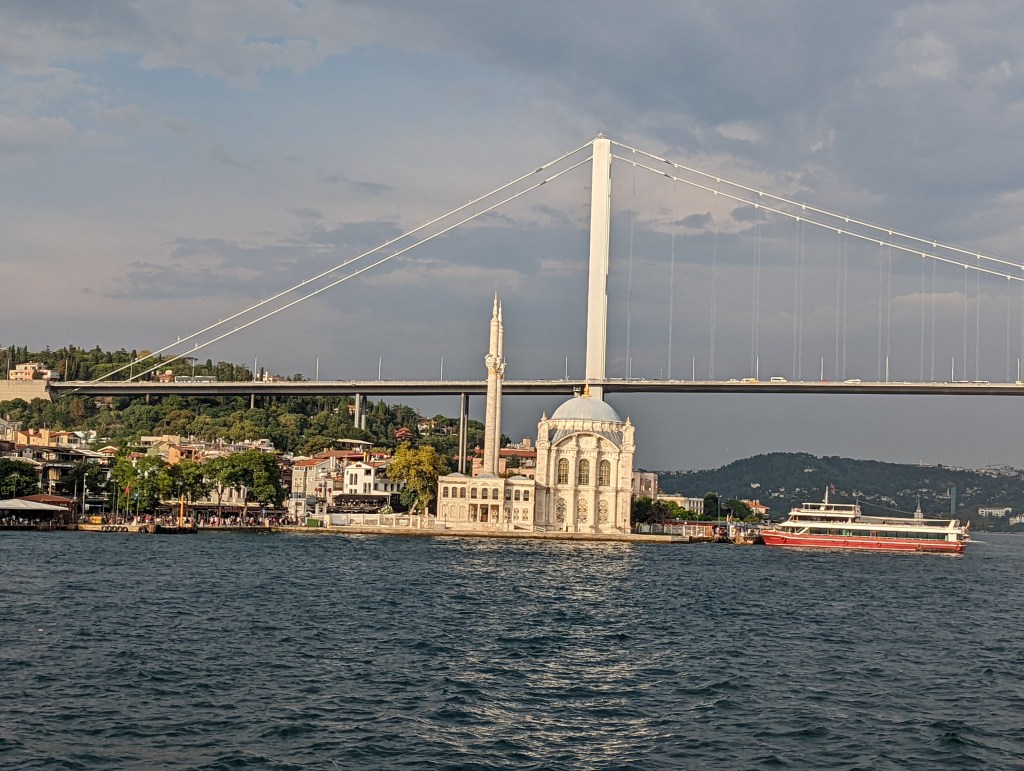
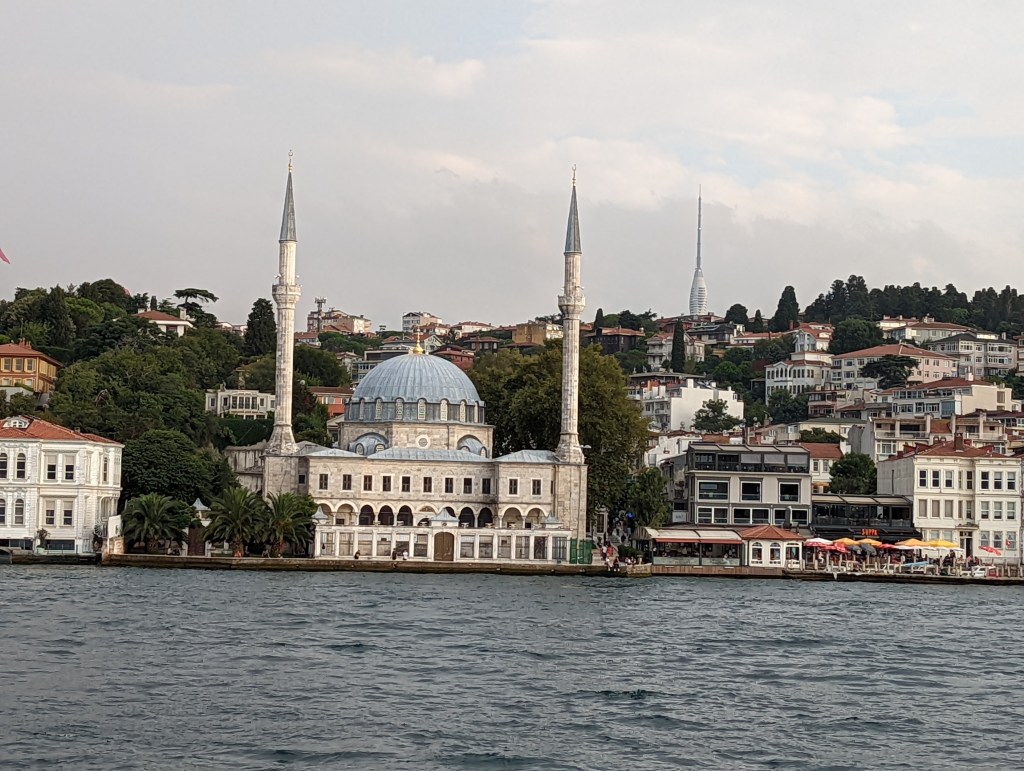
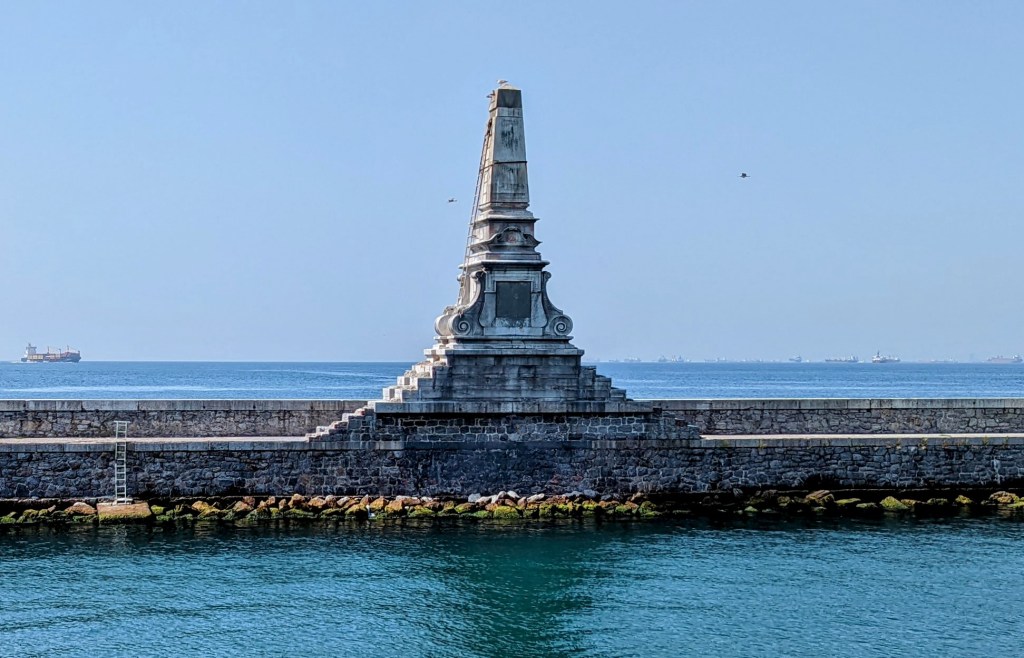
A poet once described the Bosphorus Strait as “God’s beautiful calligraphy written by an ink made of sapphires.” The strait provides part of the continental boundary between Asia and Europe and divides Istanbul into Anatolia and Thrace. An important international trade route, it also connects the Black Sea to the Sea of Marmara. We enjoyed a cruise along the strait as well as a ferry ride from Besiktas Pier on the European side to Kadikoy on the Asian side. Views on both rides were spectacular!
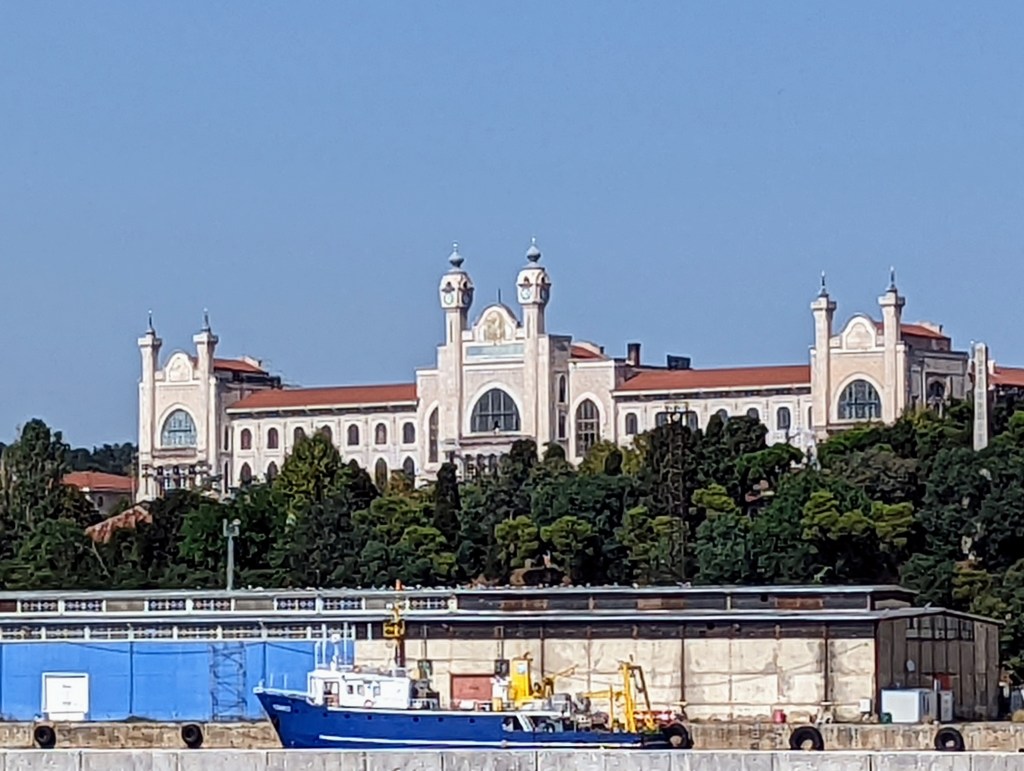
15 July Martyrs Bridge and Grand Mecidiye MosqueHamid-i Evvel Camii MosqueMaiden Tower, another Istanbul landmark Wall Mural in KadikoyMarmara University
We can’t say enough about the food! From street vendors selling grilled corn on the cob, roasted chestnuts, and the ubiquitous simit (yummy round sesame bread) to fresh seafood, grilled kebabs, and the fresh fruits, nuts, cheeses, and vegetables in abundance at the bazaars, we found the food in Istanbul to be satisfying and delicious.
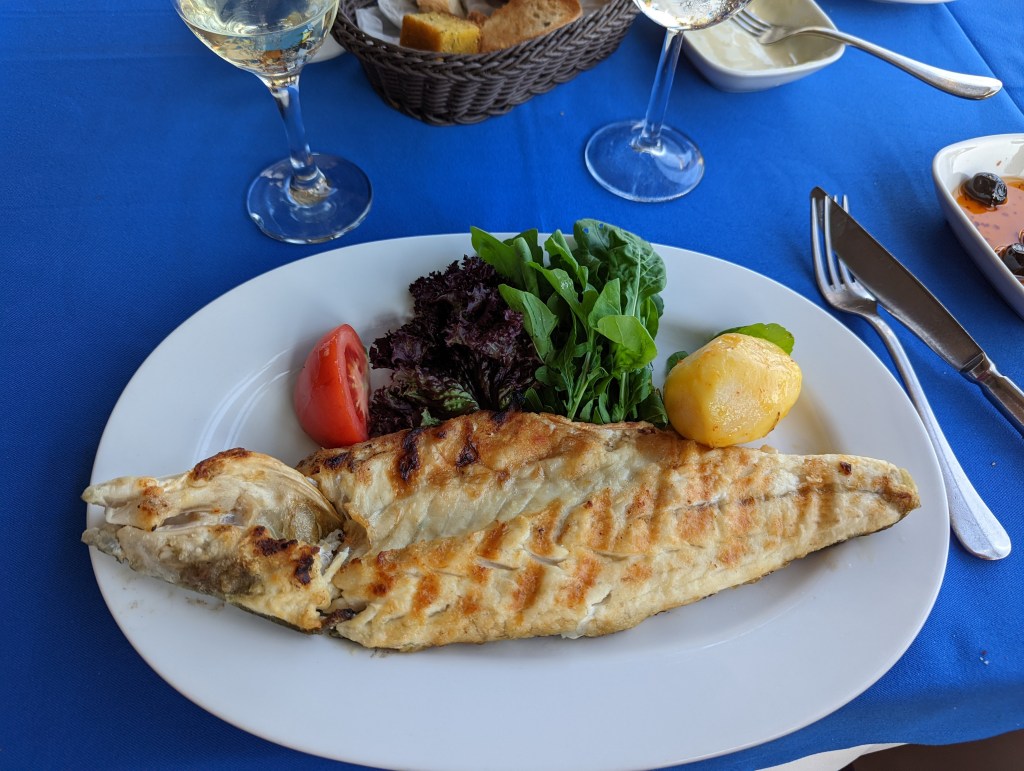
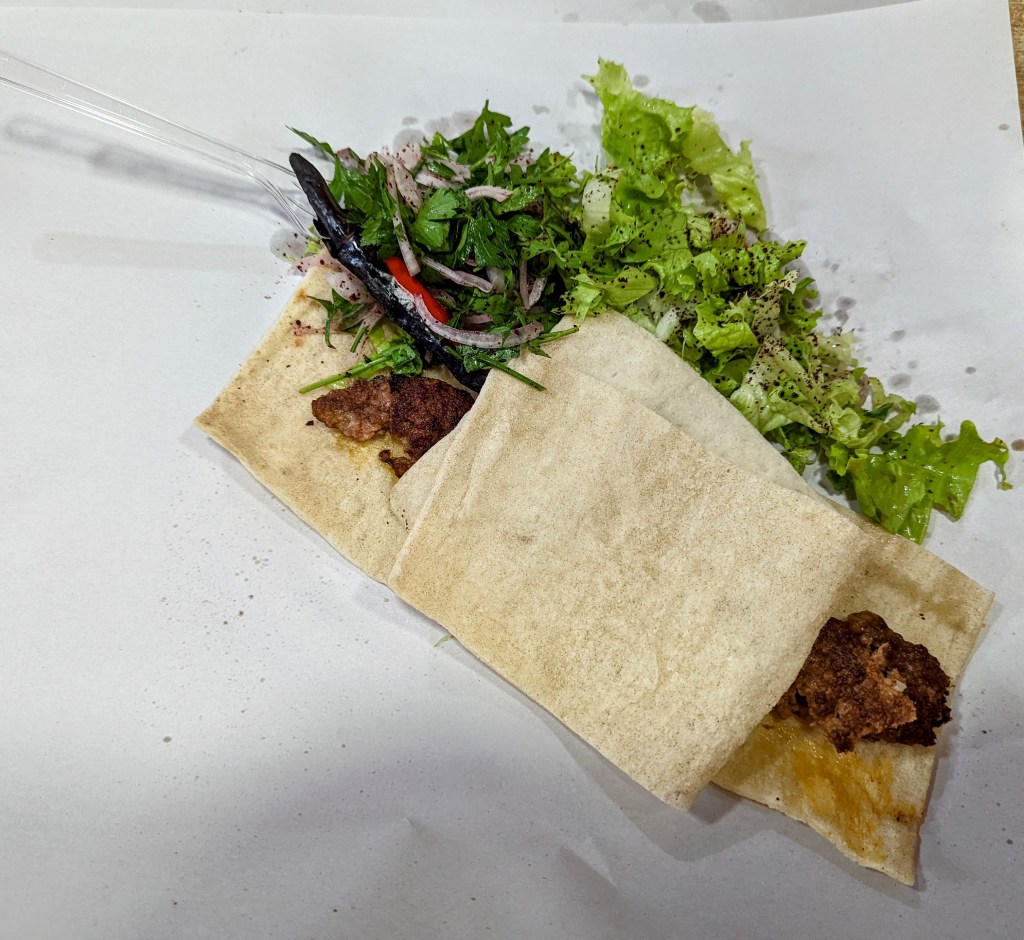
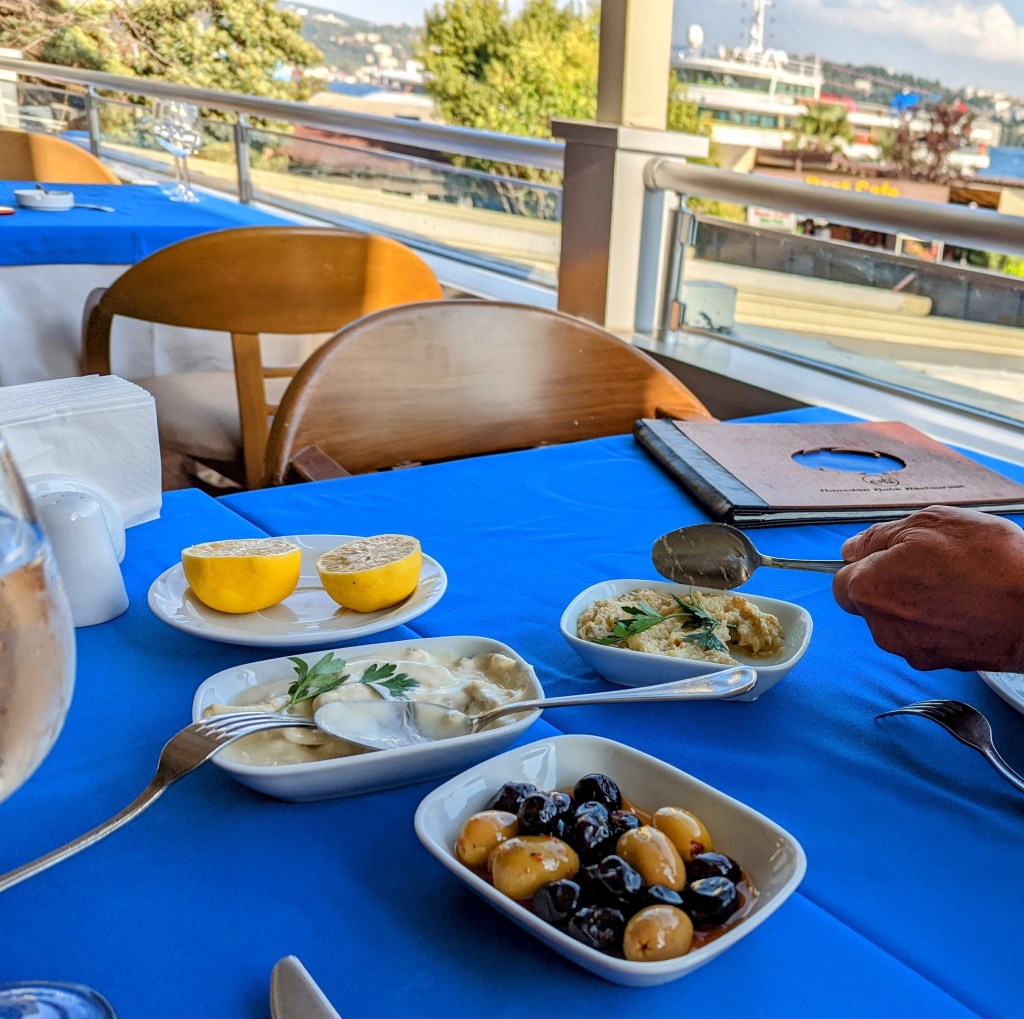
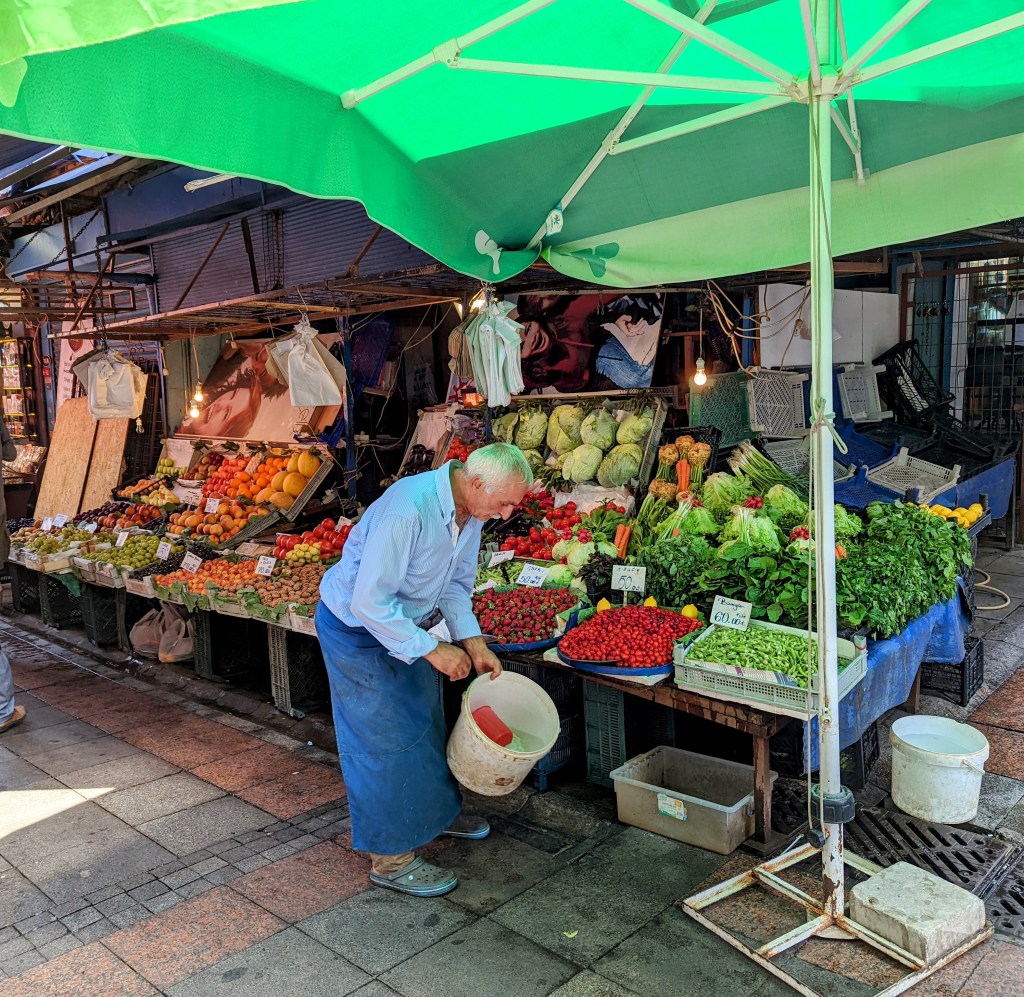
Breakfast selections from the bountiful buffet at our hotelFresh grilled sea bassNuts of all kinds at a bazaarGrilled kebab with salad and pitaSmall plates Sweets, sweets, and more sweets!This lively produce vendor watered his goods every so often to keep them fresh. We witnessed him in a random act of kindness giving some lemons and peaches to a woman who clearly needed some help.
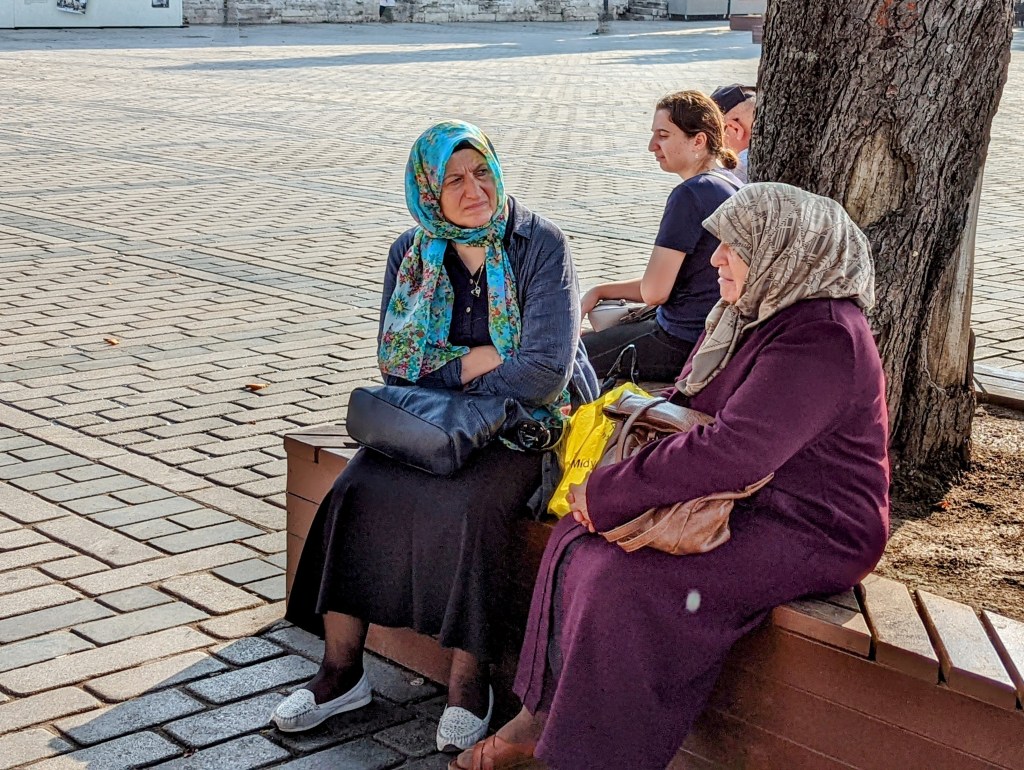
But it was the culture in Istanbul that we found most appealing. Although Turkey is 95% Muslim, 3% Christian, and 2% Jewish, we were told that religious freedom and tolerance is the norm. The call to prayer 5 times a day is a reminder of a greater good. And we were told that getting together for a coffee in Turkey can last 2-3 hours. Friends gather before and after prayer, and people seem to greet one another with genuine hospitality. These lovely friends pretty much sum up our views of the people of Turkey…old friends taking time for genuine conversation. We liked that!
Would love to have been able to understand their conversation!
At our ages, it’s not likely that we’ll have the opportunity to return to Istanbul, but we’re delighted we had four truly enjoyable days there!
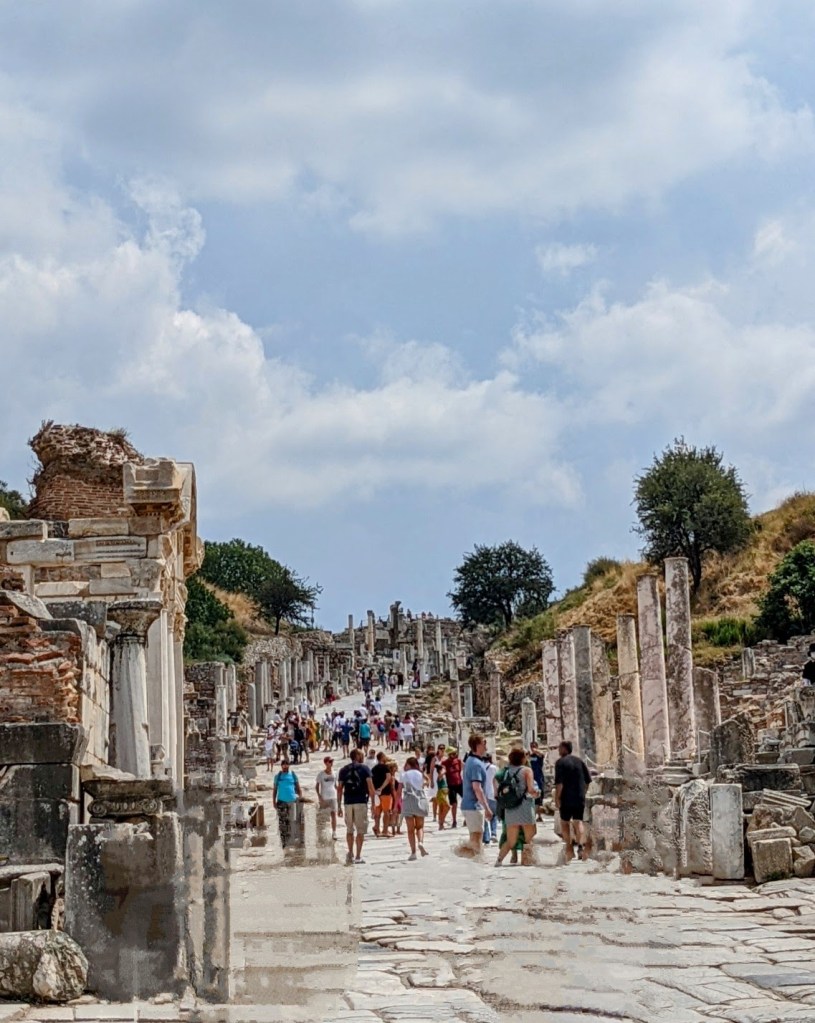
Ephesus is an ancient city in Turkey’s Central Aegean region. Its excavated remains reflect cultures of history from classical Greece to the Roman Empire. Although a great deal of the area has been recovered, archaeologists anticipate that it will take another 200 years before their work is complete. The library has become symbolic of the city, and over 2 million visitors pose in front of its imposing facade every year.
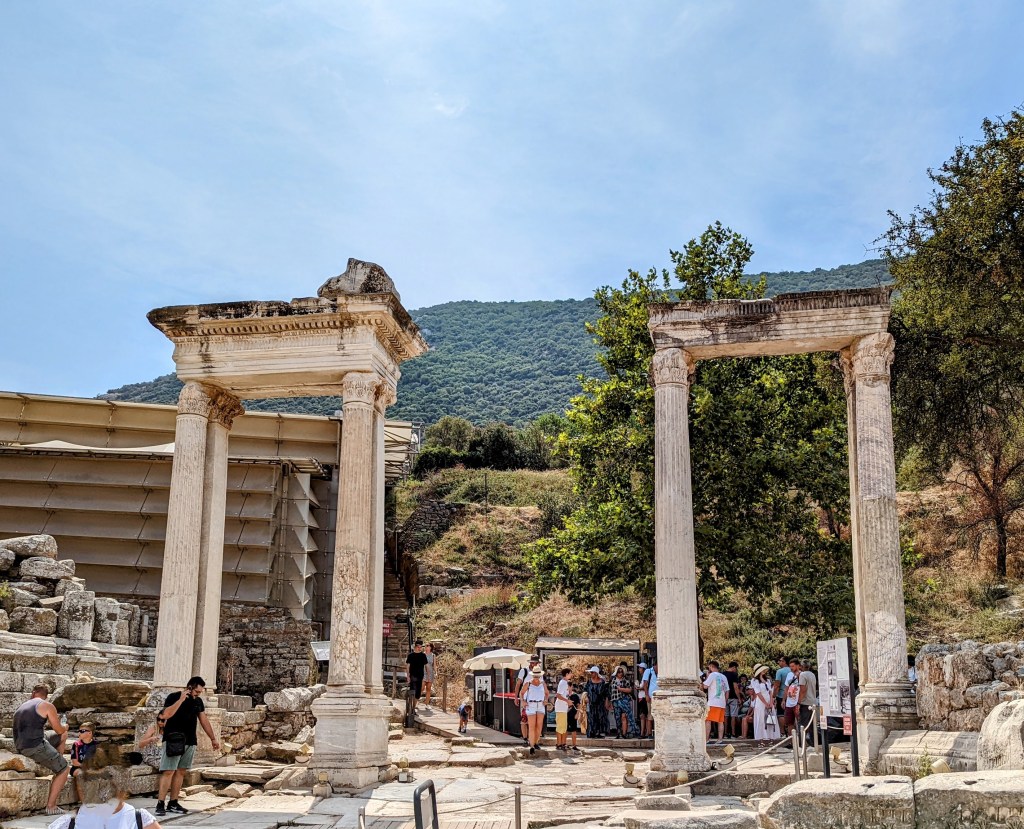
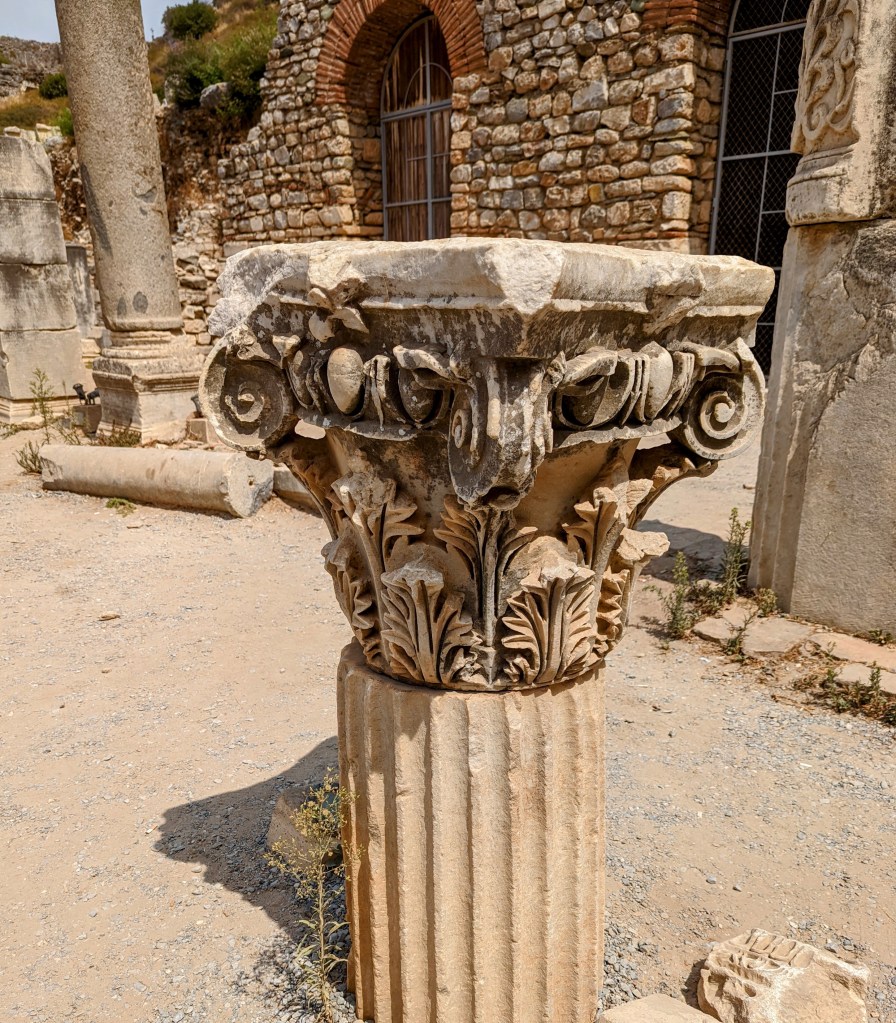
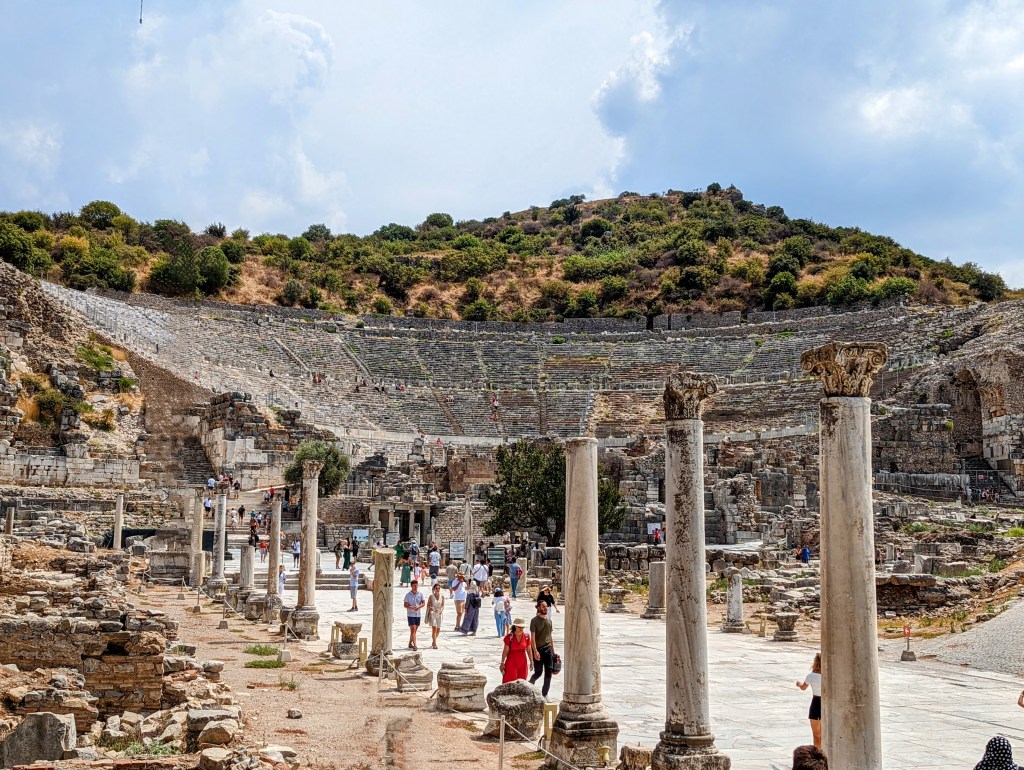
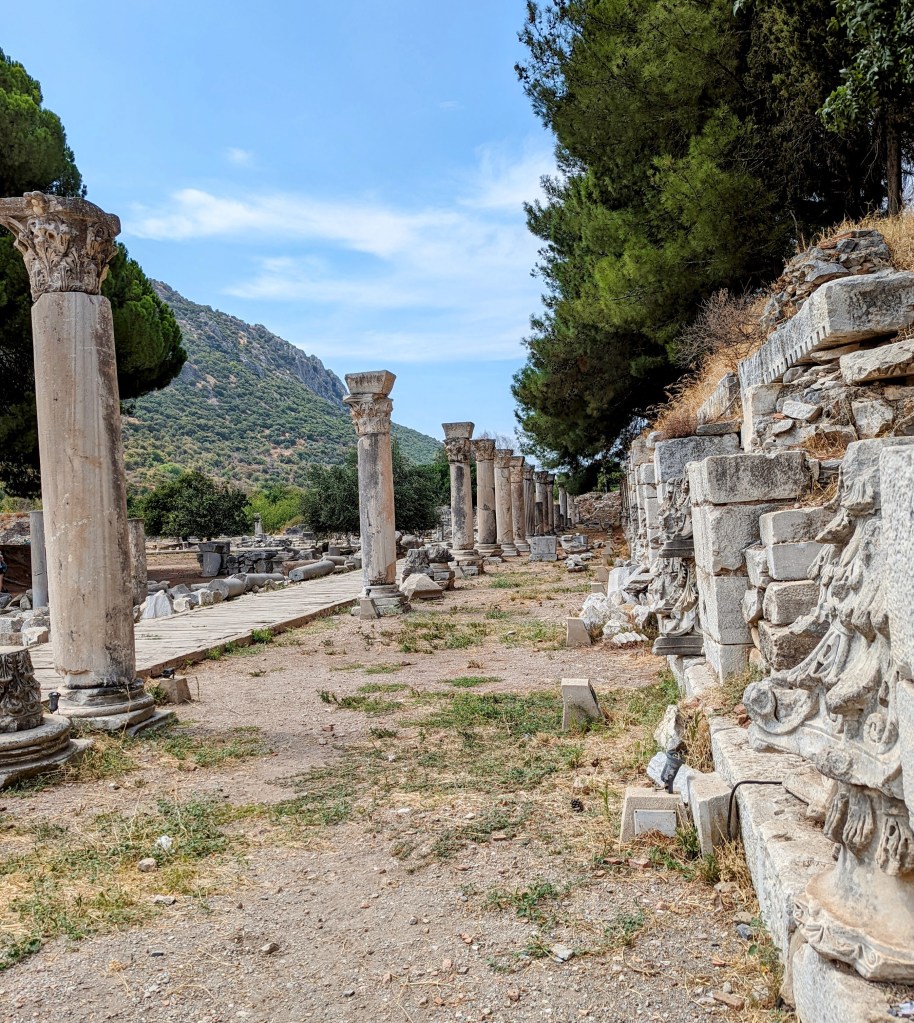
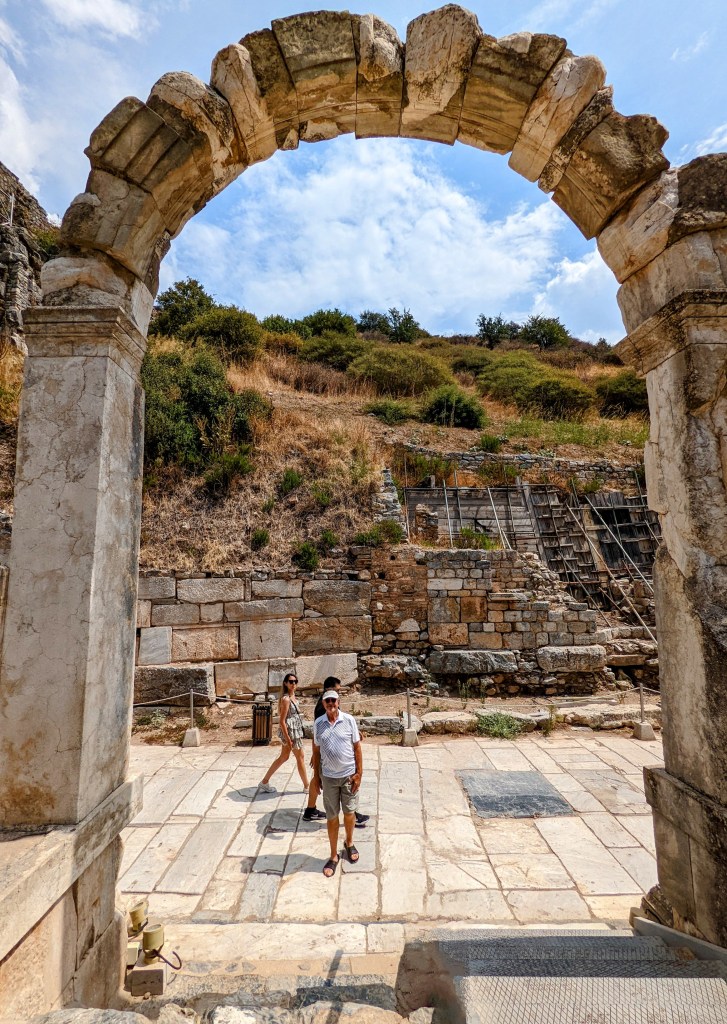
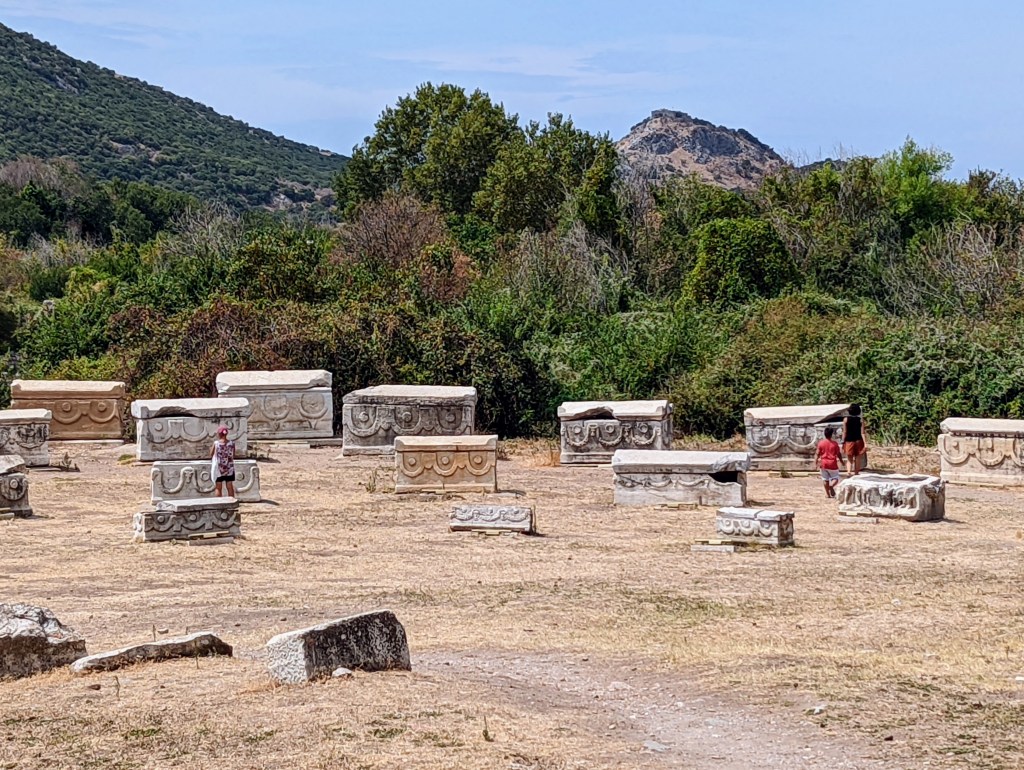
Hadrian’s Gate is located at the junction of Curetes Street and Marble Road. It is a triumphal gate built in honor of Roman Emporer Hadrian who visited Ephesus in 130 AD.Curetes Street lined with booths where vendors sold their goodsClassic Corinthian column reflects the artistic skill of these ancient peopleFrescoes reflect lifeThe Ephesus Theater that once held 25,000 spectators Rows of intricately carved columns lined streetsGateway onto Marble StreetSarcophagus (flesh-eaters) are intricately carved stone boxes in which people were buried. It was believed that the stone ate the flesh, leaving only the bones of the deceased. Way-findingReflections on decades past
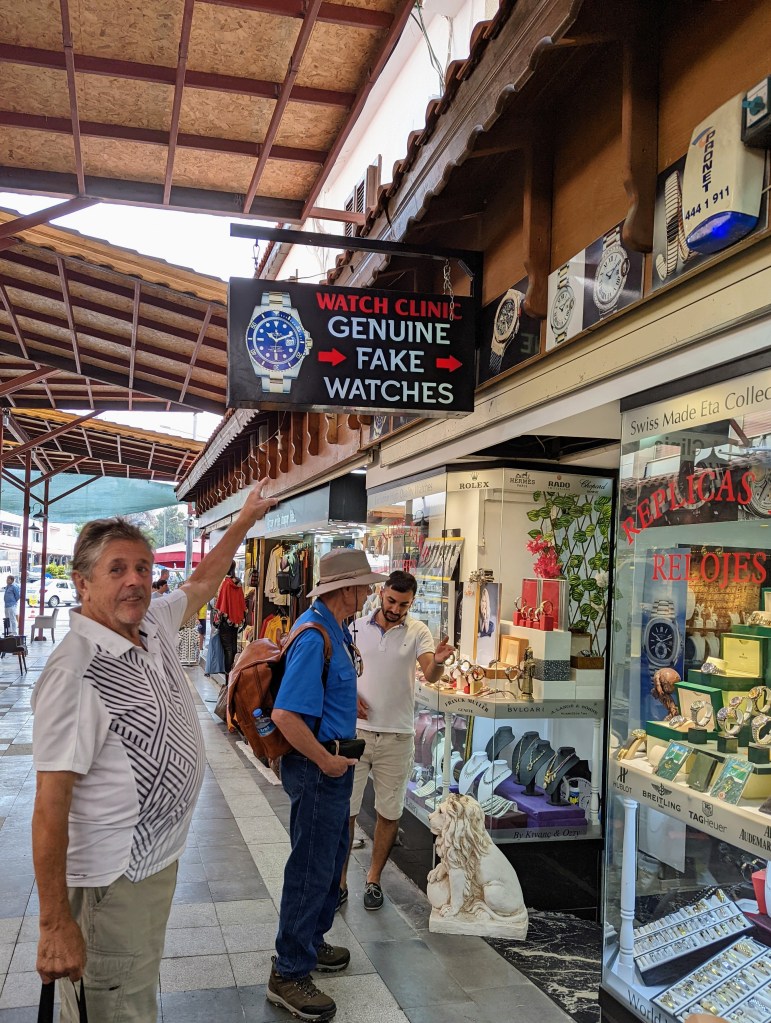
Following our visit to Ephesus, we rode back to the port city of Kusadasi, a shopping paradise. Doug honed his negotiating skills in a shop offering “almost free and almost real” Rolexes, getting the price down from $60 to $25, then walking away.
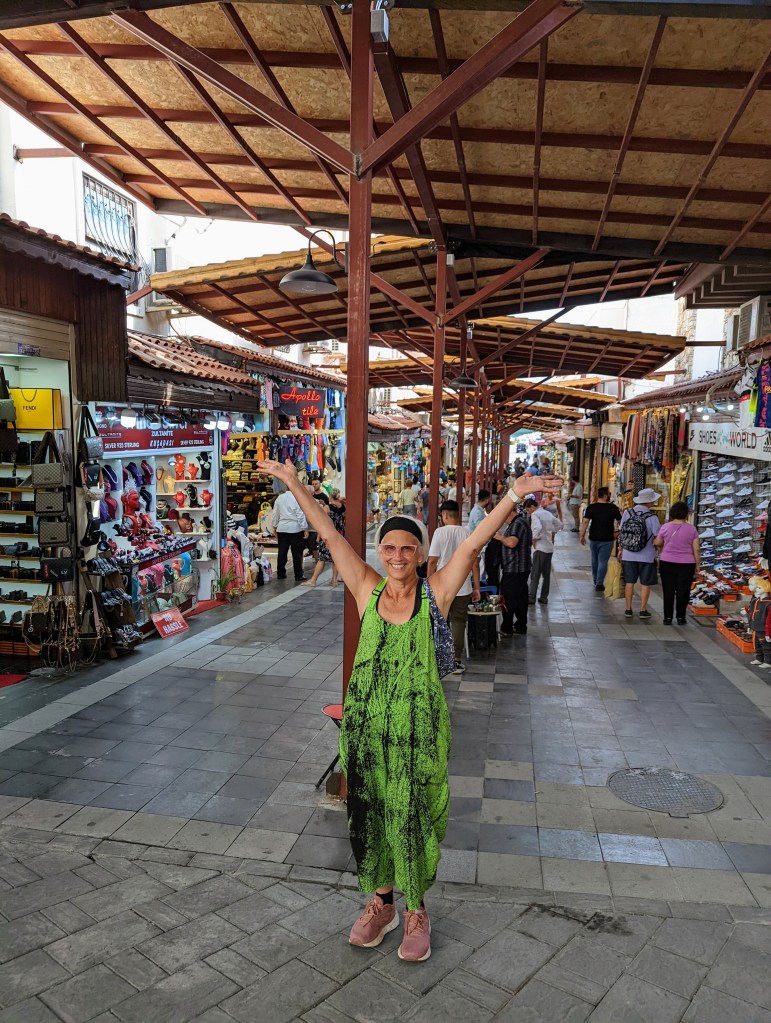
So many shops!
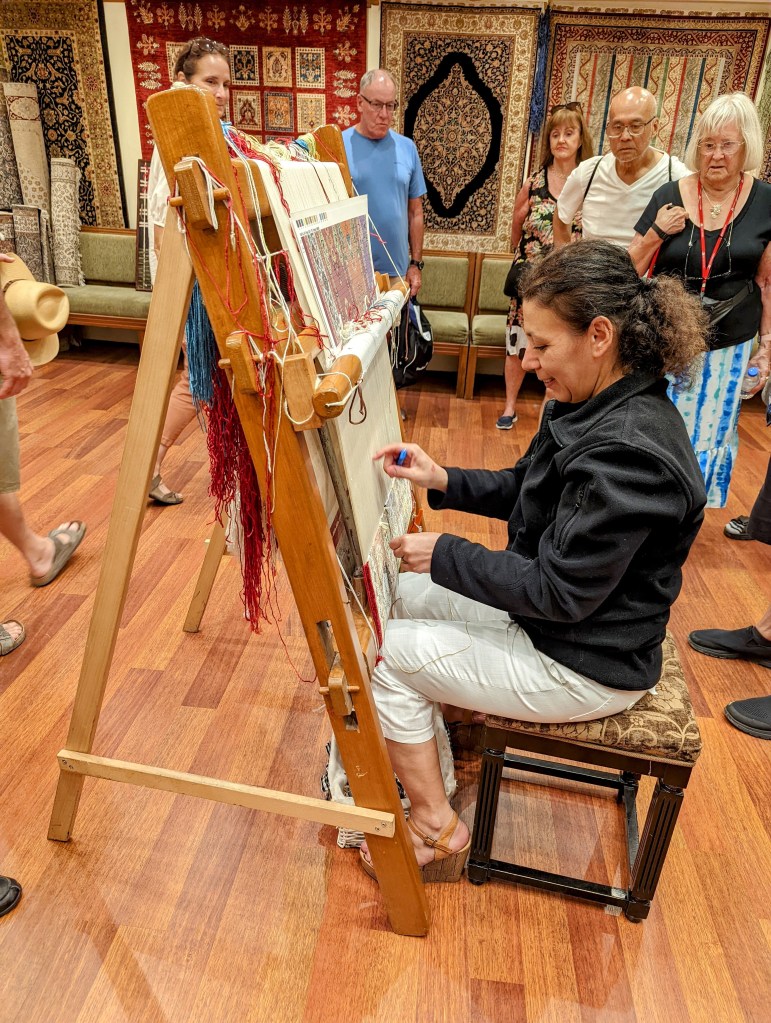
We also watched an interesting demonstration of the techniques used to weave silk and hand-tie the famous Turkish rugs. We had no intention of buying a rug, but one caught our eye that we simply could not resist. Doug did a great job of negotiating, but I’m sure the seller still made a handsome profit. It will be a lasting souvenir of a lovely day in Turkey.
Spinning silk threads using a foot-pedaled machineLayla hand-tying a rug
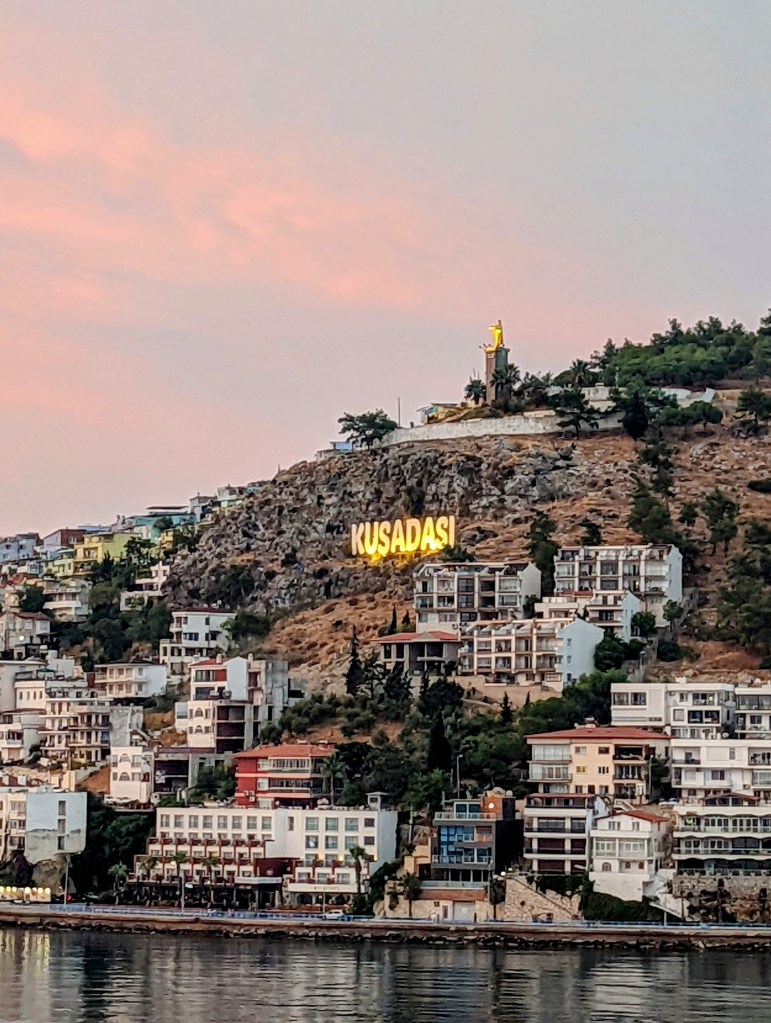
Sailing away from Kusadasi, we noticed a statue of Mustofa Kamal Ataturk standing high above the city sign. Ataturk came to prominence for his role in securing the Ottoman Turkish victory at the Battle of Gallipoli (1915) in World War I. He was the first president of Turkey, serving from 1923 until his death in 1938. He is well-respected as the Father of the Turkish Republic, and revered for his sweeping progressive reforms which modernized Turkey into a secular democracy.
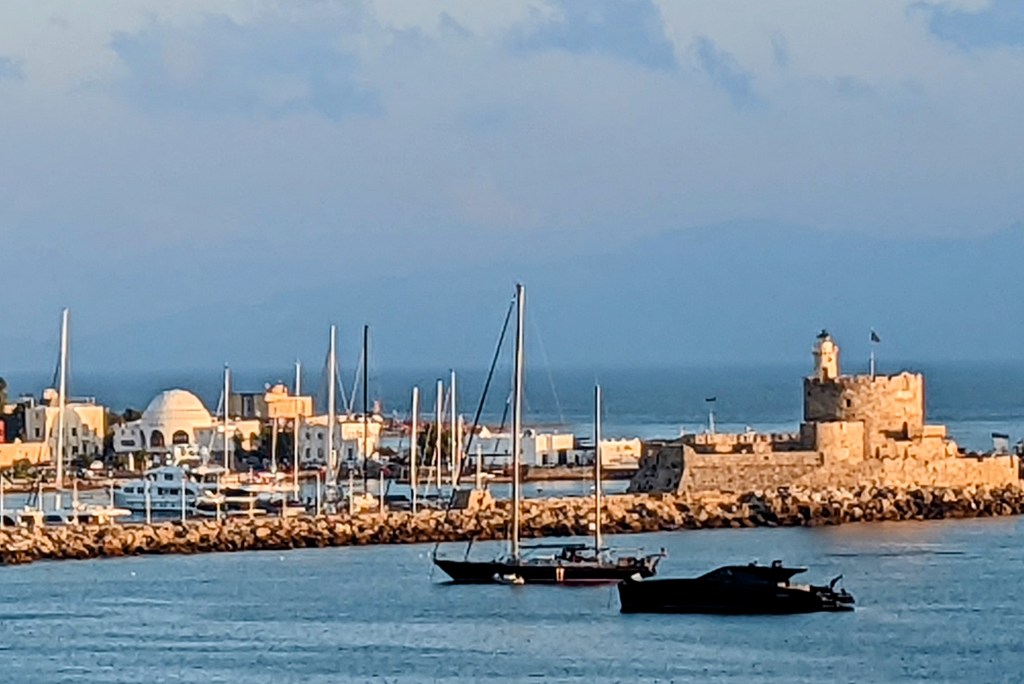
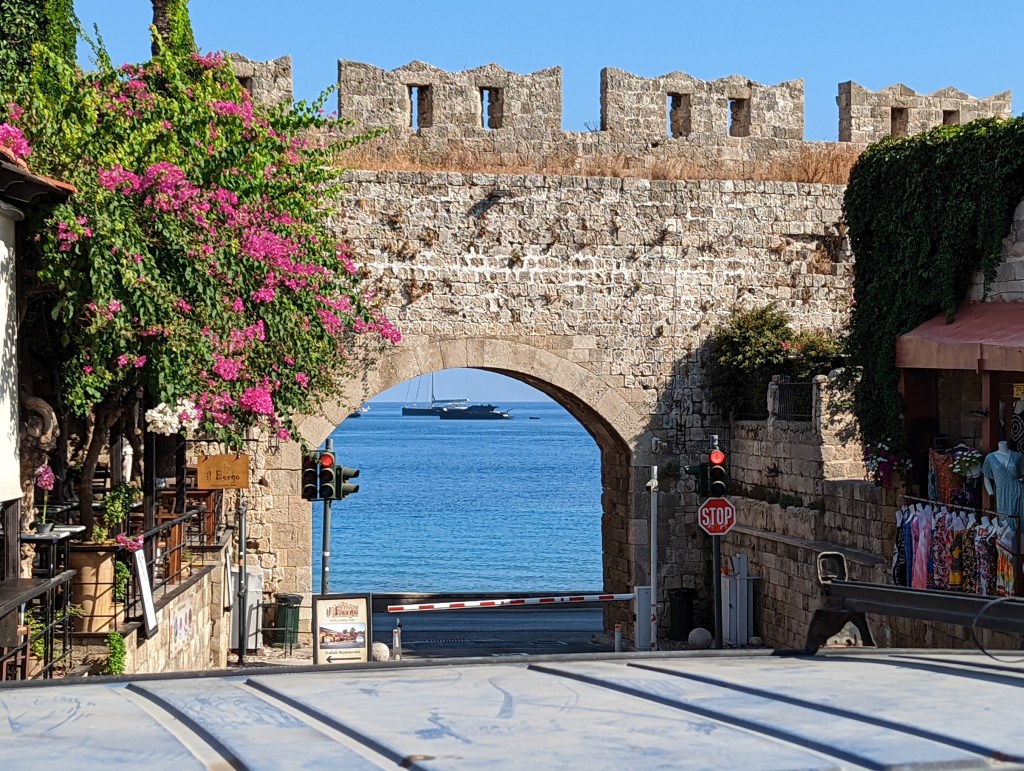
The lush island of Rhodes is the largest of Greece’s Dodecanese islands and our last stop in Greece. It is situated at the crossroads of the two sea routes of the Mediterranean, between the Aegean Sea and the coasts of the Middle East. Best known for its well-fortified and exquisitely preserved Old Town, Rhodes is surrounded by areas that paint a very different picture.
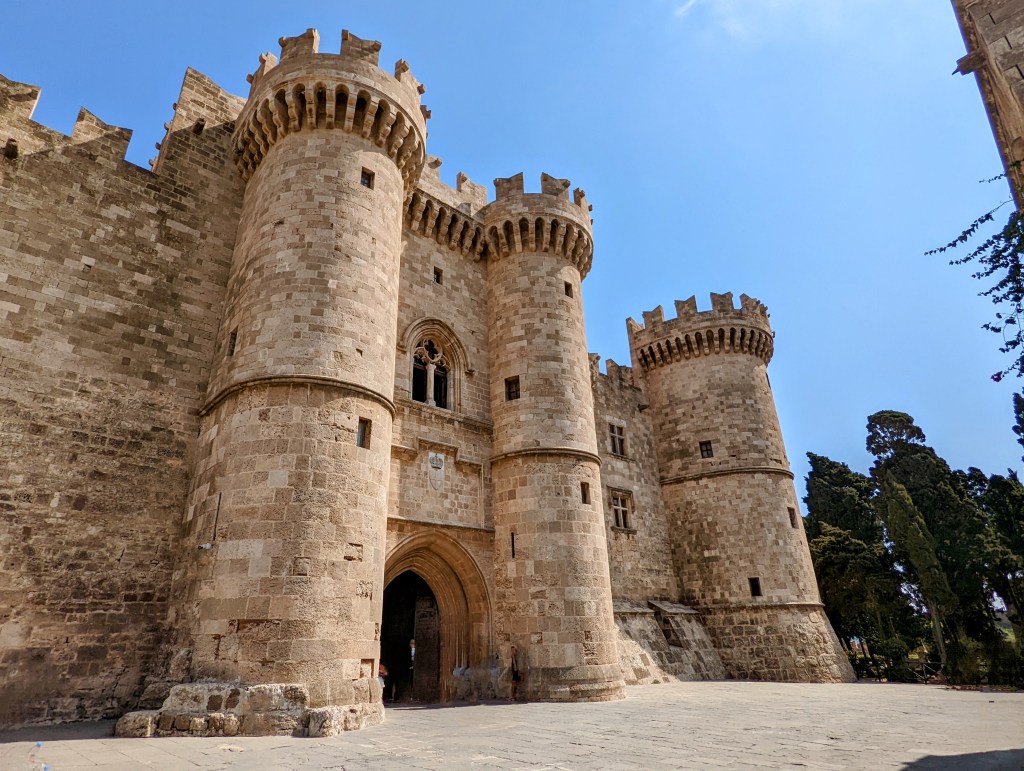
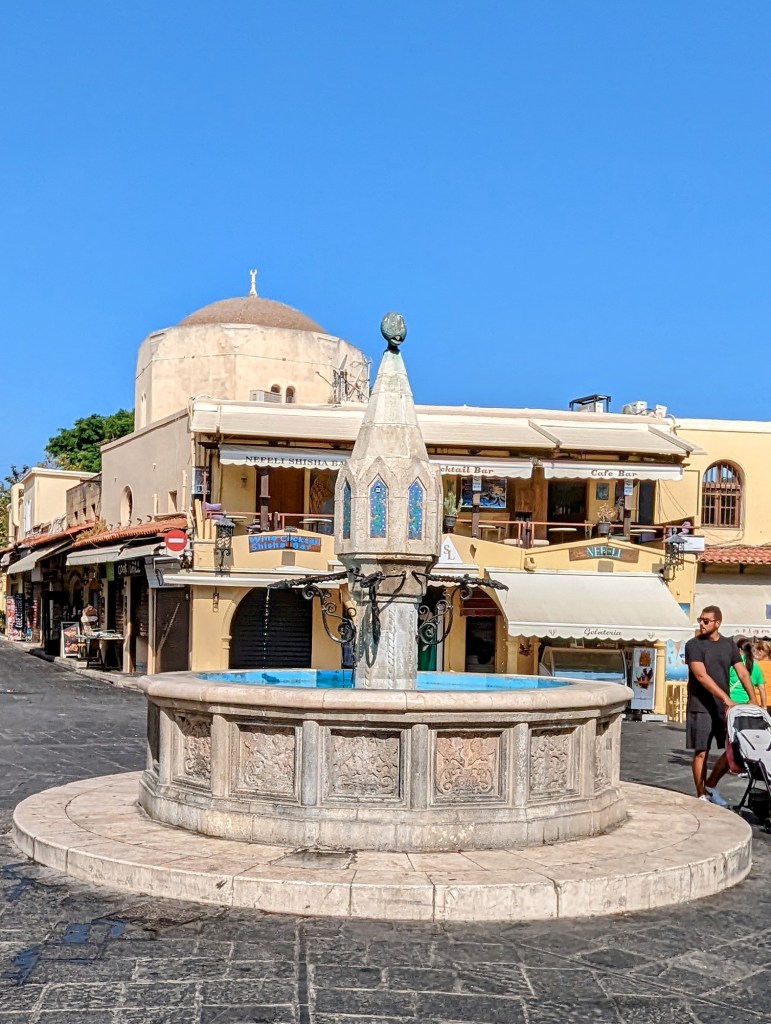
The Medieval Old Town contains remnants of the many civilizations that have left their marks. Its unique architectural style combines Byzantine, French, and Spanish influences. The imposing Palace of the Grand Masters, Byzantine temples, buildings left by the Knights of St. John including a hospital, stone-paved streets, mosques, a Jewish synagogue, Orthodox churches, and lively squares come together to form a complex mosaic.
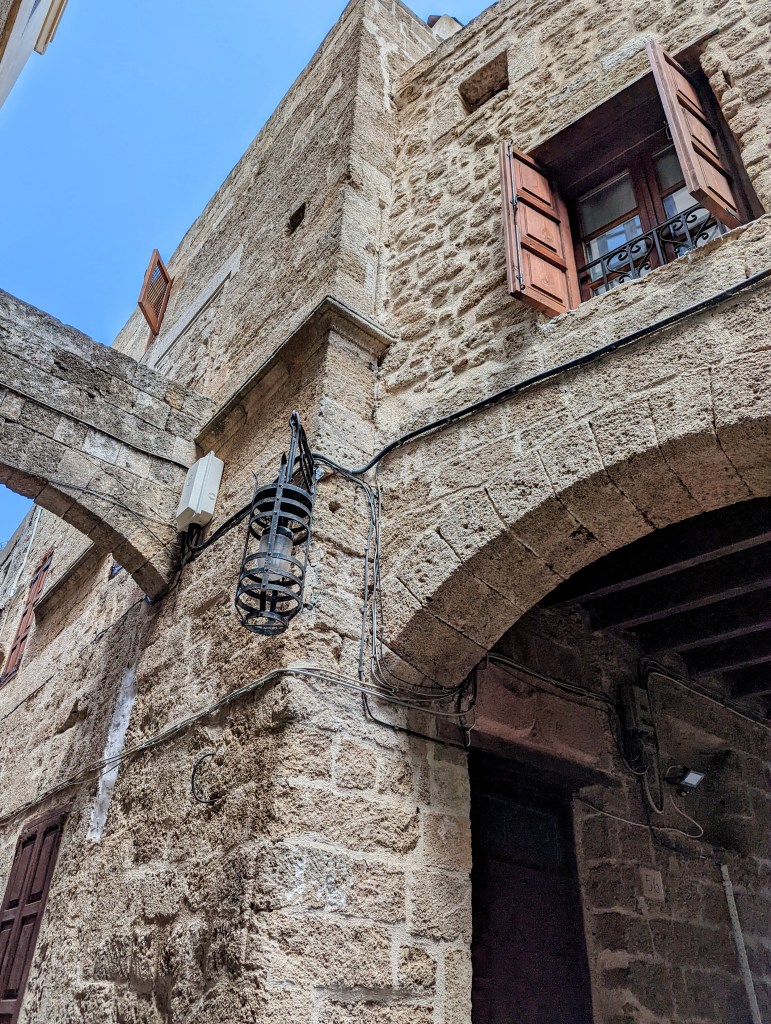
One of 11 gates into Old TownA view from inside Old TownSeahorse FountainBackdrop for concerts and special eventsHippocrates Square
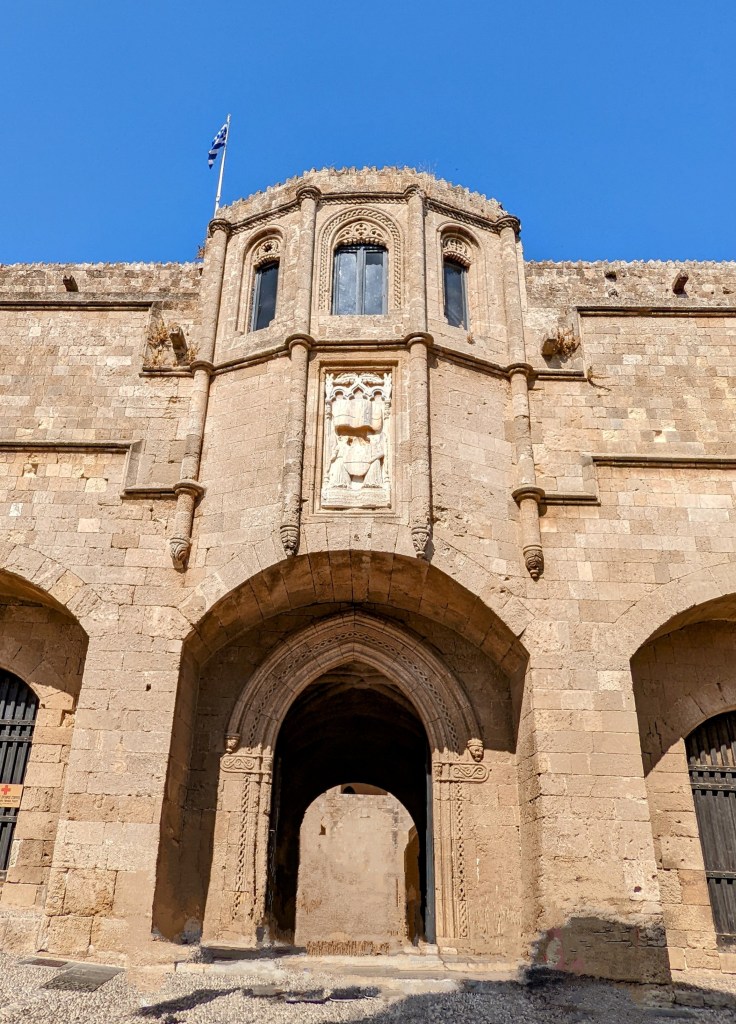
The Knights of St. John were a religious order founded in the 11th century. Members represented eight major European Catholic countries and divided themselves strictly into exclusive classes based on their degree of aristocracy. Their primary objective initially was to care for wounded and ailing crusaders, serving as soldiers, nurses, and clerics based on their skills. Occupying Rhodes in 1310, they brought great wealth to the island and left their mark by building massive buildings such as the Palace of the Grand Master and the Knights Hospital. Strolling up and down the Street of the Knights, visitors are provided with glimpses of what life was like during their occupation. The quarters of the various nationalities represented in the knights are located along the pebbled street. The knights fled to Malta in 1522 when the Turks were finally triumphant, but much of their influence remains.
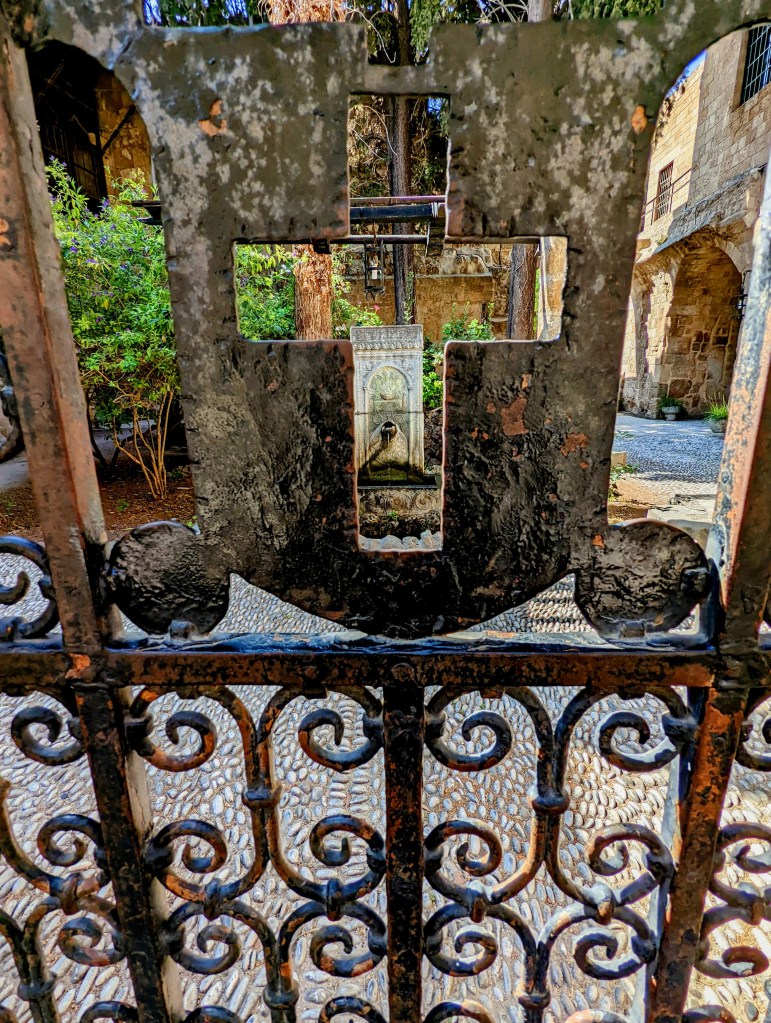
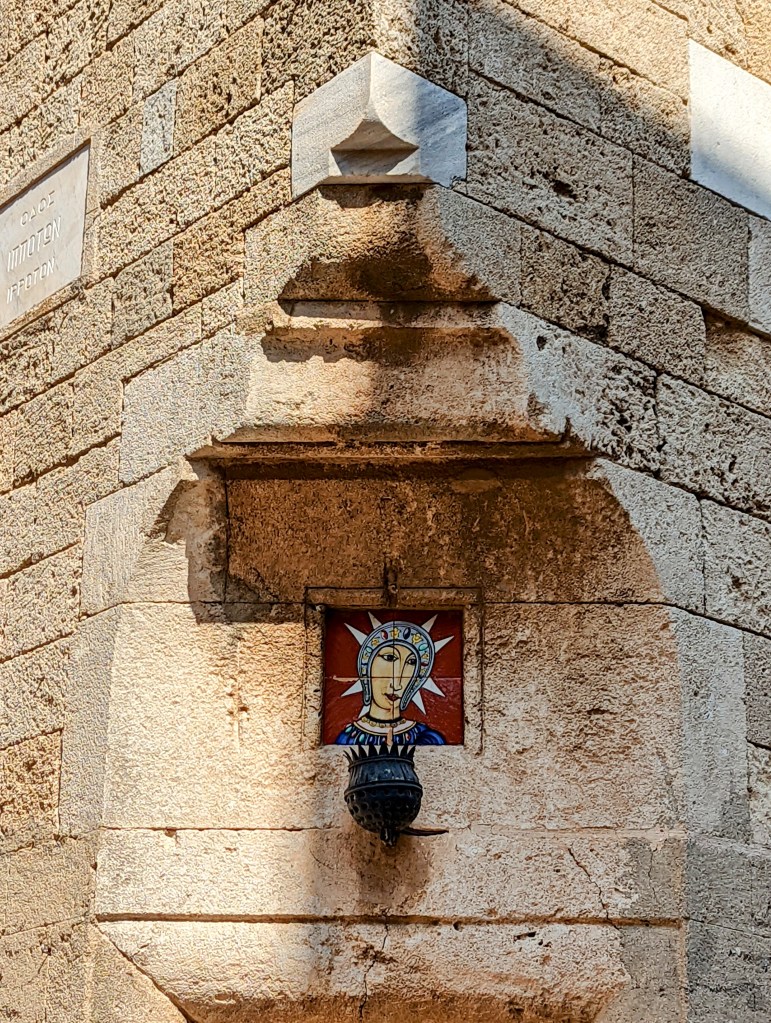
Knights Hospital which now serves as an Archaeological Museum The hospital courtyardMosaic of the Virgin Mary the base of the Street of the KnightsThe Street of the Knights
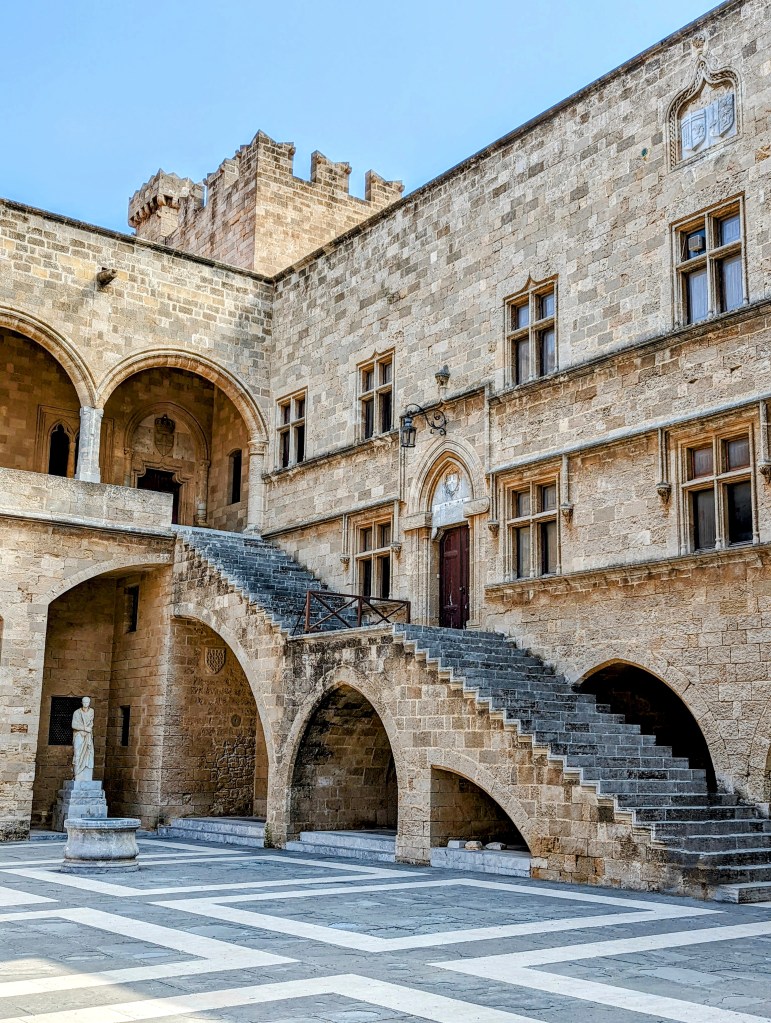
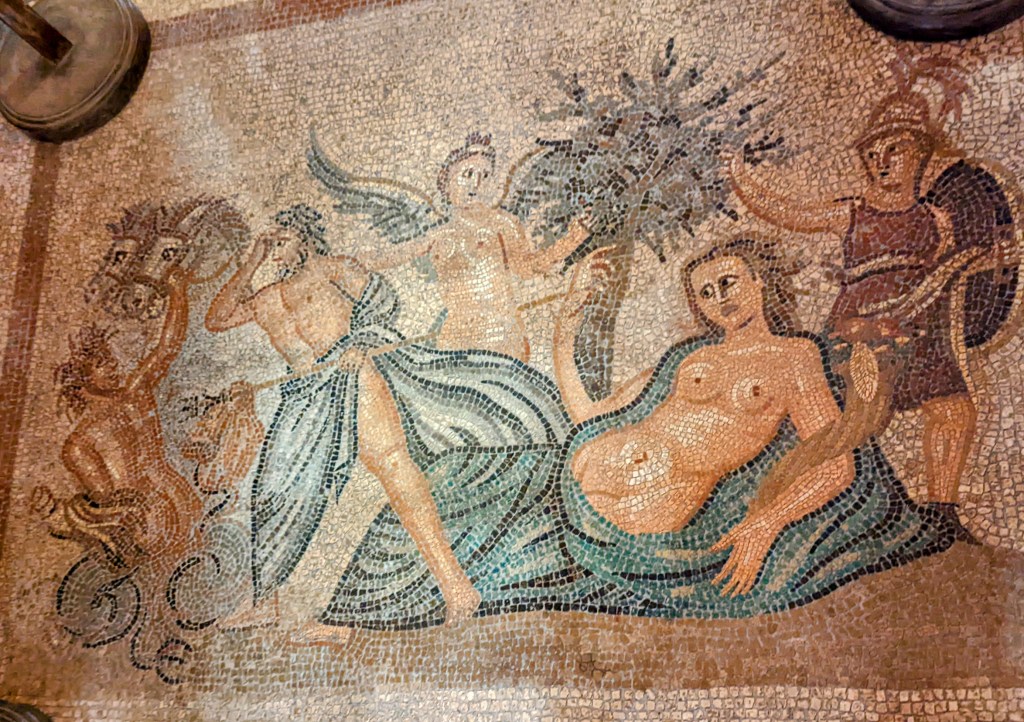
The Palace of the Grand Masters is the most significant building in Old Town. Originally built on the foundation of the Temple of the Sun God Helios, it was the seat of government and home to the Grand Master during Medieval times. It was largely destroyed in 1856 by explosives hidden in the basement of the nearby Church of St. John. At the beginning of the 20th century, it was magnificently restored as a holiday retreat for Mussolini. Although he never actually got the chance to visit, he decorated the palace using floors of intricate mosaics found during archaeological restorations on the nearby island of Cos and furnishings of ornate Italian design.
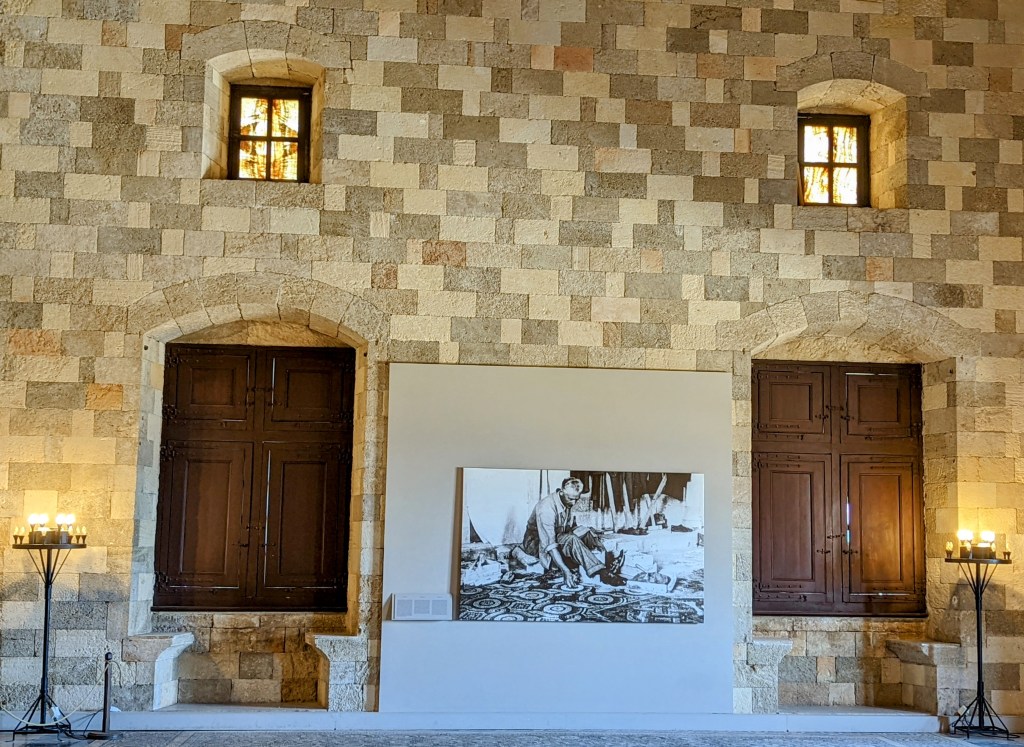
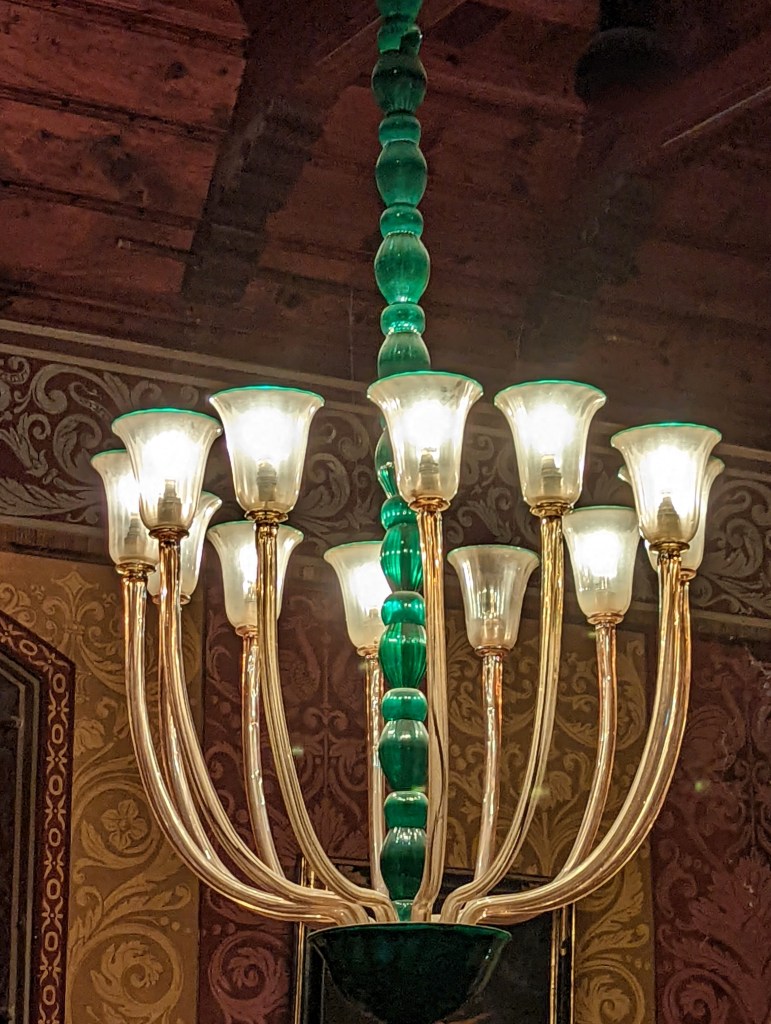
Courtyard One of many mosaic floors, this one of MedusaA photograph from 1938 showing of one of the archaeologists restoring the mosaics used in the palace floors Massive Corinthian columns and intricate mosaic floorsColorful Mosaic telling the story of the fight between Athena and Poseidon for naming rights to AthensMurano glass chandelier Palace windows including the small alabaster window which let in light
In addition to numerous historical venues, Old Town is home to some 6,000 people who live here. Their homes and cafes are tucked into quaint side streets, where we stopped for lunch before heading outside to explore more of the island.
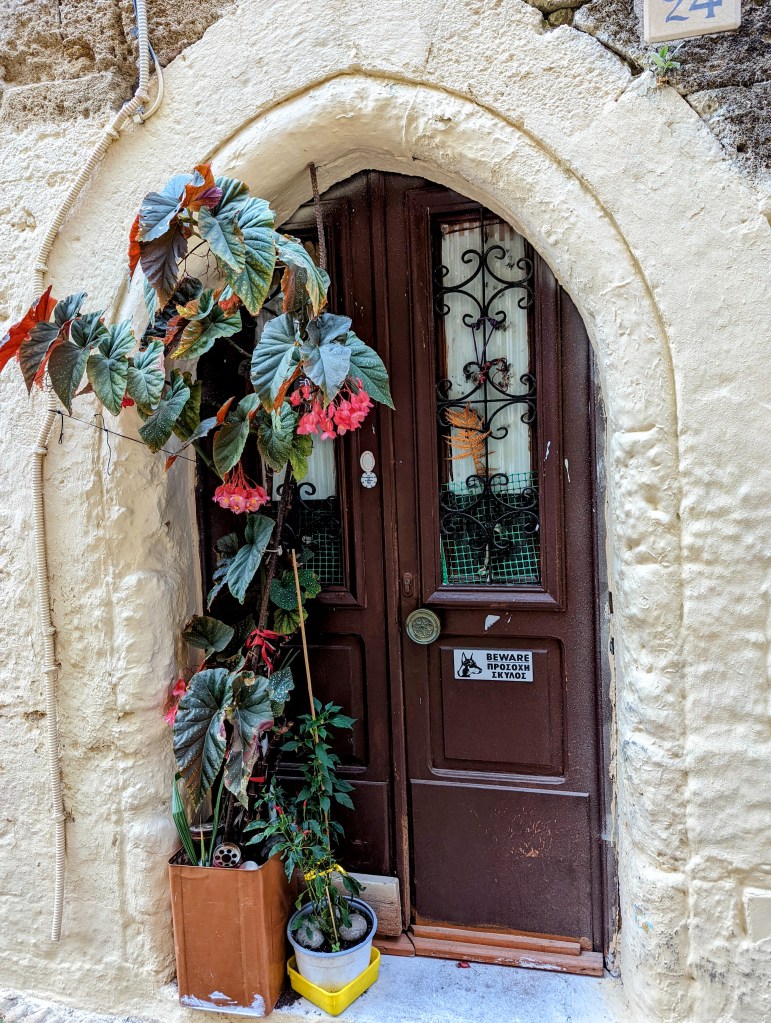
Pet parrotWarning to curious visitors to keep out!Imagine living in this second floor apartment!More Greek coffee and delicious spinach pie…Doug chose a latte and baklava!
Making our way on foot through modern residential neighborhoods to the less populated countryside, we were surprised to find groves of citrus and olive trees soaking up the Aegean sun and forests of cypress and pine trees covering the hillsides. As we hiked Rhodes’ expansive Acropolis area (not the better-known Acropolis of Lindor nearby), we found breathtaking rocky slopes overlooking beautiful beaches. Yet to be fully excavated, this acropolis is a surprising and delightful place that we had almost to ourselves!
Acropolis of Rhodes dates back to the 3rd and 2nd centuries BCThe stadium Overlooking the Aegean Pristine beaches belowRestoration of the Acropolis underway
Our visit to Rhodes was exhilarating and rewarding. Logging in almost seven miles, we had the opportunity to travel through centuries of triumph and struggle. Back to the port, we agreed that this final day in Greece was one we’ll remember fondly for a long time.
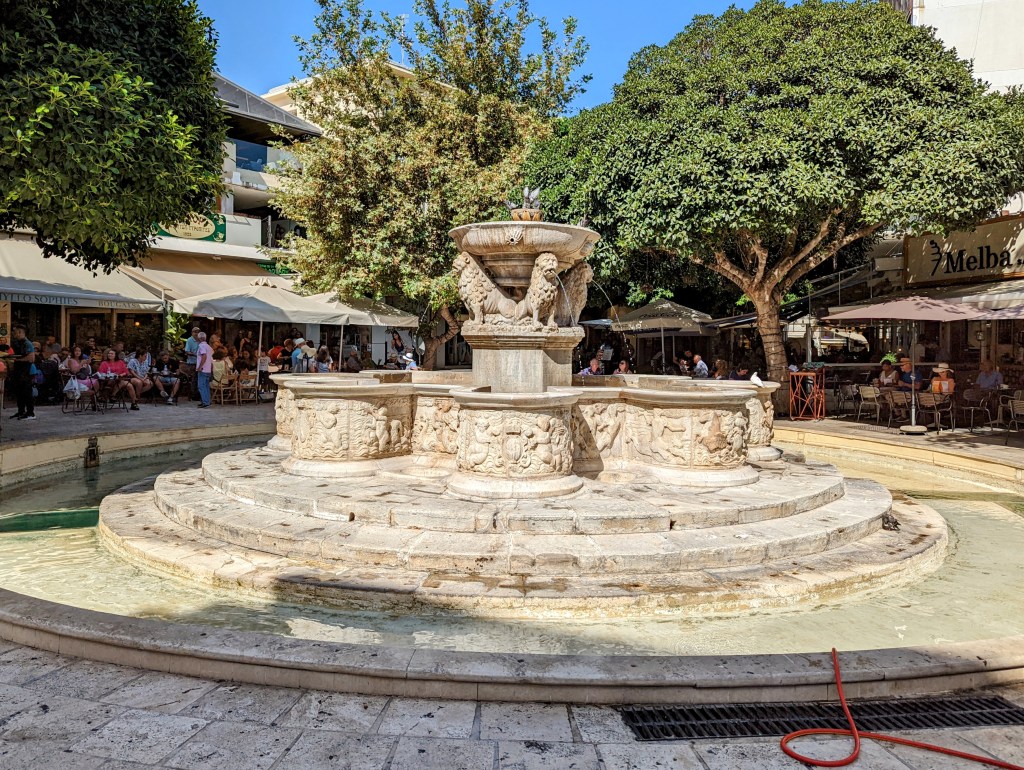
Morosini Fountain at Venizelou Square. This popular meeting spot is simply called “Lions” by locals.
Heraklion is named for the divine Greek hero Heracles, son of Jupiter and the mortal Alcmene. It’s the largest port city on the beautiful island of Crete. During our visit, we spent considerable time in the fascinating Minoan Collection of the Archaeological Museum taking in the well-preserved antiquities from the vibrant, artistic, nature-loving people who settled Crete as early as 3500 BC. The museum is famous for the masterpieces of Minoan art that make up its prehistoric collection, and it did not disappoint.
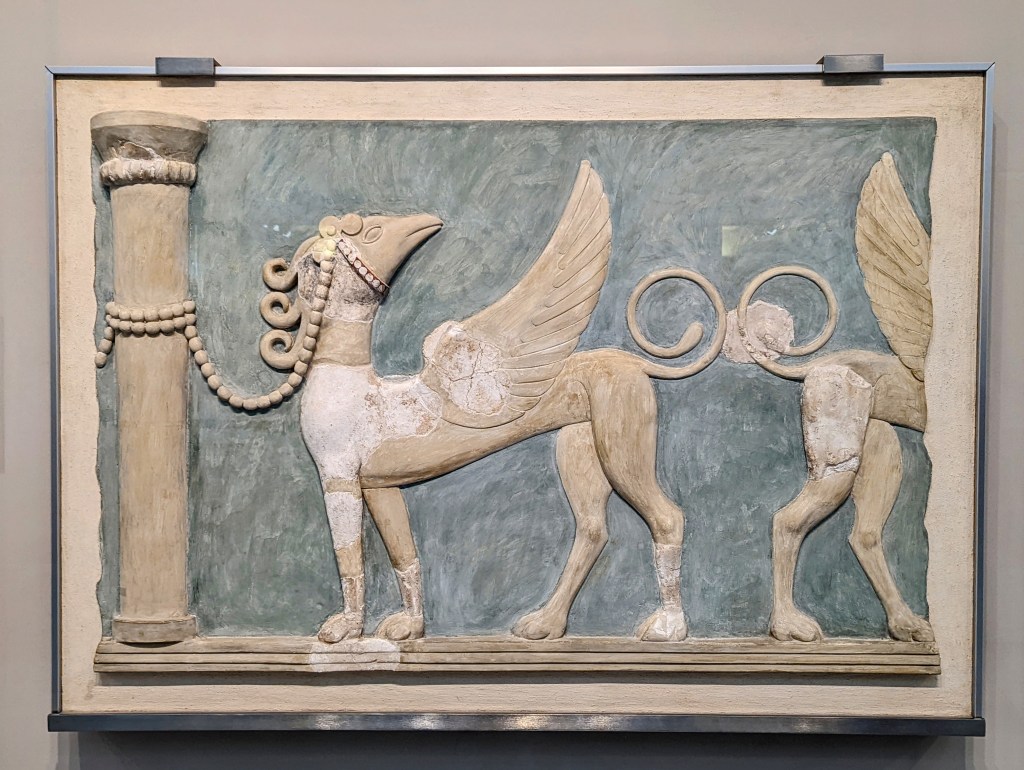
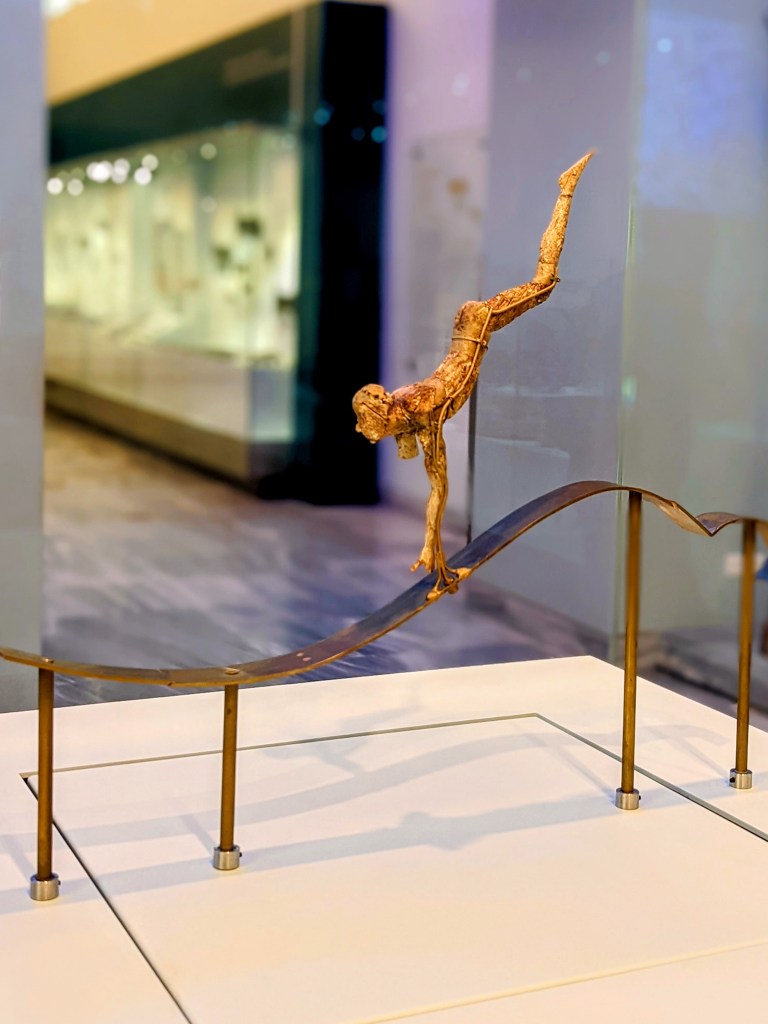
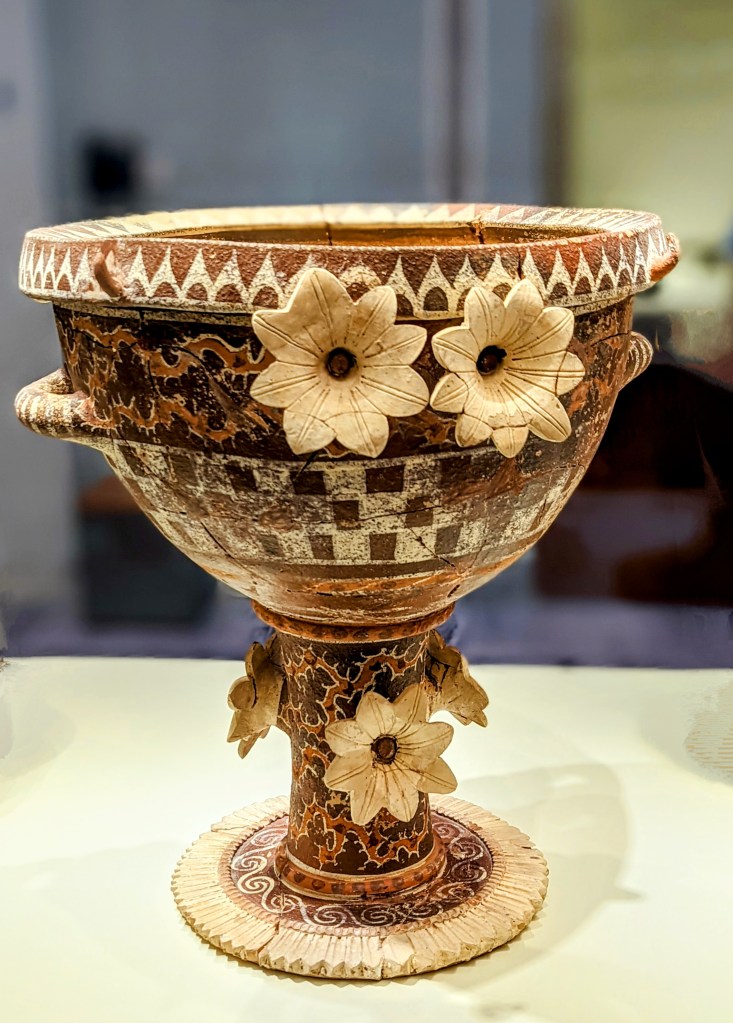
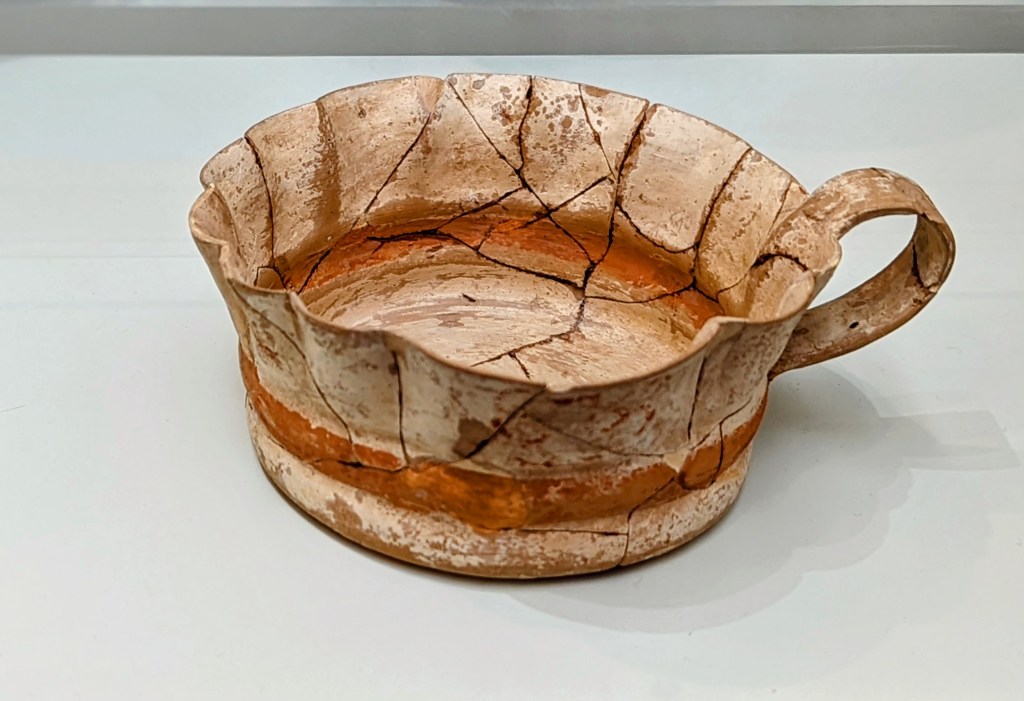
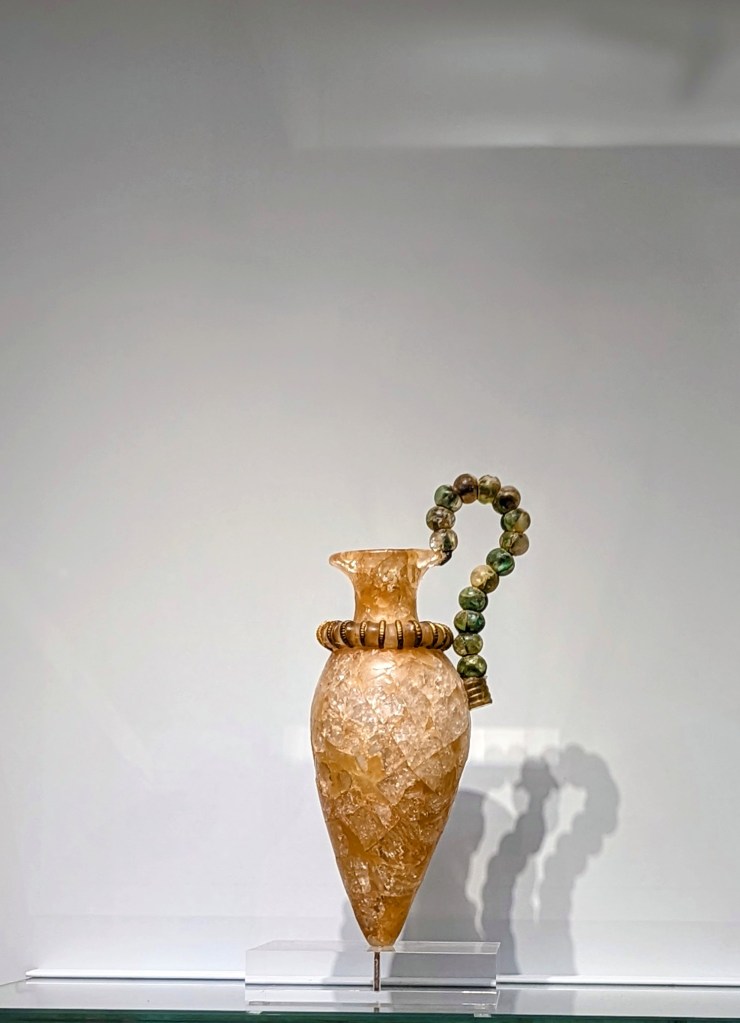
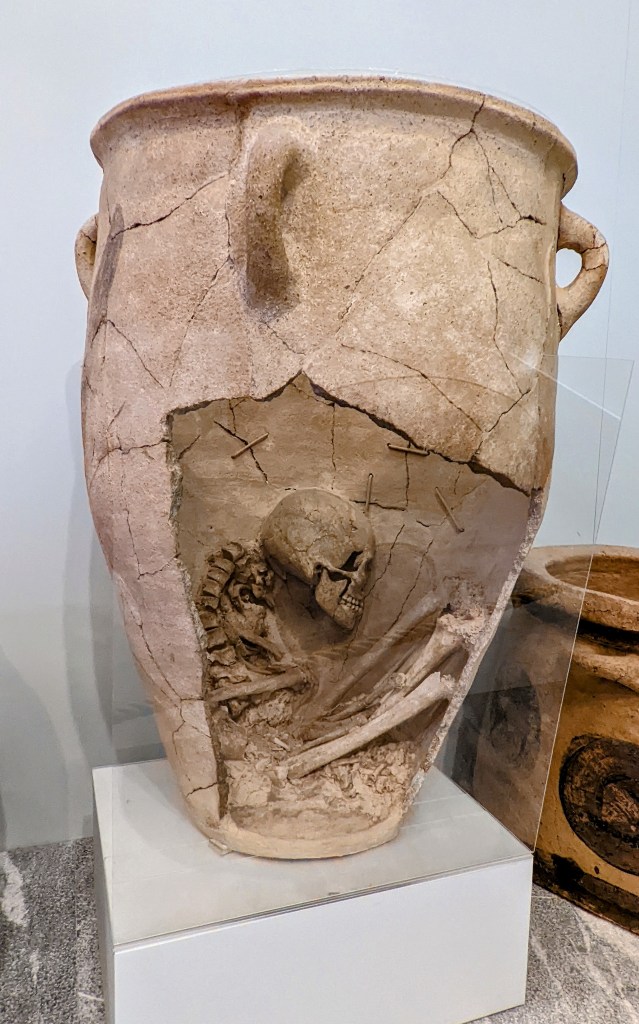
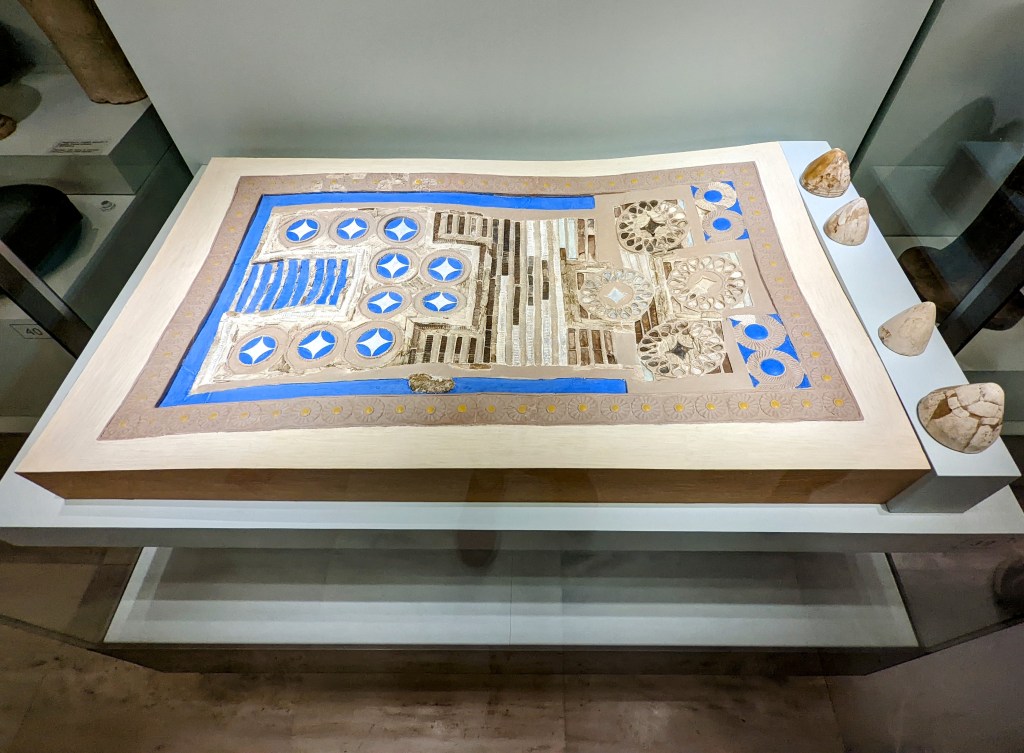
The enigmatic “Phaistos Disc” is inscribed with 45 pictorial signs arranged in different combinations of 61 groups. Made of clay, the disc is believed to contain a hymn or something magic, but experts have been unable to decipher its true meaning. It’s believed to be from the early 17th century BC.“The Ladies in Blue” have become somewhat symbolic of Crete. Their rich dress and lavish jewels reflect the opulence and prosperity of the royal court. Their fresco was found in the Knossos Palace 1600-1450 BC.“Prince of the Lilies” was part of a larger mural in high relief. He’s the personification of religious and secular authority. 1600-1450 BC.The high-relief fresco of a griffin, with body, tail, and hind legs of a lion, head and wings of an eagle, and front feet of eagle’s talons, is believed to be from 1600-1450BC.“La Parisienne,” with her vivid makeup and intricate hairstyle, was likely a priestess. Her fresco was found in the Knossos Palace 1450-1300 BC.“The Bull Leaper” is a graceful ivory figurine of a bull-leaper. His elongated limbs indicate the tension and direction of the leaper’s effort. This is believed to be a very early attempt to represent three-dimensional space. 1600-1450 BCKamares ware is a distinctive Cretan pottery dating back to 1450 BCThis kamanare is a fine example of hemispherical cups with walls so thin they were named “eggshellware” This stone bull’s head is considered a masterpiece of Minoan art. It would have been used as a liquid vessel, with holes in the neck for filling and the snout for pouring. 1600-1450 BCThese beautiful snake goddesses are from the temple repositories. They symbolize fertility, goodness, and nature. 1650-1550.This small rhyton made of rock crystal is a piece of artistic and technical perfection. The oval body is made from a single piece of the extremely hard stone. The neck is attached by a ring of crystal beads and gilded ivory discs. The raised handle is also crystal beads threaded into a bronze wire. 1500-1450 BCThese over-sized bronze double-axes, found stored in a room of a very large building, were used for cult purposes. They’re thought to have been used as display objects with religious symbolism. 1500-1450 BC. A Minoan crypt containing some remains“The Draughtboard” served as a very early game board with inlaid ivory (likely from Syria), blue glass paste, and rock crystal plated with good and silver. The large conical gaming pieces sit alongside the board. This complex, luxurious artifact bears witness to the high standard of living in the palace where this was found. 1700-1450 BC
These are just a few of the Minoan treasures that captured our attention during this delightful museum visit, after which we spent some time exploring Heraklion’s Old Town.
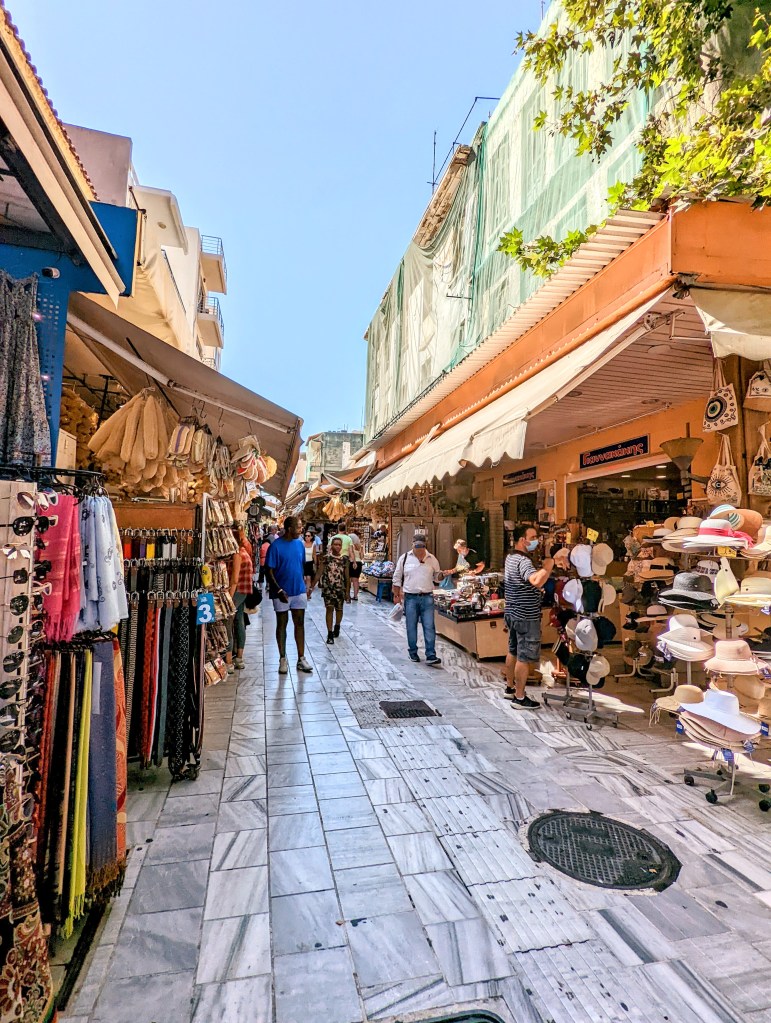
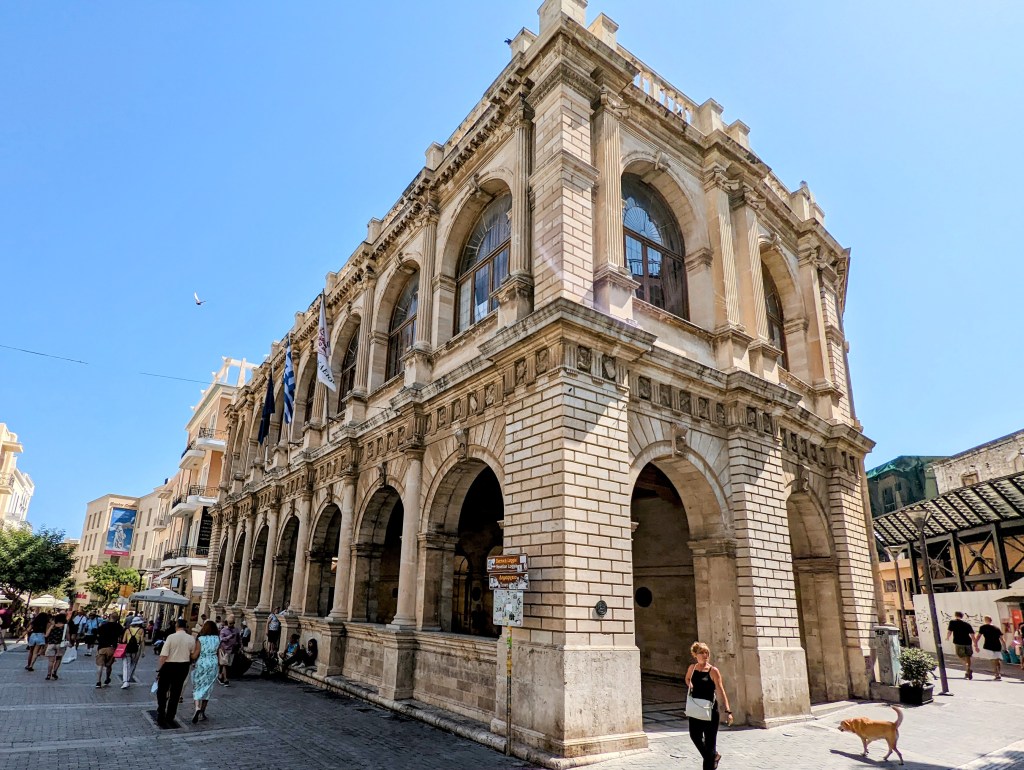
Market StreetVenetian loggia turned Town HallLocal restaurant This sweet image of a pappous using the fountain rim to teach his grandson balance made us miss our grandkids.
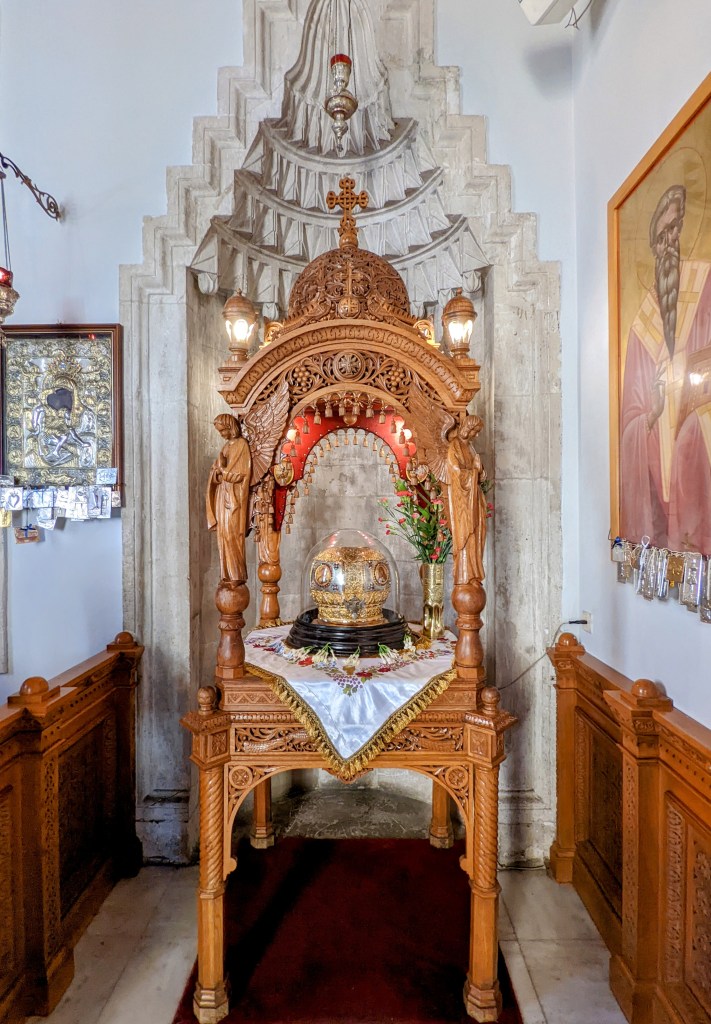
And it wouldn’t be a Greek town without a few Orthodox churches. This one is named for the first Bishop of the Greek Orthodox Church in Crete. St. Titus was a disciple of St. Paul who is said to have preached in Crete in 62-63 AD.
The skull of St. Titus is enshrined in a special room. Orthodox Christians venerate relics as part of their worship.
Heraklion, with its ancient Minoan roots, is a beautiful, vibrant city. We topped off our visit with traditional Greek coffee and baklava while watching the world go by.
Enjoying some music and our Greek coffee and baklava near the Lion
Our two day visit to Athens began with an early-morning visit to the Acropolis, a good thing since this would become the hottest day of their summer. It was also a Saturday at the height of the tourist season, so although most Athenians had the good sense to leave the area for vacation, throngs of visitors were standing in line as we finished our tour. But we’re going to cover a bit about Athens from our second day first, because there’s so much to say about the Acropolis later.
A panoramic view of Athens
Ancient Athens, a beautiful walled city-state, was originally called Aktaio after a king, then Cecrops who was half man/half snake. Athens was the most powerful town in Greece, and its citizens developed an enduring civilization based on the principles of democracy. According to legend, the gods of Olympus saw this beautiful place and wanted to name the city after themselves and become its patron. The most persistent rivals were Poseidon, sea god, and Athena, goddess of wisdom. To solve the dispute, Zeus asked each of them to make a gift to the city and let the citizens decide. Poseidon went first. He struck a rock with his trident, causing a spring of water to gush forth. This, he promised, would assure a ready source of water and the end of droughts. The water he commanded, however, was sea water and tasted of salt. Athena planted a seed which grew into a beautiful olive tree. The people knew that olive trees produce delicious food and oil, and can also be used for fire wood if necessary. They therefore proclaimed Athena their patron, giving her the everlasting honor of naming the city after her. Glorious temples were built in her honor, and when money was invented, she and her sacred bird, the wise owl, were depicted on their coins.
You might think this is simply a myth, but as with all great stories, there’s a grain of truth to it. Olive trees still thrive throughout Athens and its countryside, while drought continues to be a major problem. Water has to be imported to Athens from nearby lakes, especially in the summer.
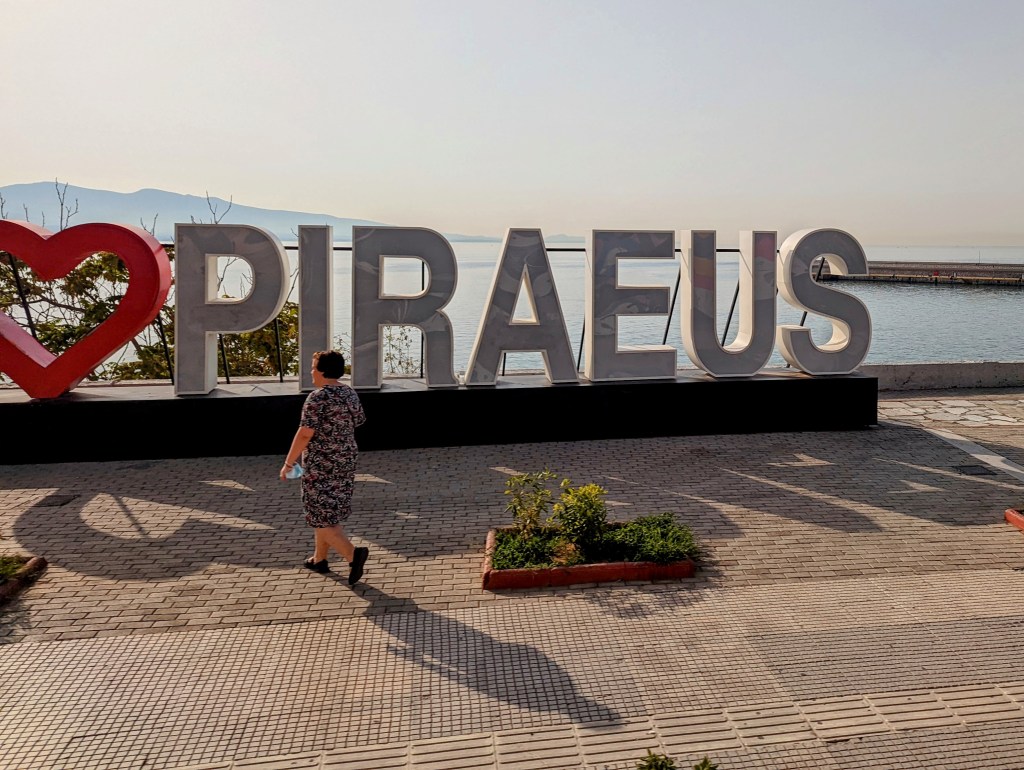
The port of Piraeus, also an ancient city, still serves as the primary port of Athens. The Viking Sky docked there for two days, giving us a bit of time to explore this town as well.
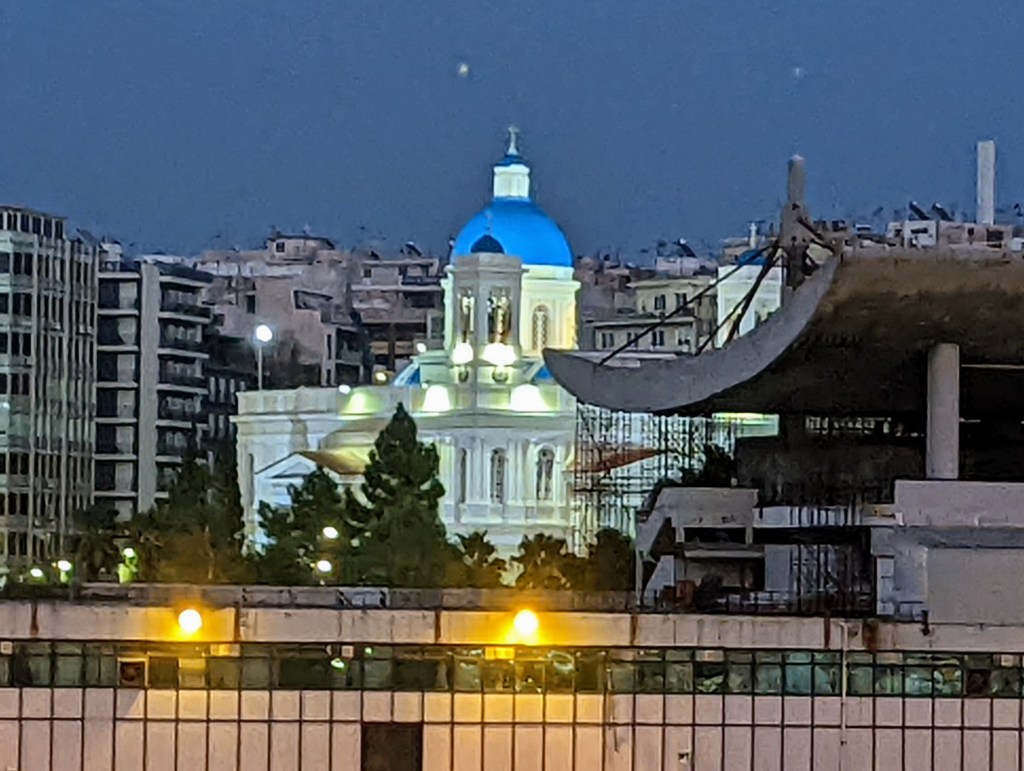
Looking out from our deck after dinner, we noticed a beautiful church close by. We learned that it’s a Geek Orthodox church dedicated to Saint Nicholas. Denise decided to investigate further.
St. Nicholas Greek Orthodox Church at Night
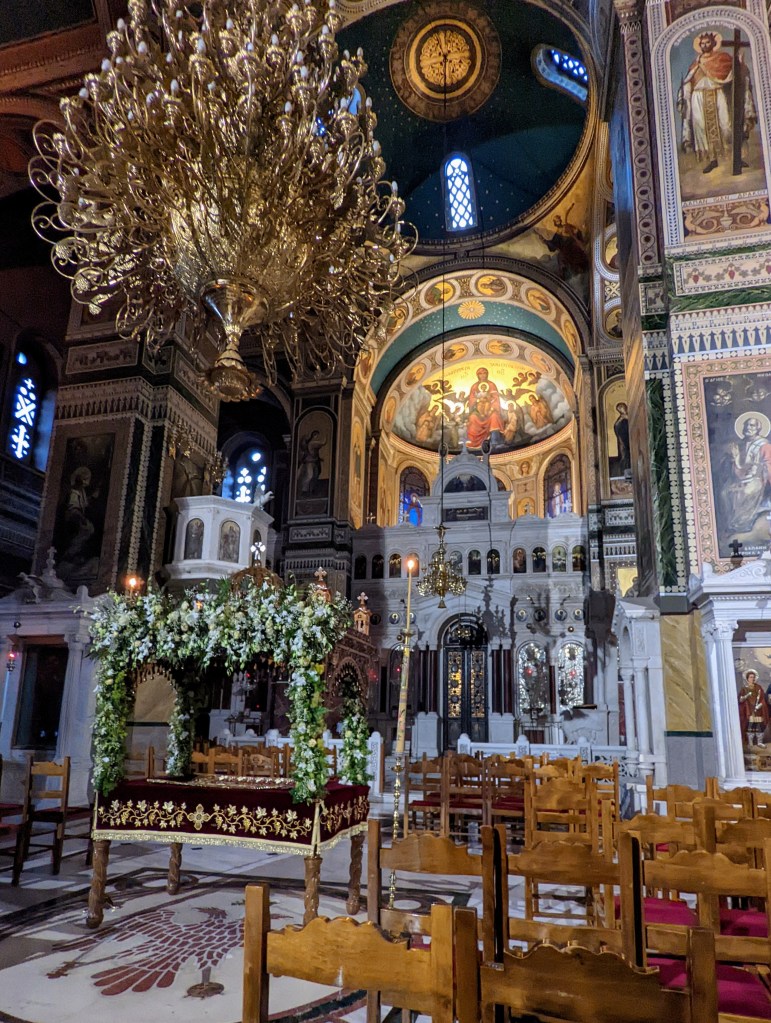
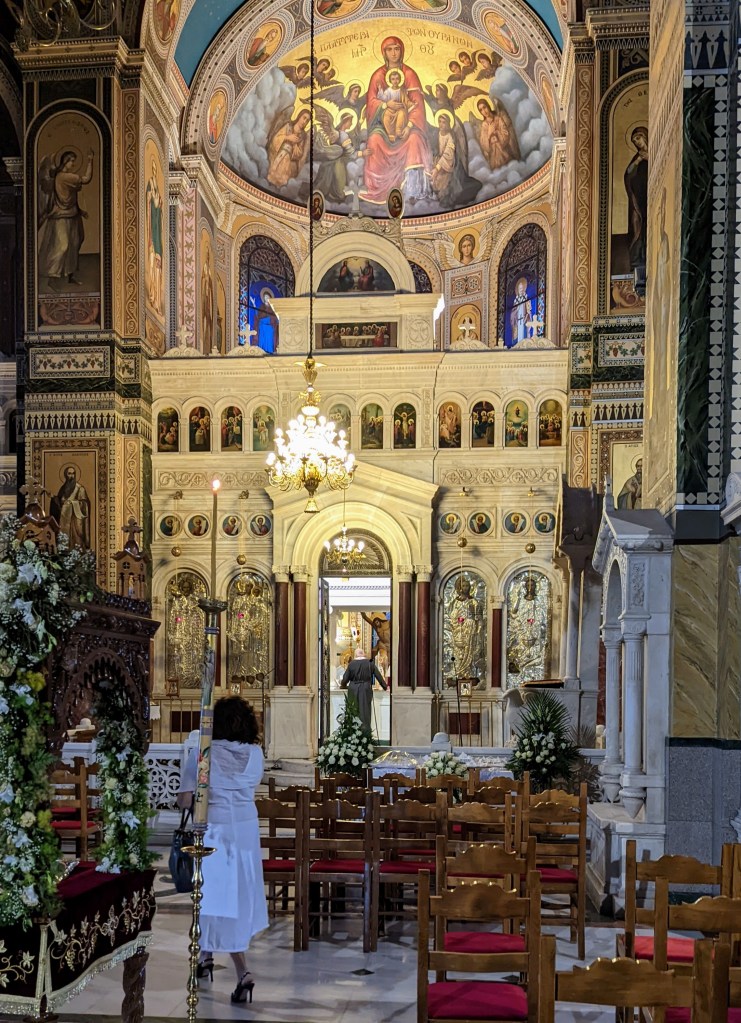
The next day being Sunday, I decided to attend services which started at 7:00 am. I made my way to the church around dawn, and was a bit surprised that I was the first to arrive. Shortly thereafter, a priest came in, and then an older woman dressed in black. I knew enough to dress modestly for church, but missed the memo to wear black. As people entered the church, all wearing black, they made an elaborate ritual involving multiple crossings, bowing, and kissing specific icons. Then one woman entered wearing all white. She proceeded to the front of the church, placing an elaborate cake with a picture on it on a table in front of the altar. Soon a florist delivered three beautiful floral arrangements around the table, and then more cakes. A cantor was singing, but the priest was nowhere in sight. Slowly people started to file in, and after about 90 minutes, the lights came on, the screen opened, and the priest came out. He carried a gold bible around to each person in church, and everyone kissed it. I did the same. Services lasted three hours in total, but people seemed to arrive whenever they felt like it. I couldn’t see what was going on during communion, and since I stuck out wearing pink anyway, I didn’t want to call any further attention to myself so I refrained from receiving. At one point a large man charged the altar shouting and attempted to pull the cantor’s microphone away from him. No one seemed particularly worried, but several men subdued him and led him reluctantly out of the church. I figured they knew him, but I don’t think that was part of the liturgy. As the service was drawing to a close, however, everyone crowded to the front of the church to receive a small piece of blessed bread from the priest. I followed the crowd. I took a few pictures of this beautiful church before and after services, and although I didn’t understand one word, I felt at one with the congregation. I’m glad I started my day this way.
The church before services from my seat in the backIf you look closely, you can see the woman in the front. I watched her for cues.One of many stained glass windowsThe woman in white just as the priest opened the screenThe flower/cake table. It turns out that this is in honor of the deceased at specific intervals following a death. The woman in white was ending her year of mourning.
After church it was time for a Greek coffee, a strong brew with foam on top, sweetened and prepared in a special copper pot called a briki.
Greek coffee
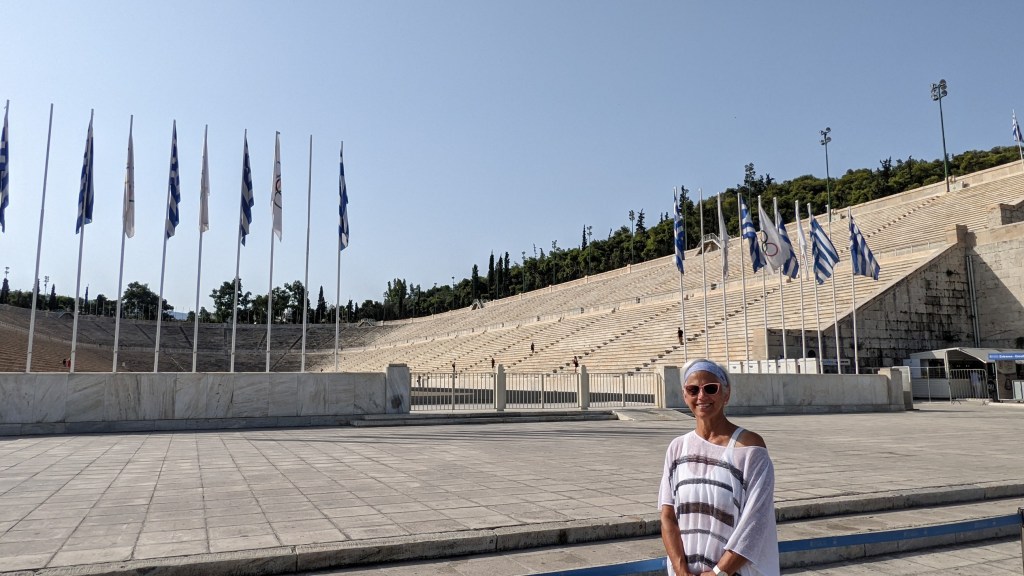
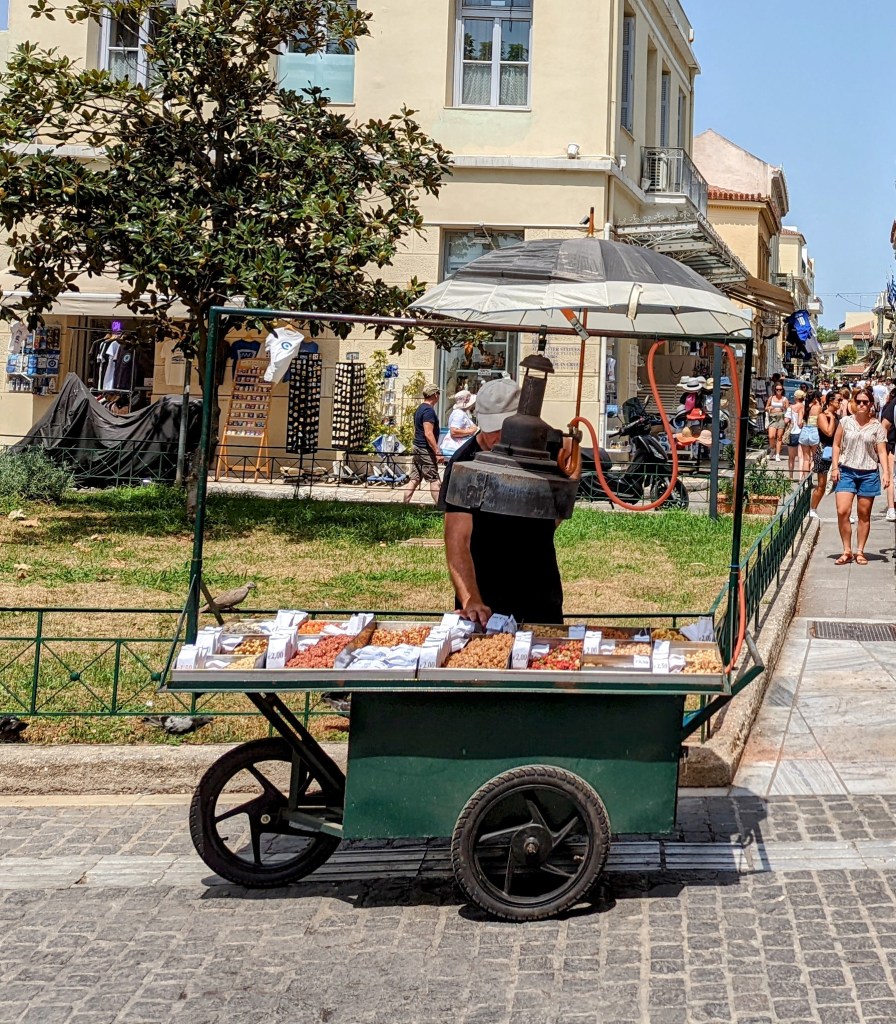
After our visits to the Acropolis and the Acropolis Museum yesterday (described below for continuity) we made this a low-key, relaxing day taking in a few sights around Athens. We got to see the “new” Olympic Stadium, built in 1896 for the first modern Olympics. And we visited a few shops in Plaka, the oldest neighborhood in Athens.
Panathenaic Stadium Panathenaic Stadium Plaka Freshly-roasted nuts at Plaka
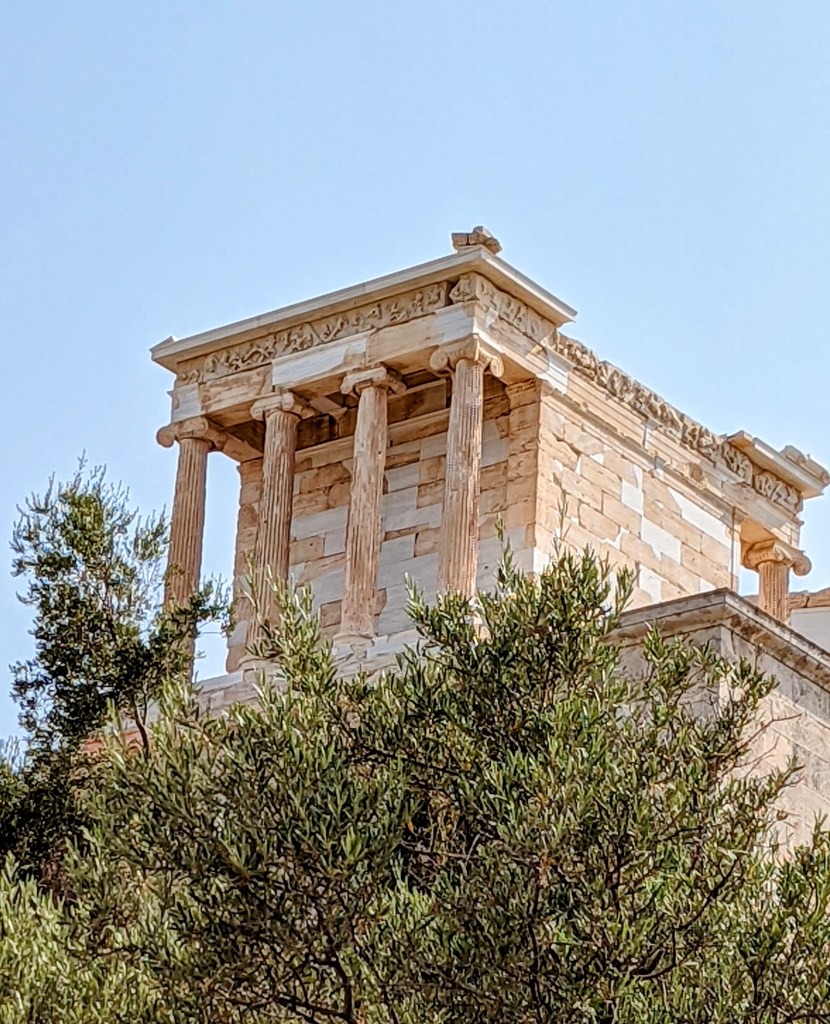
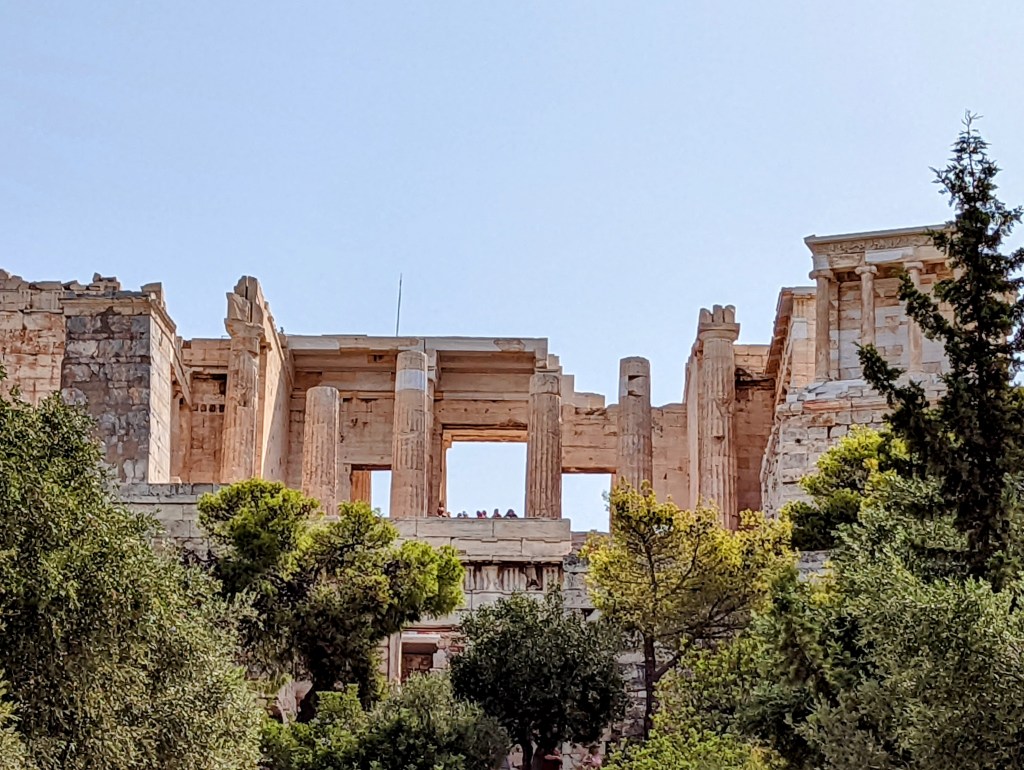
For us, the Acropolis was the most interesting part of our visit to Athens. The word acropolis comes from the Greek words akron (highest point) and polis (city.) The Athens Acropolis sits high on a rocky hill above the city of Athens. It contains the remains of many ancient buildings of great historical and architectural significance. While there is evidence that the Acropolis was inhabited as early as the 4th century BC, the first records of construction are from around 495 BC.
Climbing to the Acropolis
There are several very well-preserved buildings among the ruins at the Acropolis. Teams of archaeologists are conducting painstaking, careful restoration work and new discoveries are being made daily. Many of the original artifacts have been moved to the Acropolis Museum for further restoration and preservation. We visited the museum later in the day as temperatures reached close to 100°!
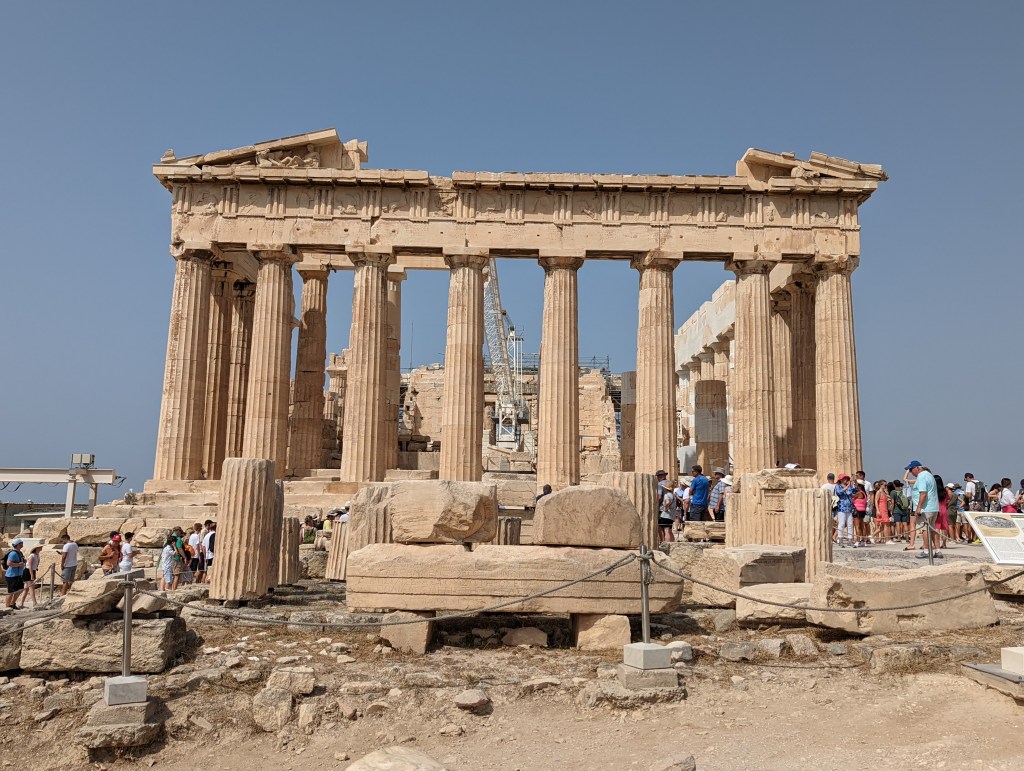
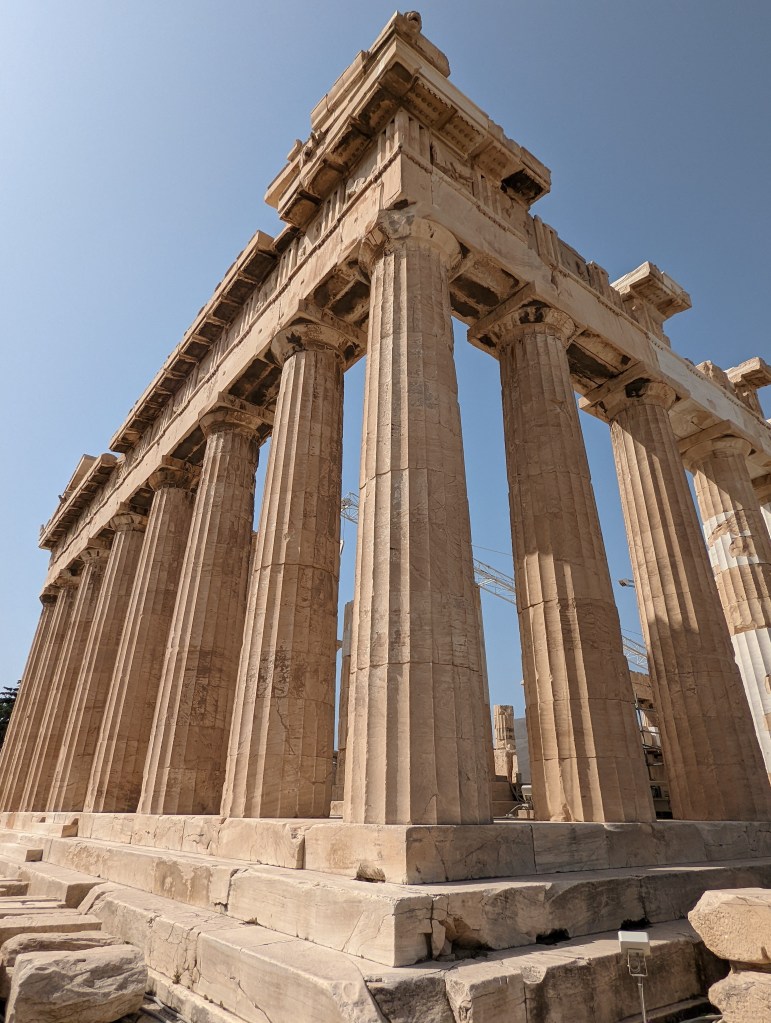
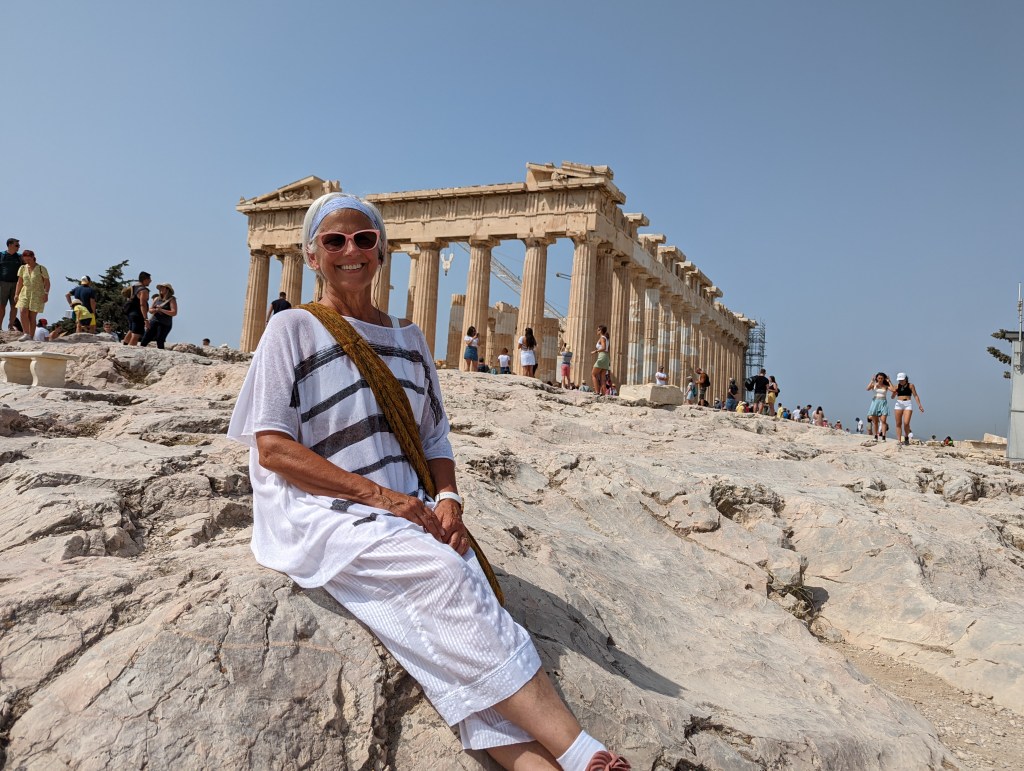
The most familiar building at the Acropolis is the Parthenon. This majestic collonaded marble temple to the goddess Athena has been under restoration for the past 40 years. It has become almost synonymous with the City of Athens as it stands watch over the city. As the day went by, more and more visitors were arriving to view this marvel.
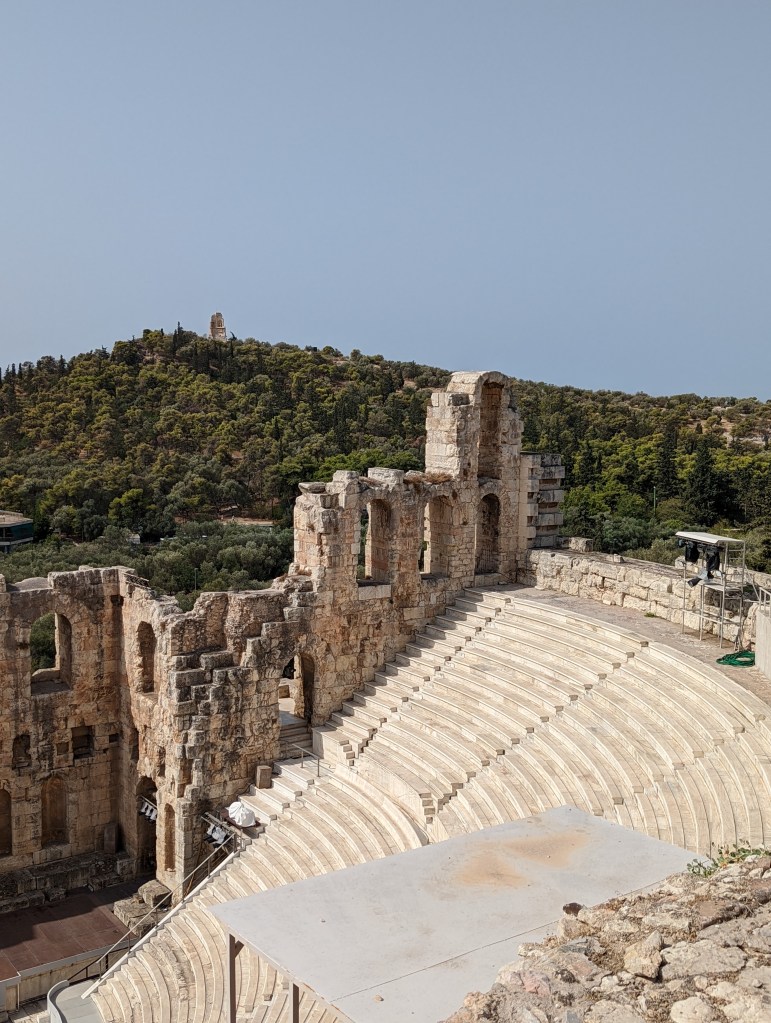
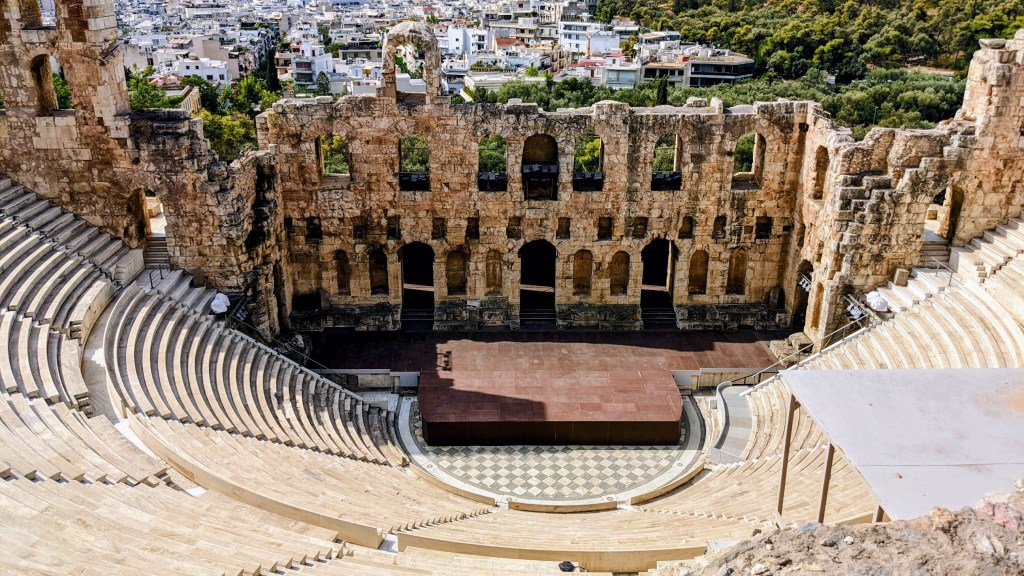
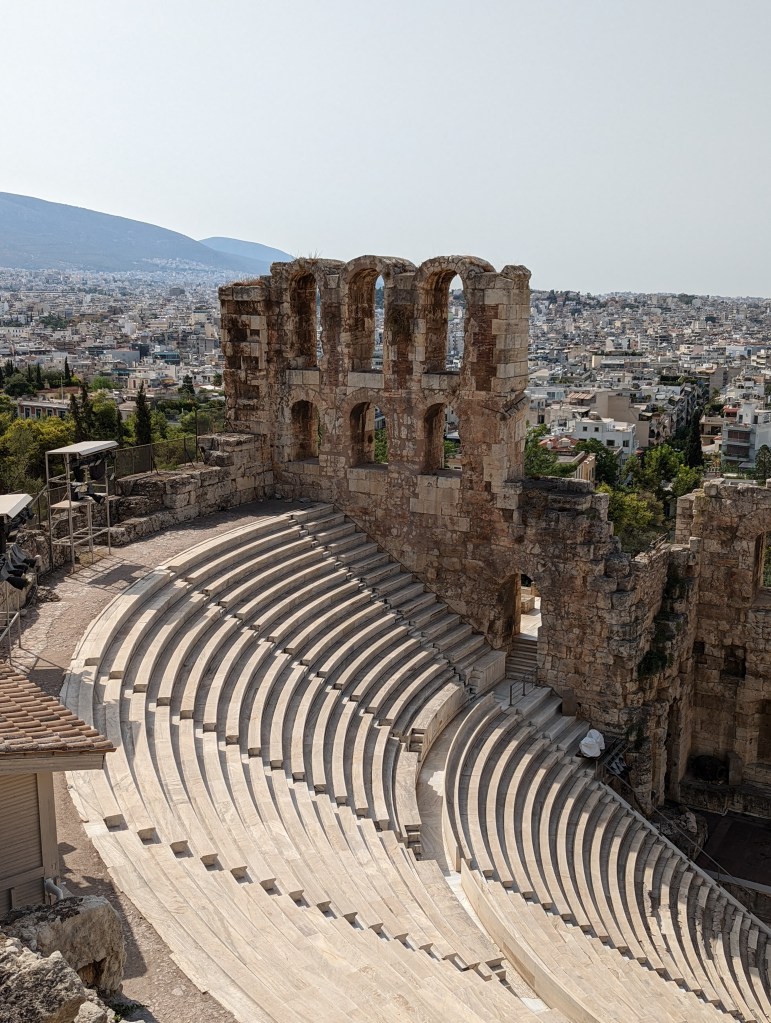
The Odeon of Herodes Atticus is a stone Roman amphitheater at the southwest slope of the Acropolis. Completed in 161 AD and renovated in 1950, this performance venue has been used for concerts since it was built. Today it’s the primary venue for The Athens Festival which runs annually from May through October.
Over the years, the Odeon has played host to such stars as Maria Callas, Frank Sinatra, Diana Ross, Luciano Pavarotti, Yanni, Sting, Elton John, Liza Minnelli, and many other well-known musicians. What an incredible backdrop for a concert!
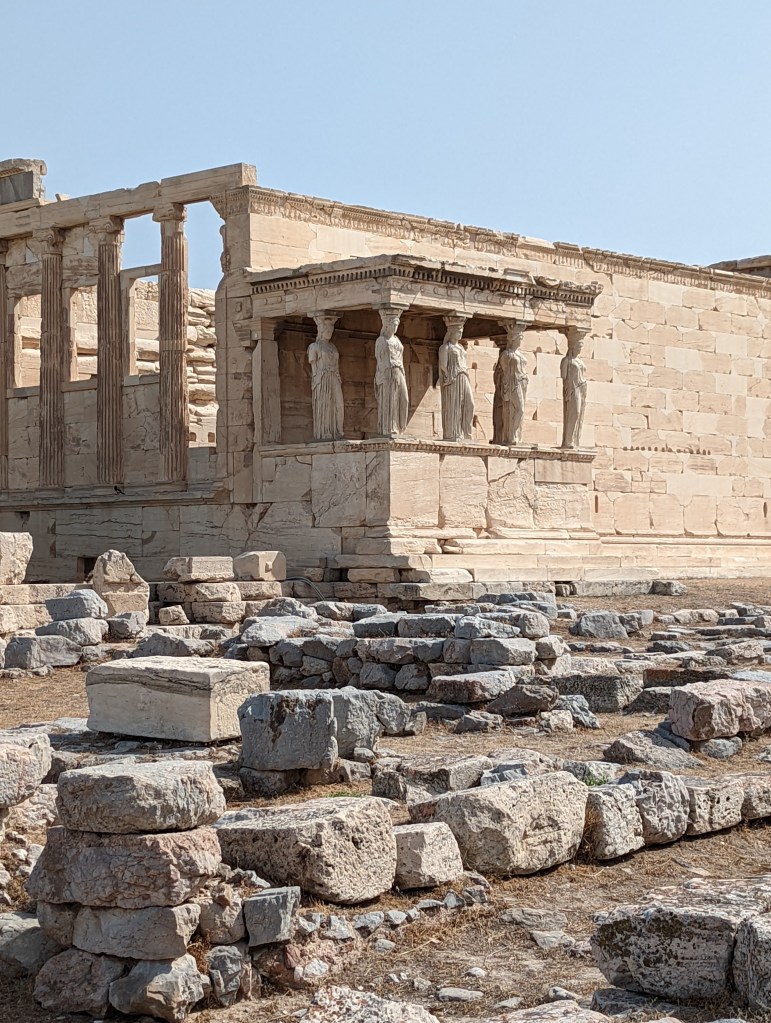
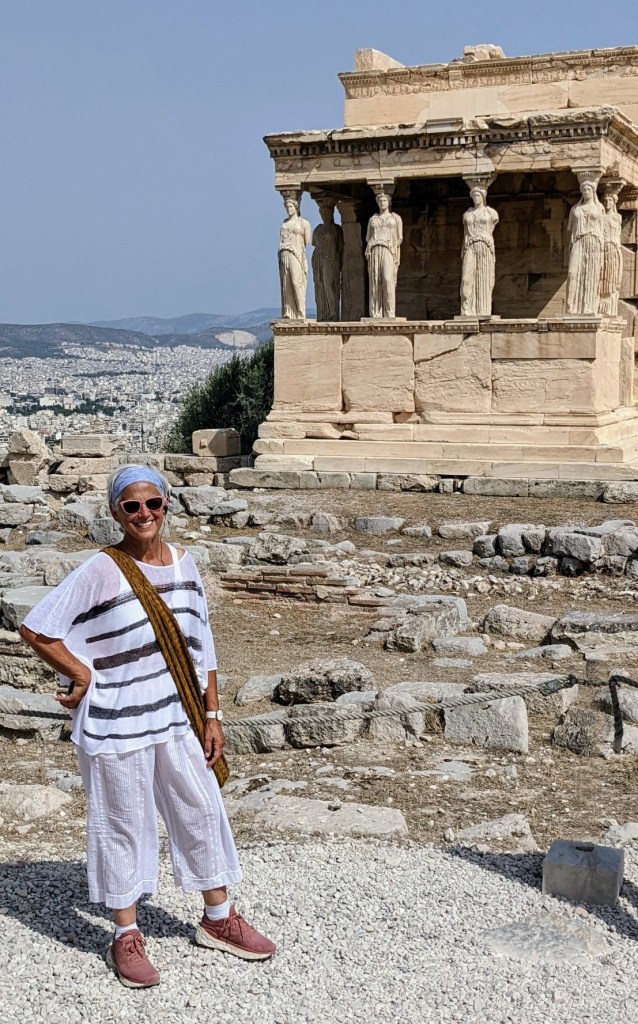
The Erechtheion, built as a temple of Athena Polias, is best known for the six beautiful Caryatids holding up the porch roof. We learned later that these beauties are actually replicas of the originals, five of which are housed at the Museum…but more on that later! It is believed that the olive tree seen peeking out next to the temple in the third picture down was actually the tree planted by Athena in the contest that gained her naming rights to the city.
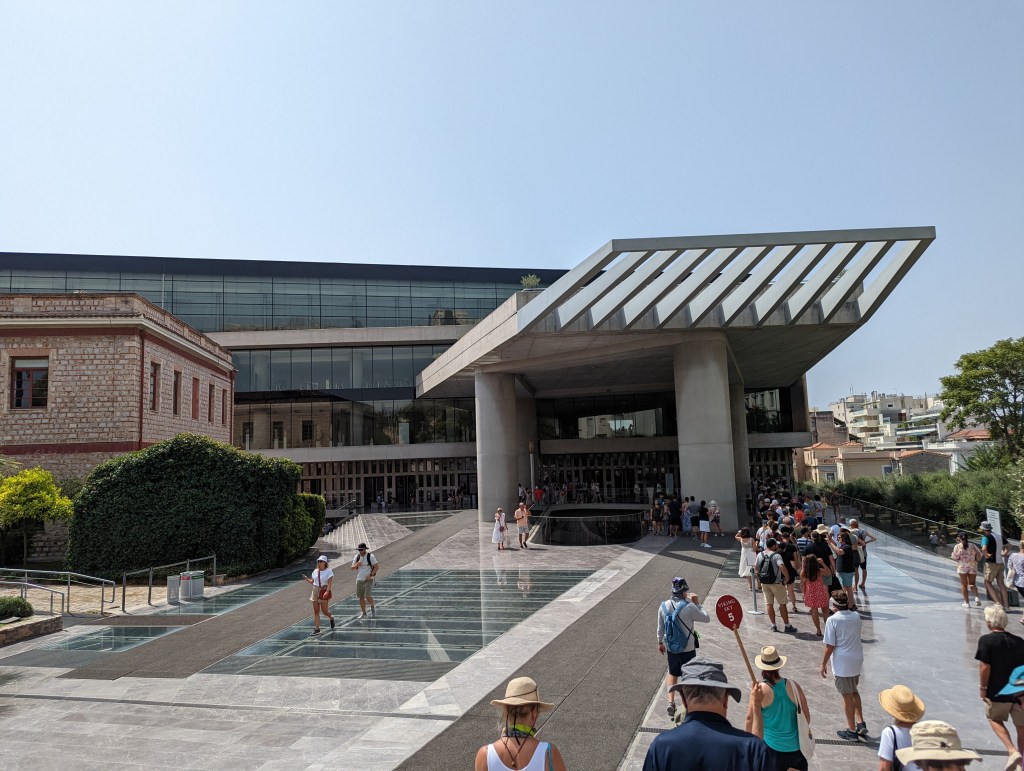
As the temperature climbed and the crowds grew, it was time to make our way to the Acropolis Museum just a short walk away. The Museum was opened in 2009 to preserve and display the important artifacts found on the rock and its surrounding slopes from the Greek Bronze Age to Roman and Byzantine times. Photos are prohibited in several rooms, but most of the museum is welcoming and accessible. Visiting the museum truly enriched our overall Acropolis experience as we learned more about certain treasures, their histories, and whereabouts. The museum makes extensive use of windows and light to create aesthetics that compliment the exhibits beautifully.
The Acropolis Museum Entrance
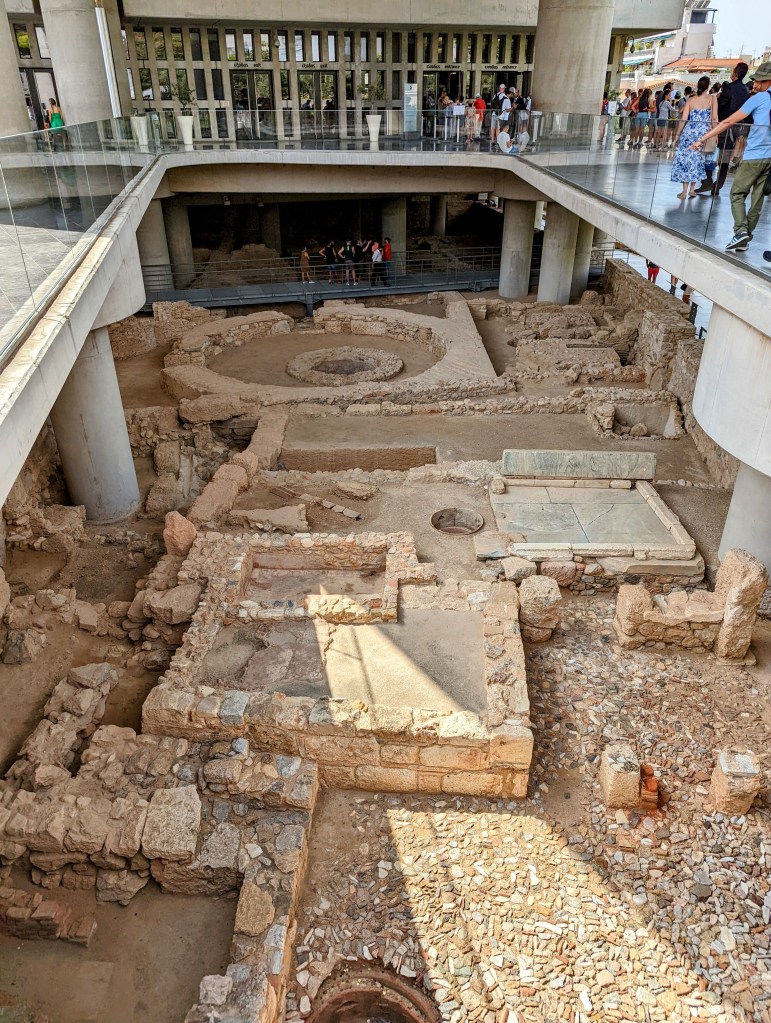
The ground level contains artifacts from sanctuaries and settlements along the Acropolis slopes throughout history. There is also active archeological work underway on this level.
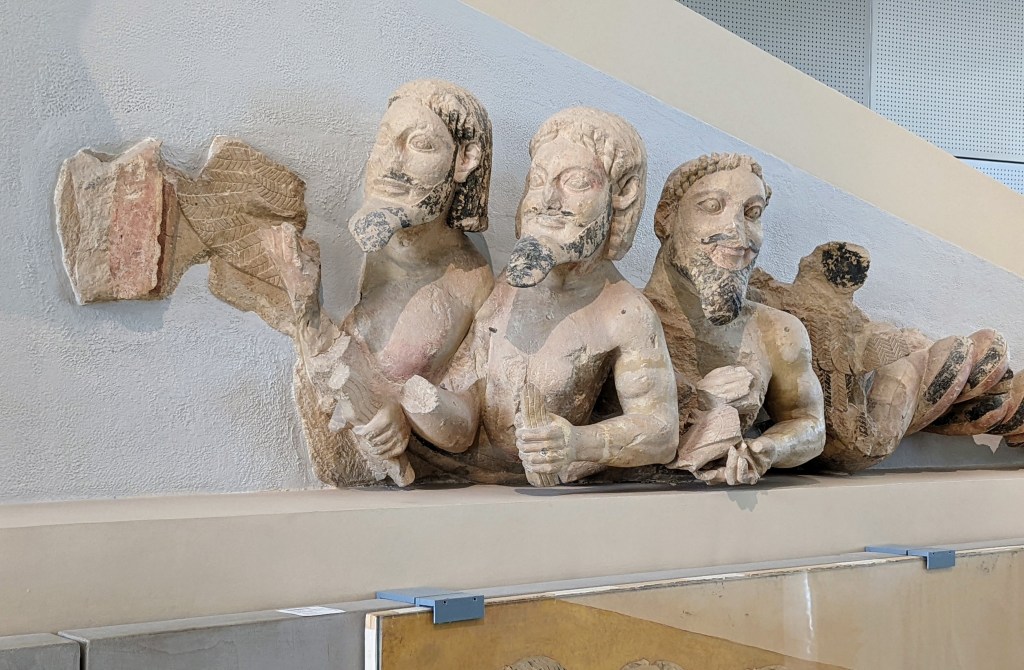
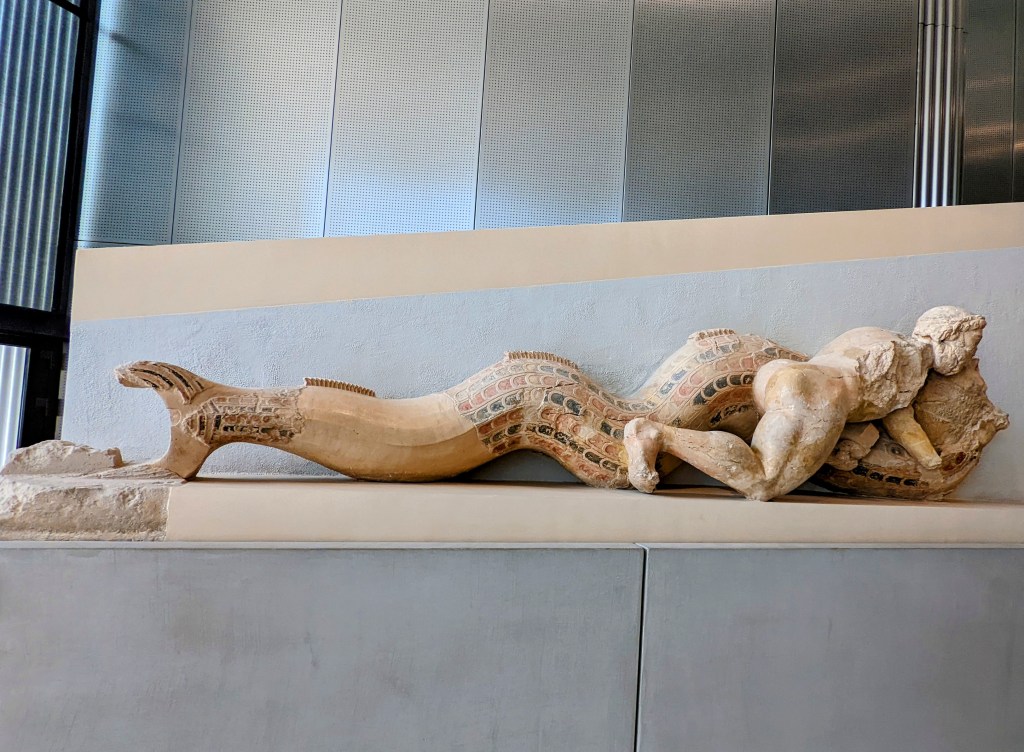
Actual remnants from the pediment of the Parthenon are displayed up close to tell their stories of war and triumph.
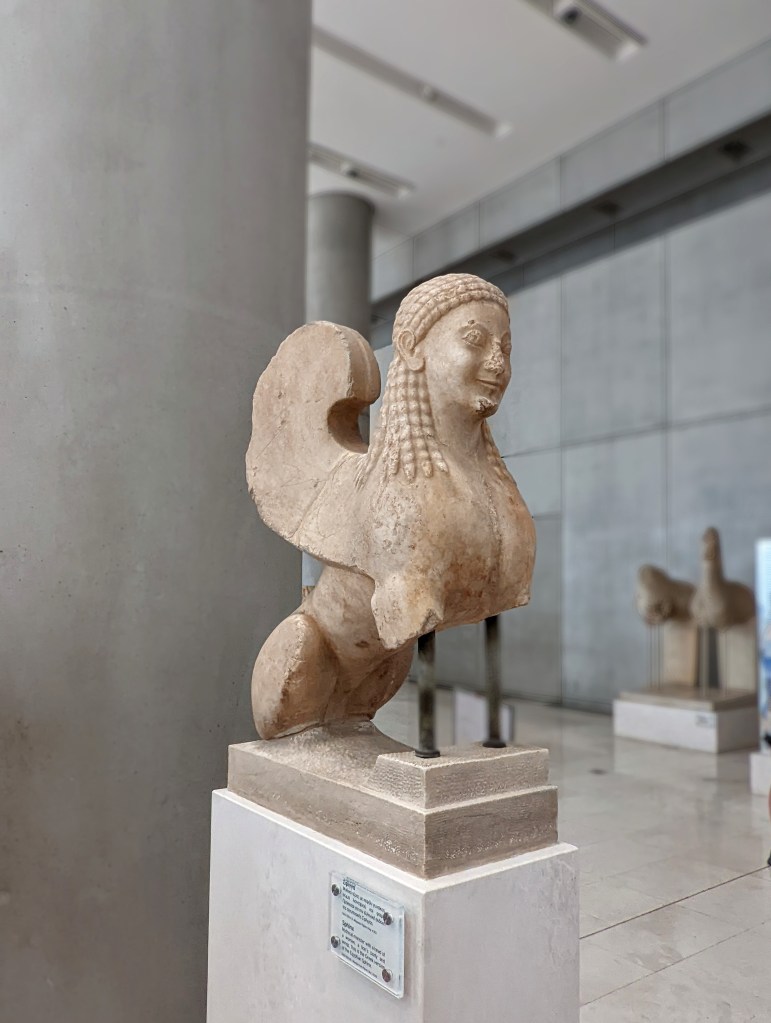
There are many mythological artifacts, such as this beautiful sphinx, a creature with the head of a woman, wings of a bird, and body of a lioness.
Sphinx of Naxos
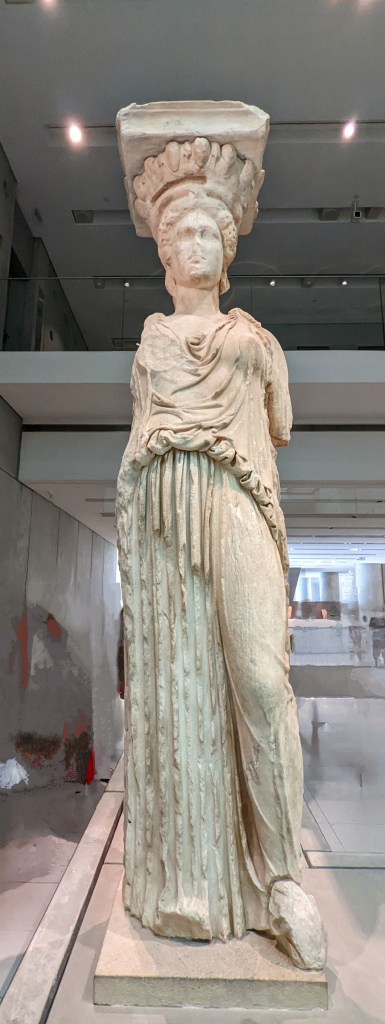
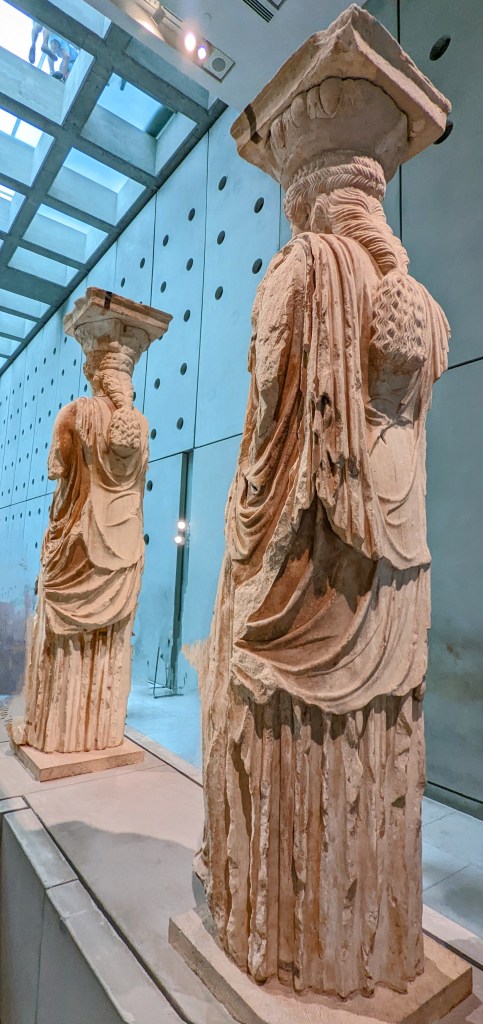
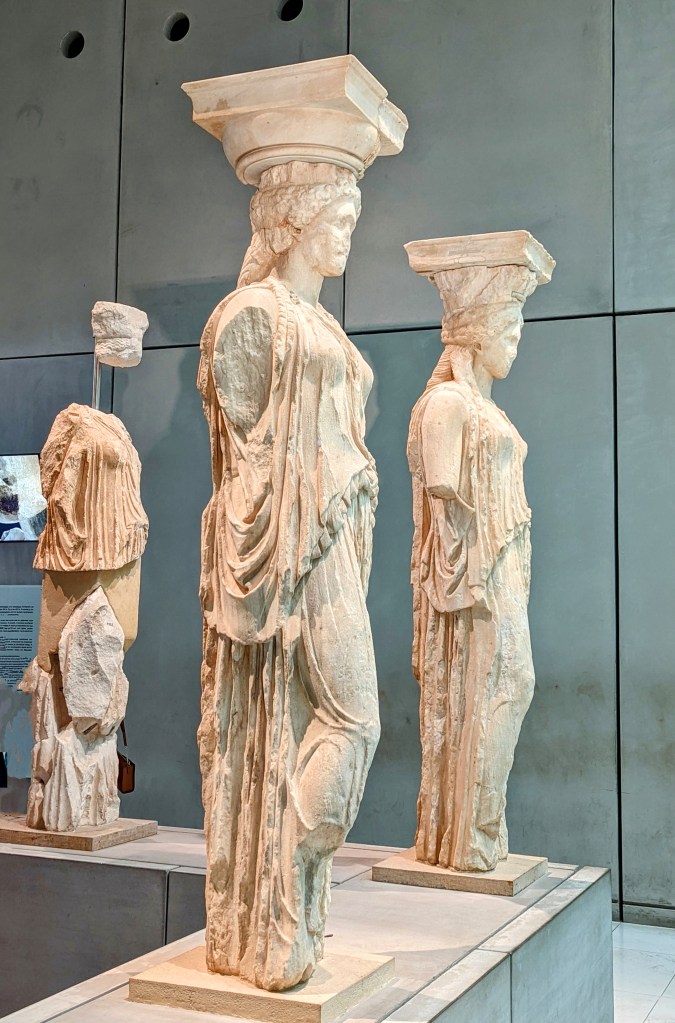
But the most surprising thing we learned is that the six Caryatids displayed at the Acropolis itself are replicas of these beauties. Five of the original six are displayed in the Museum.
There’s an empty space awaiting the 6th caryatid, which we were surprised to learn is found today in the British Museum along with many original marble artifacts.
It seems that Lord Elgin (Thomas Bruce, 7th Earl of Elgin and British ambassador to Greece) was an art collector as well as a diplomat. There’s great controversy over how he was able to procure these Greek treasures back in 1802, but it shouldn’t come as a surprise that the ladies are missing their sister. And it’s also pretty clear that this story’s ending is yet to be written!
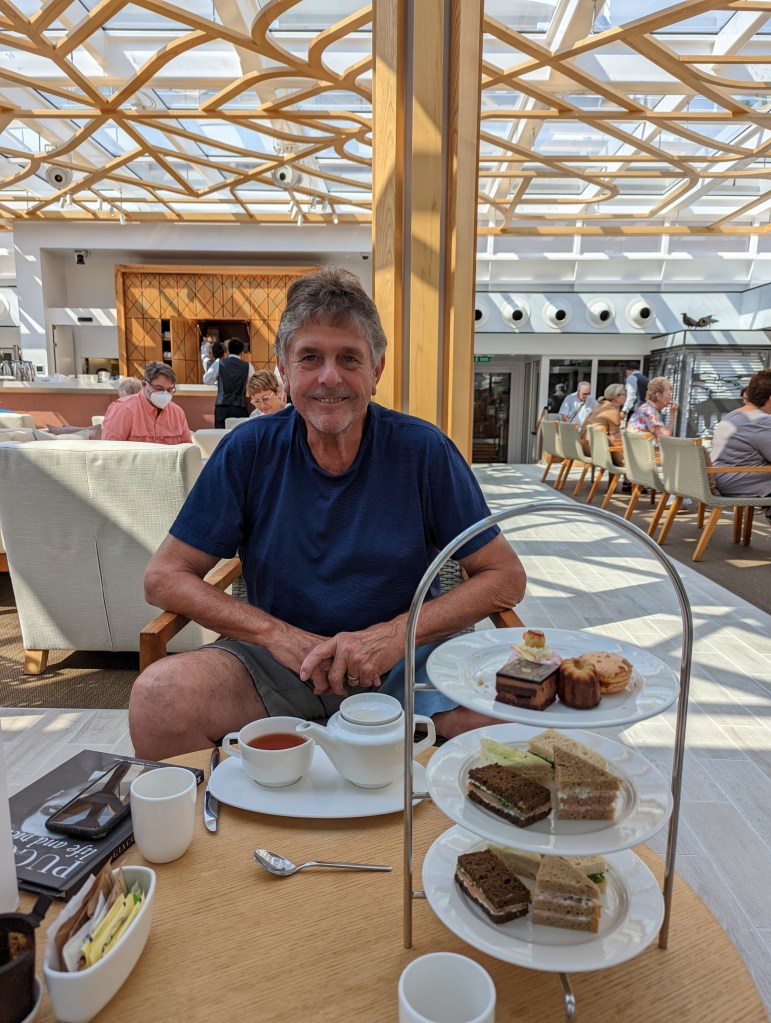
Our two days in Athens flew by, and by the end of the second day we were pretty tired. So as we sailed away toward the Island of Crete, we stopped by the ship’s Wintergarten and did something we’ve never done on a Viking Cruise…we enjoyed afternoon tea. It was a perfect ending for two busy days.
Today we took a trip way back in time to visit the ancient ruins of the legendary city of Olympia, the classical birthplace of the Olympic Games. The well-preserved remains of temples, massive columns, the gymnasium, fountains, hotels, and the stadium all evoke the glory of the early games. It is unclear who came up with the idea of the games initially, but they were definitely dedicated to Zeus, King of the Gods of Mt. Olympus.
One likely theory is that a regional king, frustrated with the constant wars among the kingdoms, went to Delphi to ask Apollo how to end the wars. Apollo recommended starting athletic competitions between the kingdoms during which there would be a Sacred Truce to which all would commit. This truce would be in honor of Zeus. Although it is guesstimated that this might have occurred as early as the 10th century BC, the first written record of the games is 776 BC. After this, every four summers the people of Olympia would organize the games and athletes, trainers, and spectators would make the journey. There was a grand procession to mark the beginning of the games, and sacred fires were kept burning. The wars were suspended during the games, which increased over the years from one event to fifteen and from one day to five. The early athletes were all men (women started their own games later) and the winners would receive a wreath of olive branches. Once the games ended, the parties started! This went on until 394 AD when the games were suspended. By then most Greeks had become Christians and had stopped worshipping Zeus. We were surprised to learn that the marathon was not part of the original Olympic games…but that’s another story!
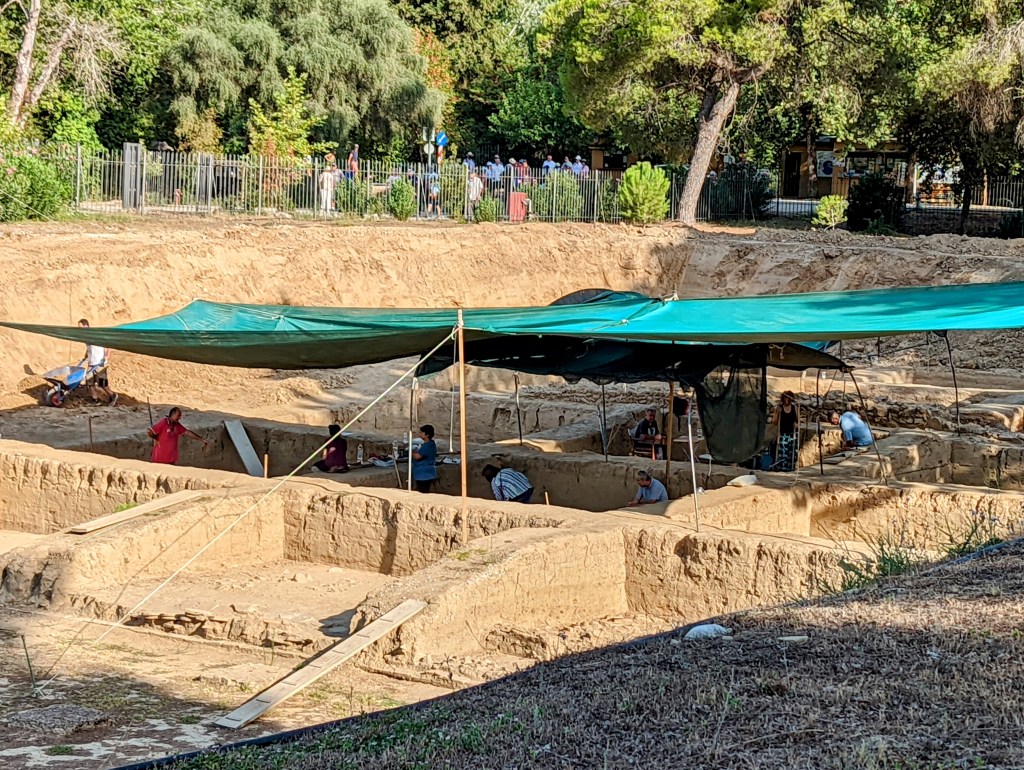
Over the years, the Olympic venues fell to ruin through earthquakes, wars, mudslides, etc. and the once imposing structures were buried and forgotten. It wasn’t until the 19th century when a team of German archaeologists found some Olympic remains that interest in the games was revived. New facilities were built and the “new” games were held in Athens on April 5-15, 1896, then again in 2004. The tradition of an Olympic fire was reintroduced during the 1928 Summer Olympics in Amsterdam. And the first Olympic torch relay was at the 1936 Summer Olympics in Berlin. The ancient site has been undergoing extensive archaeological discovery and restoration for decades. We actually saw part of the excavation that’s taking place today.
Current excavation
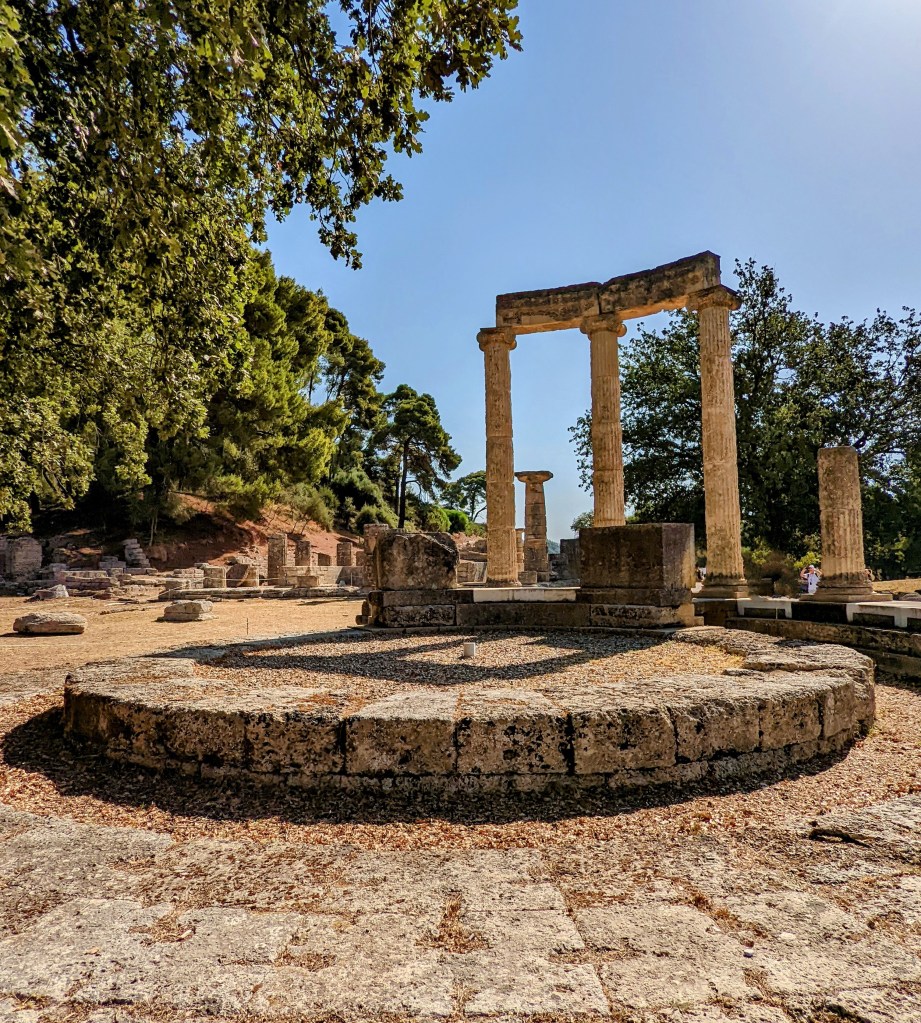
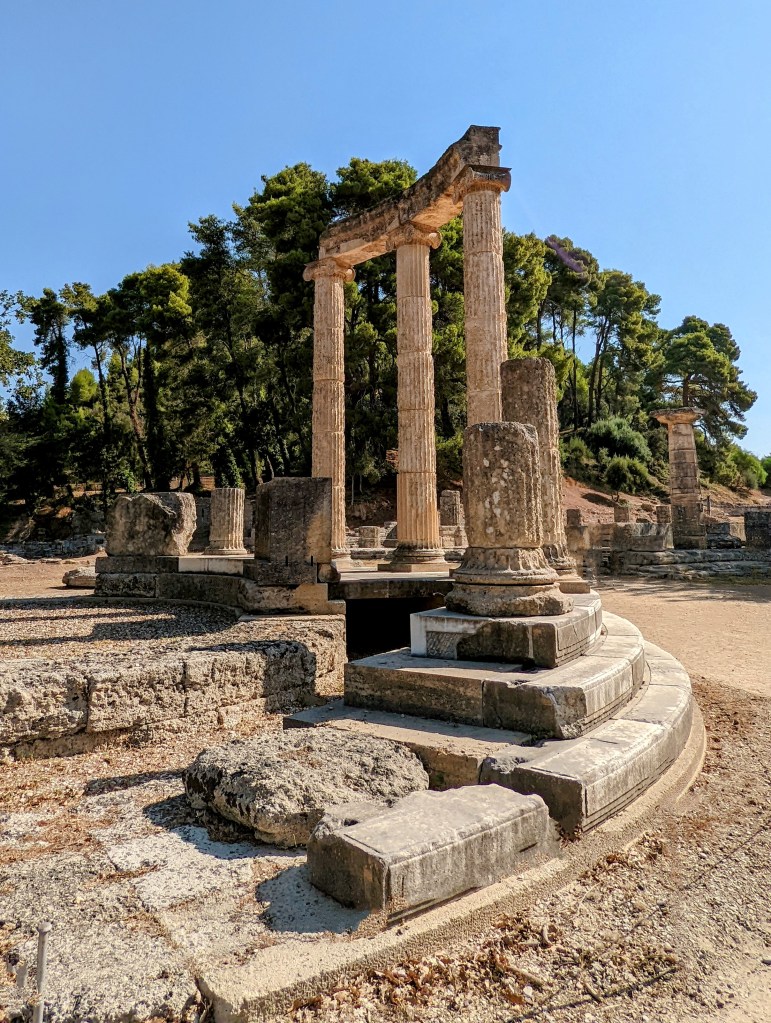
Waking among the ruins was an awe-inspiring experience. We’re happy to share some of our favorite images here in the hope that they take you back to the early days of this amazing place!
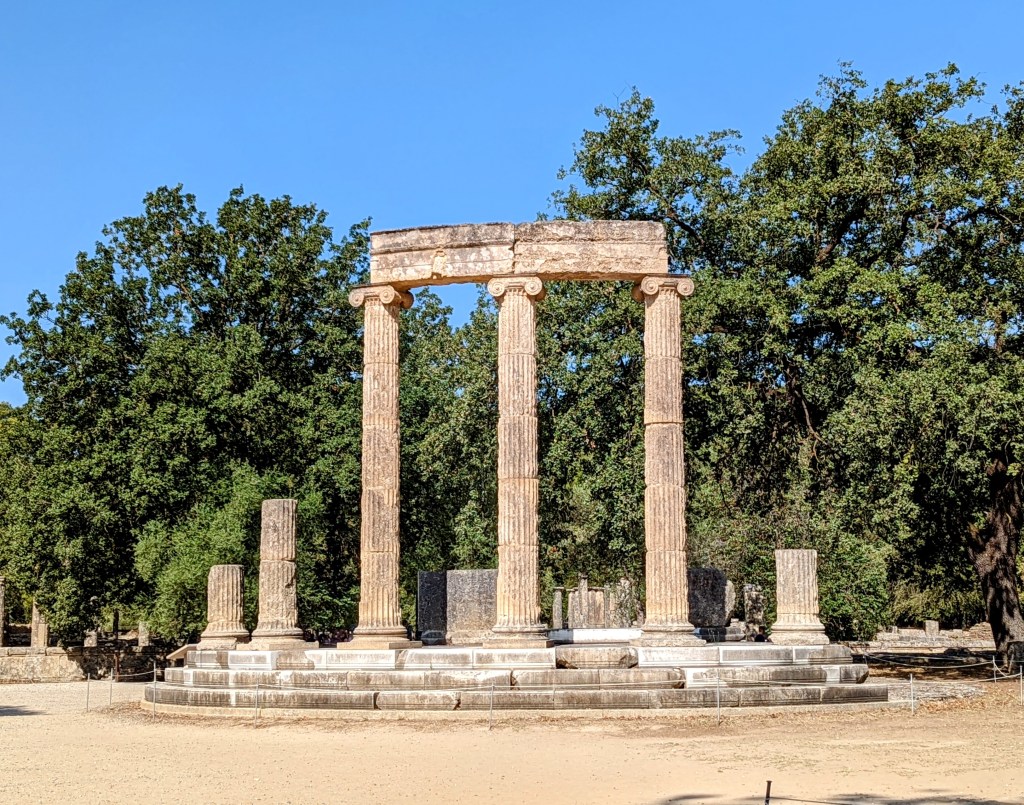
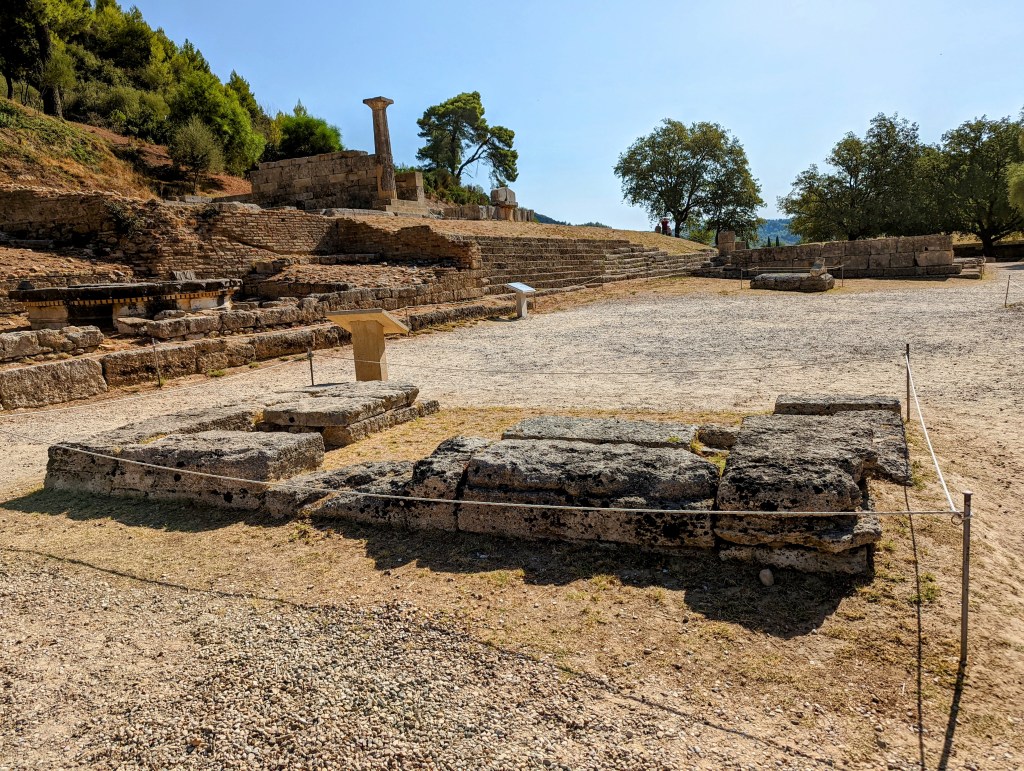
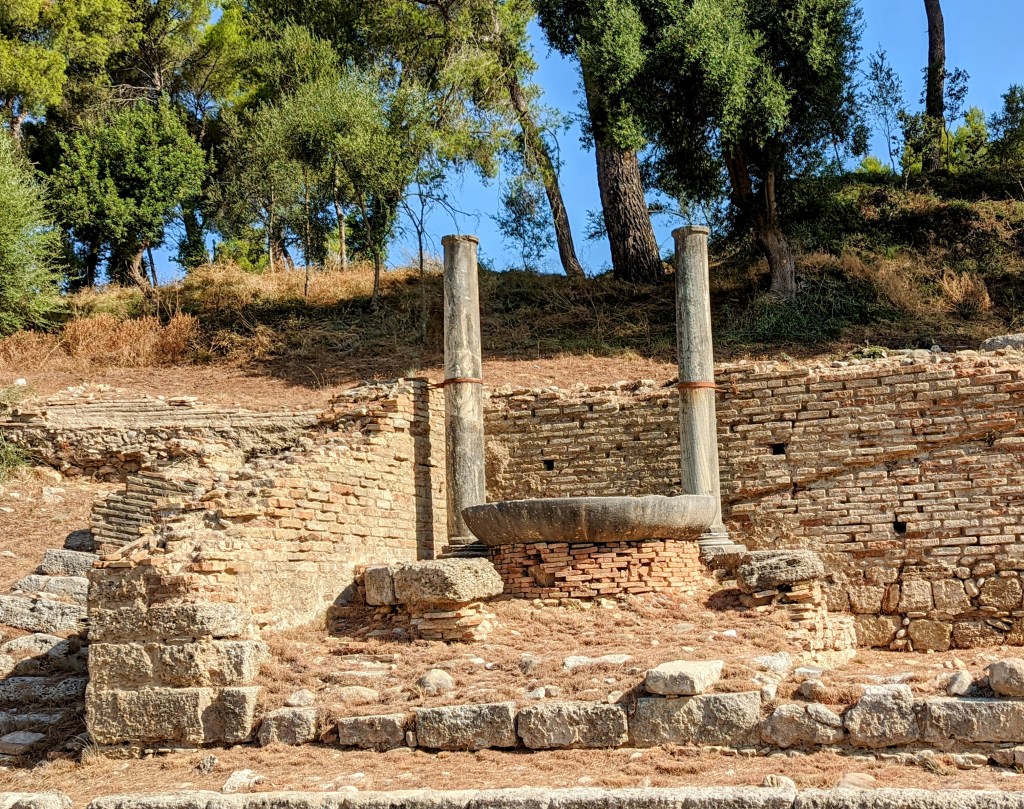
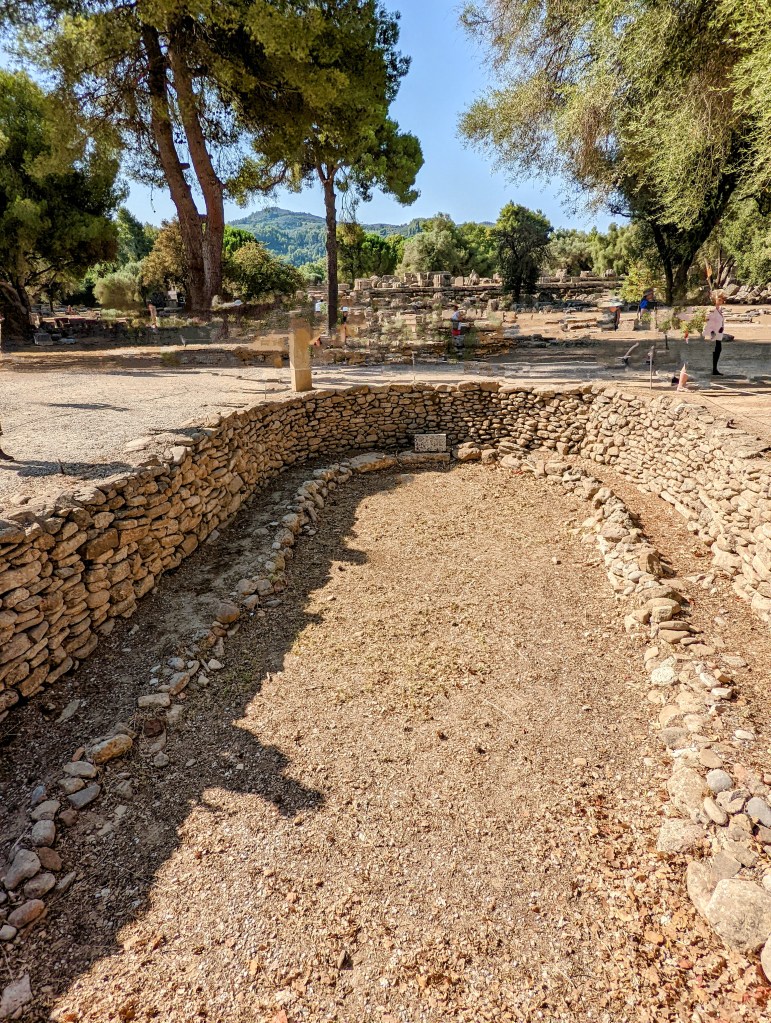
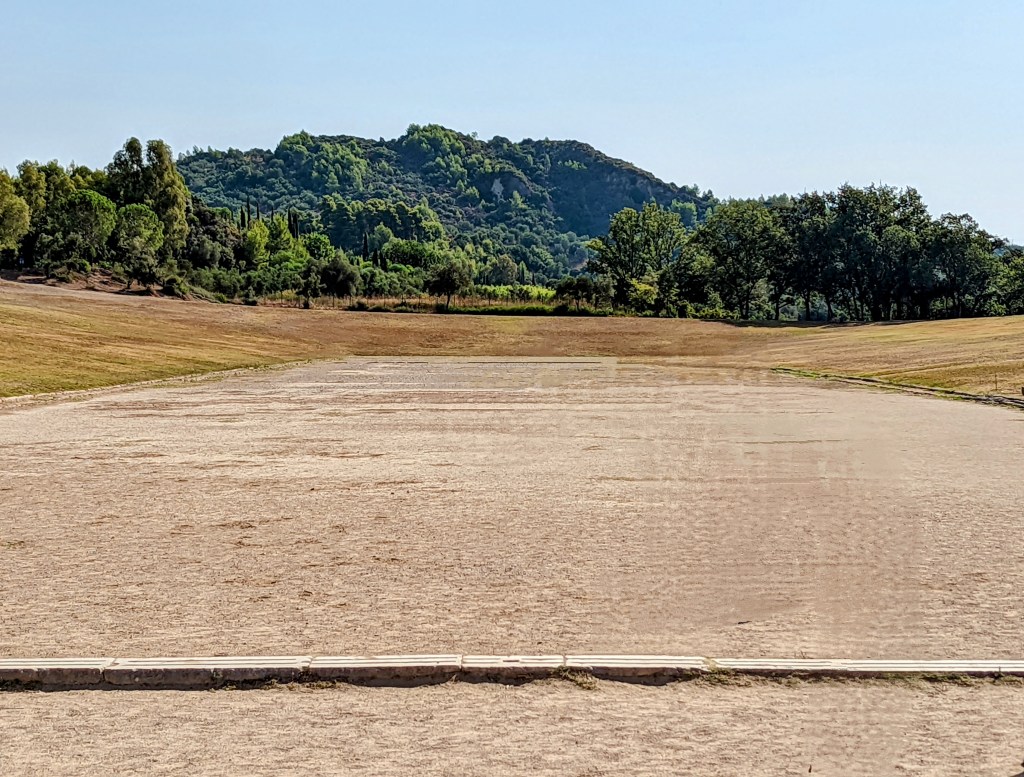
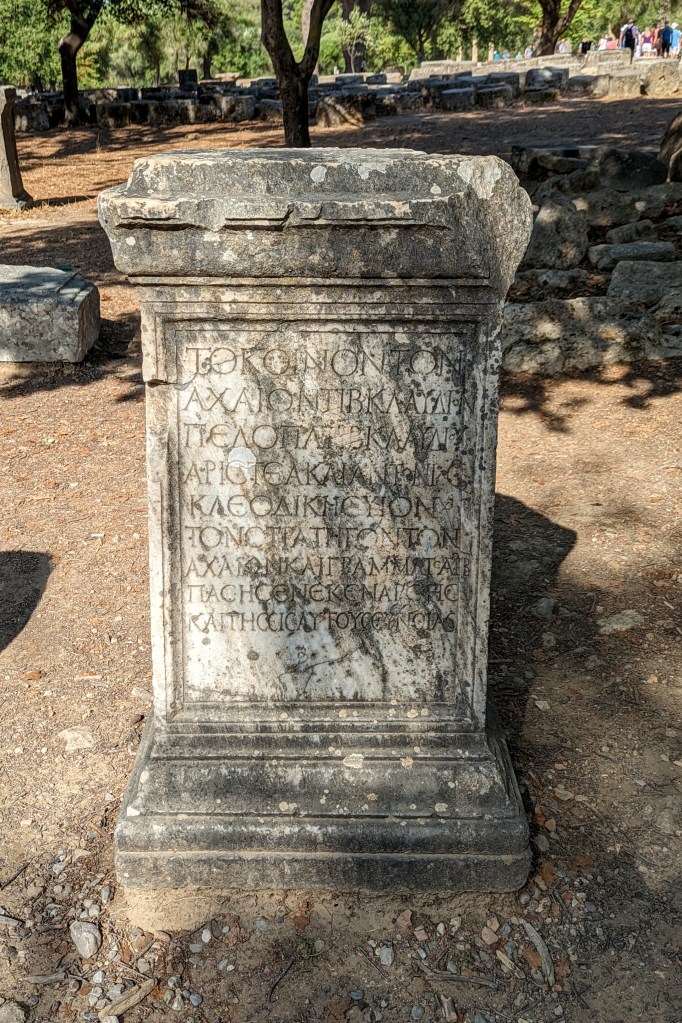
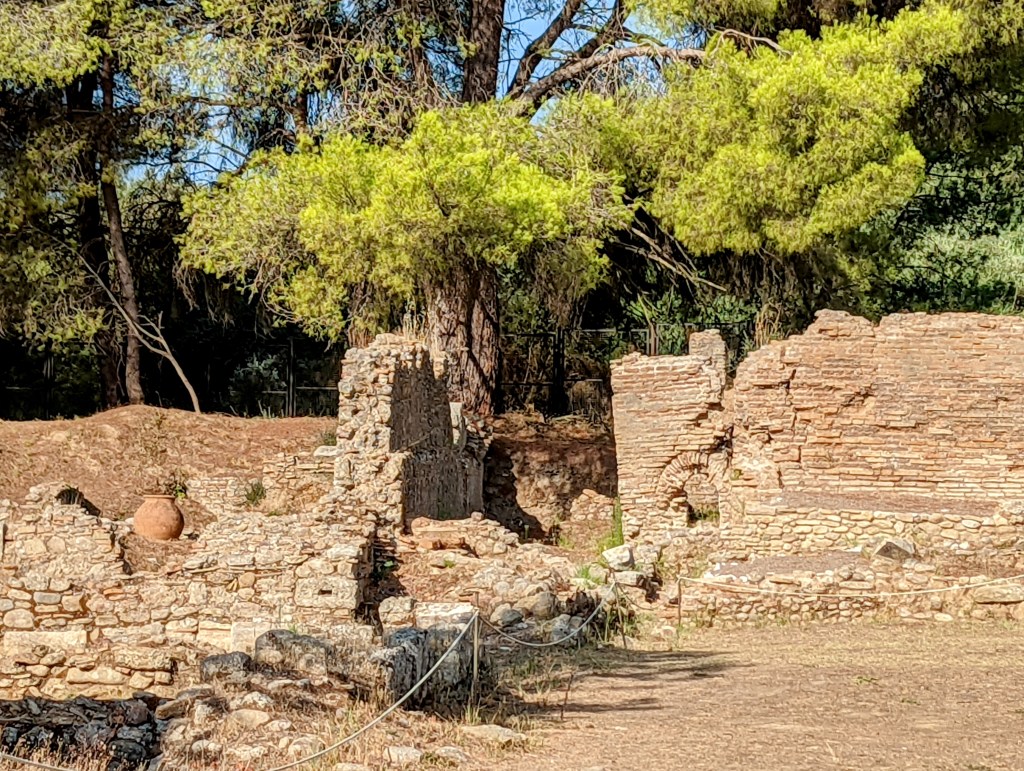
Philippeion, started in 338 BC by Philip II in thanksgiving to Zeus for victory over Chaironeia. It was finished by his son, Alexander the GreatThe only round building byAltar for animal sacrifices Part of the Nymphaion water fountain dedicated to Herodoes AtticusFoundation of a homeEntrance to the StadiumThe Stadium Arched window in the Palaestra where wrestlers practicedA pillar of the Temple of Zeus re-created for the 2004 Athens Olympics
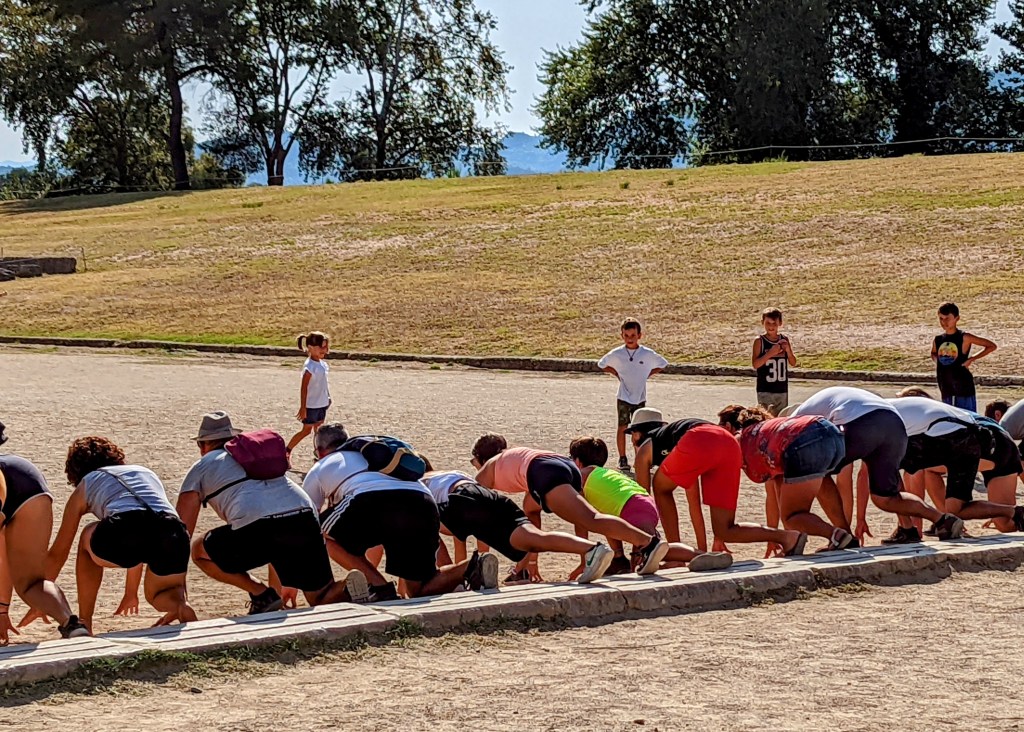
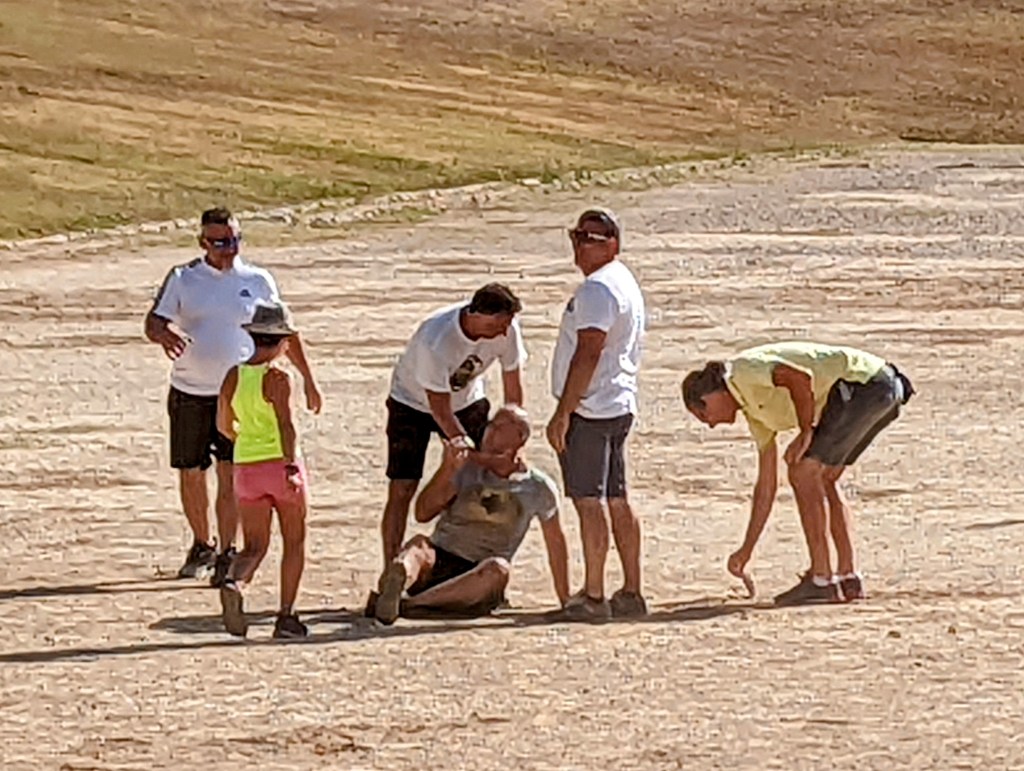
Today, several visitors were inspired to test their skills in the stadium, with varying degrees of success.
On your marks…get set…go!Taking one for the team!Doug crossing the finish line!
I mentioned that the Marathon wasn’t originally part of the Olympics, but how did it start? It’s actually a story of war and love with a happy ending. Marathon was a battlefield 26 miles from Athens where the Athenians confronted the Persians in 490 BC. When the Athenians prevailed, a soldier ran from Marathon to Athens to announce the victory. A Frenchman learned of this story, and in 1896 organized athletes from 13 countries to run the marathon as an Olympic event. A young man named Spiros was hired to carry water for the athletes. Spiros loved a young woman named Helen. Her father said he couldn’t marry Helen unless he did something important. Spiros, not an athlete himself, covered the 26 miles in 2 hours, 59 minutes, and 58 seconds, winning the marathon. He ended up marrying Helen. Now every year in November, over 16,000 athletes run the Athens Marathon.
Our wonderful guide Sophia regaled us with these and other stories and legends of the Olympics during our time together. Afterwards, we spent a little time in the city of Olympia which grew up to support the tourism created by the discovery of the Olympic treasures.
Denise posed with Pyrsos the Peaceful And we enjoyed a coffee break on a lovely patio before heading back to the ship
Corfu is an island off Greece’s northwest corner in the Ionian Sea. Its cultural heritage reflects years spent under Venetian, French, and British rule before it was unified with Greece in 1864. Everywhere, magnificent coastal views unfold to tell stories of Corfu’s past, but the two most imposing landmarks are large fortresses called simply old fort (built in 1545) and new fort (built in 1576.)
The old and new fortresses of CorfuOld fort Entrance to the old fort
The former grand palace of Saints Michael and George is another landmark building. Today it houses the Museum of Asian Art.
Museum of Asian Art
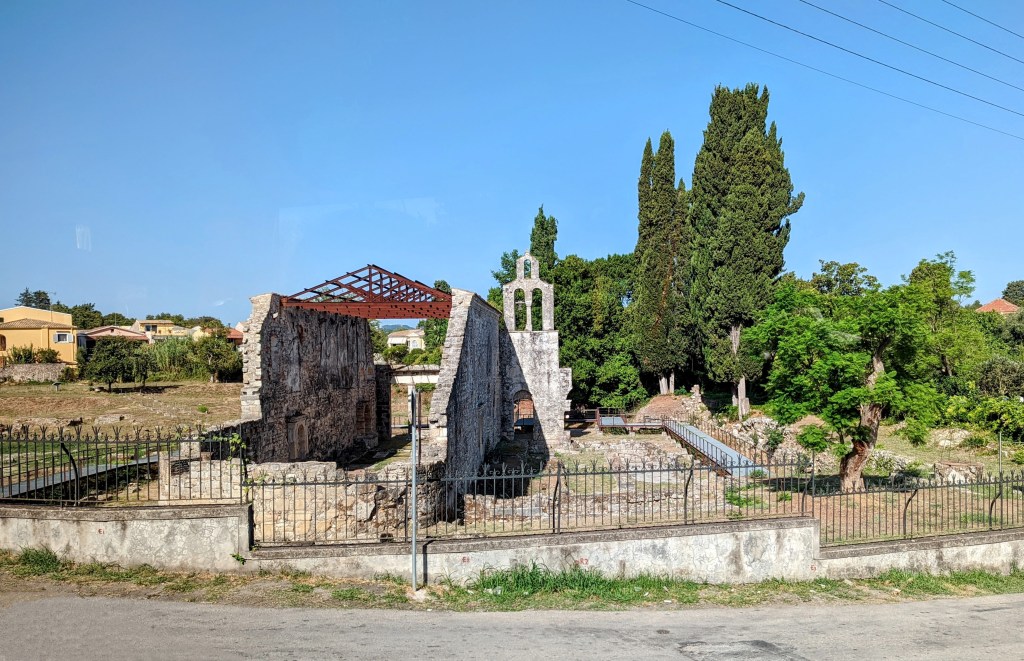
Our short panoramic driving tour took us past some interesting historic sites. The Douglas Column is a large obelisk that adorns Garitsa Beach. It reflects a period of British rule when Sir Howard Douglas was Lord High Commissioner of Corfu and the Ionian Islands. Several ancient ruins are also found dotting the island, among them the remains of the early Christian Basilica of Paleopolis.
Douglas Column Ancient Basilica Ruins
The Holy Monastery of Panagia Vlacherna sits on an idyllic island in the bay. It has become a familiar symbol of Corfu. Built in 1799, it has served as a monastery as well as a convent. Today it is used primarily for weddings and other special events.
Holy Monastery of Panagia Vlacherna
Many beautiful beaches and playgrounds dot the Corfu coastline.
Corfu has more than 200 churches spread out across the island.
Cathedral of St. James and St. Christopher Main Altar of the Cathedral Bell tower of the Cathedral of Saint SpyridonHoly Church of the Virgin Mary Mandrakina
Corfu’s Old Town is a maze of narrow streets and alleys flanked by a lovely promenade that was once reserved for the local aristocracy. Anything and everything can be found in Old Town.
Fresh produce marketsQuaint bistros Lovely apartments above shopsThe promemadePapagiorgias’ Sweet Shop has been continuously operating in Old Town since 1923. The Dafnis family has been crafting gourmet delicacies using local dairy and seasonal fruits for three generations. This is their dark chocolate kumquat ice cream. Absolutely delicious!And it’s definitely the place to see and be seen. We captured this precious moment when two color-coordinated couples were being photographed by their adorable children. When the kids were finished, I asked if I could take a photo of the six of them. They more than obliged with a cute social media-worthy pose!
With its legendary beauty and splendid weather, Corfu has served as a stunning backdrop for stories from Homer’s Odyssey to James Bond’s For Your Eyes Only to the Durrells. It’s certainly a storyteller’s paradise!
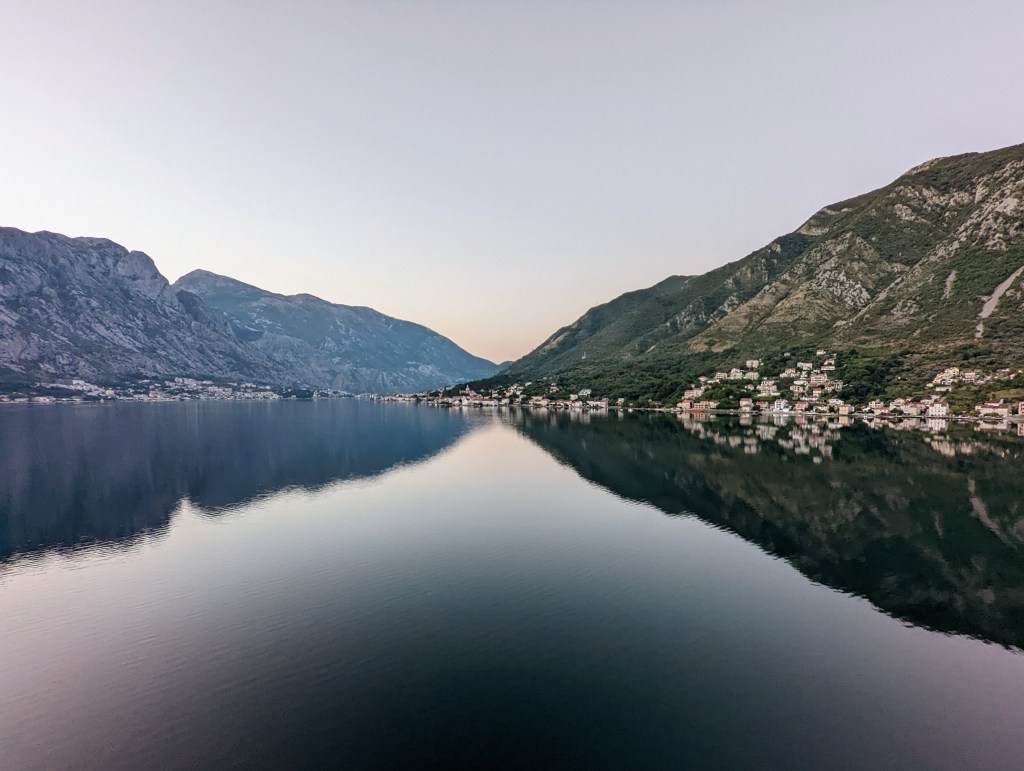
As we sailed into the Bay of Kotor before dawn, we knew Montenegro was going to be a very special place. We were so right! The 17 mile inlet that links the Adriatic to the heart of Kotor is resplendent with spectacular views. Towering cliffs soar above the narrow Kotor ria – a submerged river canyon often called Europe’s southernmost fjord.
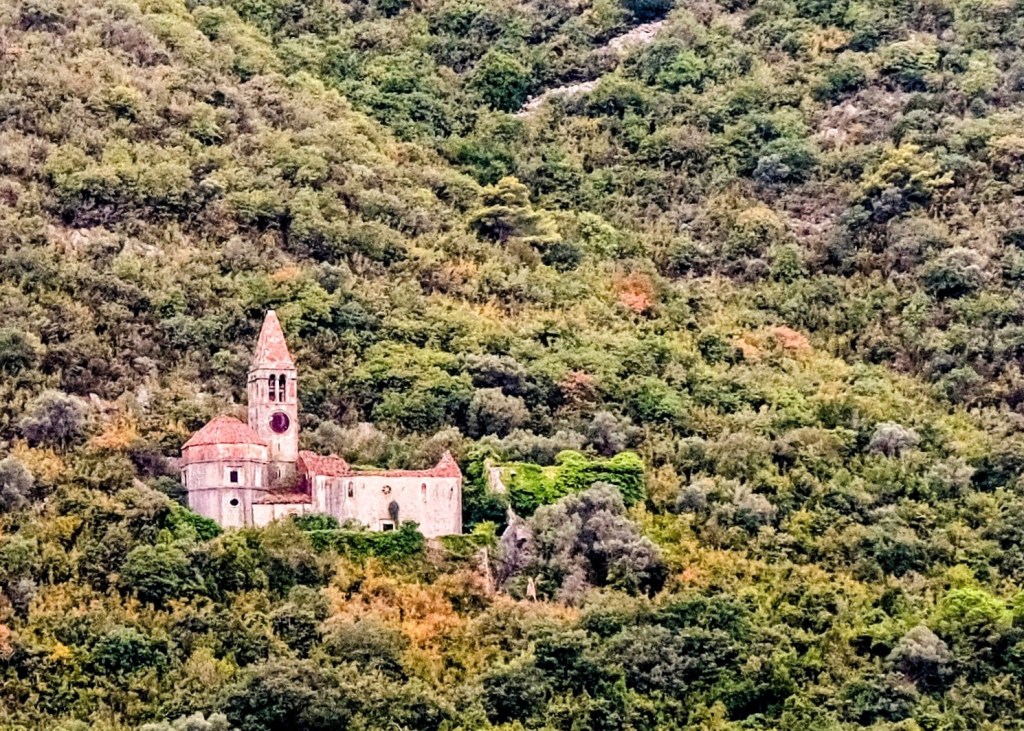
There are several small settlements along the bay, including restaurants perched on the hillside, resorts, islands, and tiny churches. One of two tiny twin islands houses one of only two of Montenegro’s Roman Catholic churches, Our Lady of the Rocks which can be visited by boat. The Island of St. George is a cloistered Serbian Orthodox Monastery. The Church of Our Lady of Remedy/Health sits halfway up the Kotor Fortress Climb, a steep walk built into the craggy hillside that looked a bit too intimidating for these timeless travelers.
One of many settlements along the bayA beach resort below a tiny churchTwin islandsThe long way up…1350 steps!Church of Our Lady of Health
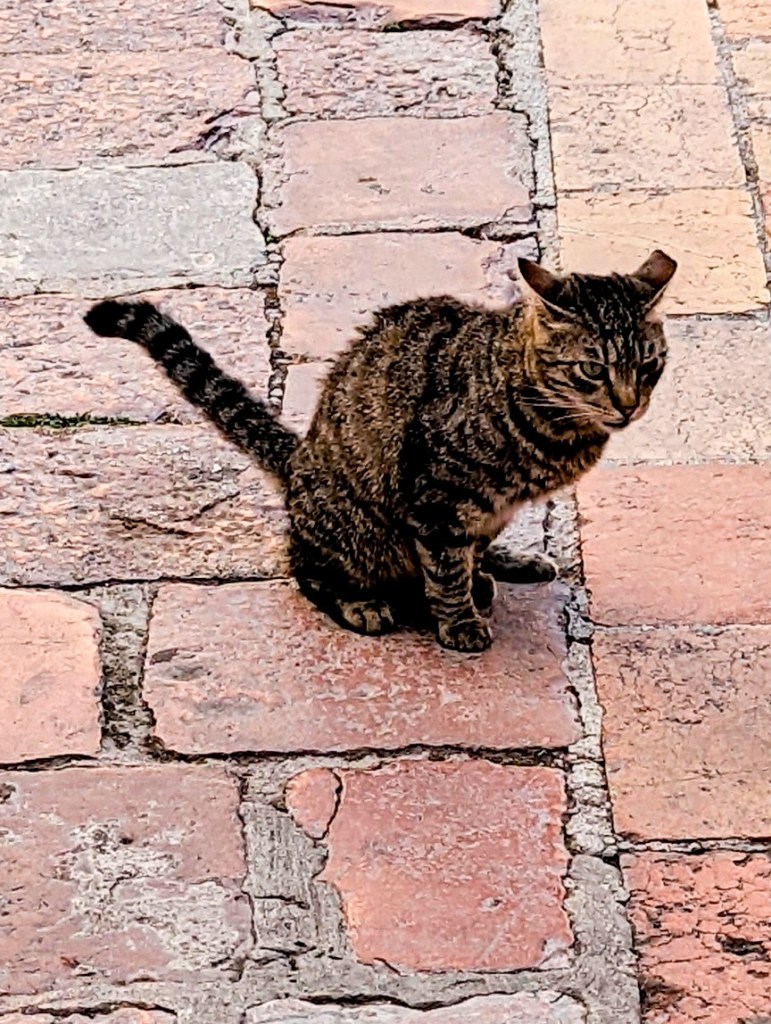
Nestled snugly between a limestone wall and a glimmering bay, Kotor is home to a well-preserved Old Town. Surrounded by medieval bastions and walls, Old Town Kotor is a labyrinth of tiny alleyways and streets too small for cars. The cats of Kotor are everywhere! There’s even a Cats Museum! Because of its location between the sea and mountains, Kotor had to bring in cats many years ago to control mice, rats, and snakes. It must have worked, because we didn’t see any of the latter, but plenty of the former.
Cats of Kotor
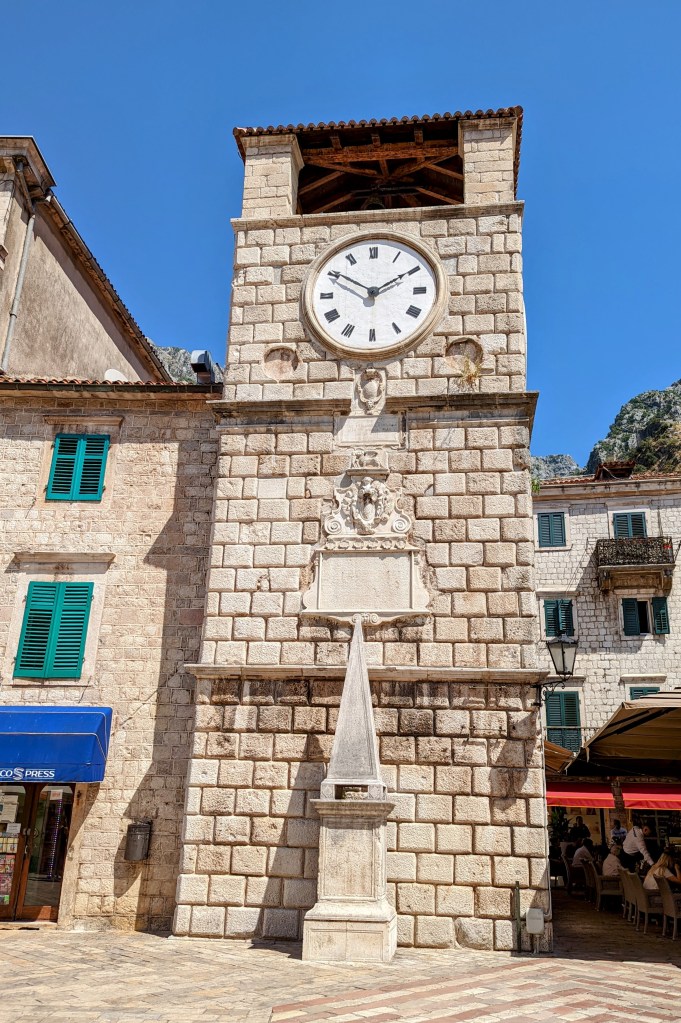
The walls themselves are stunning remnants from Kotor’s 300 years as a province of the Venetian Republic. Just inside the Sea Gate is one of the rare open areas within. Here you’ll find numerous cafes and bars as well as the old clock tower.
Sea GateClock Tower
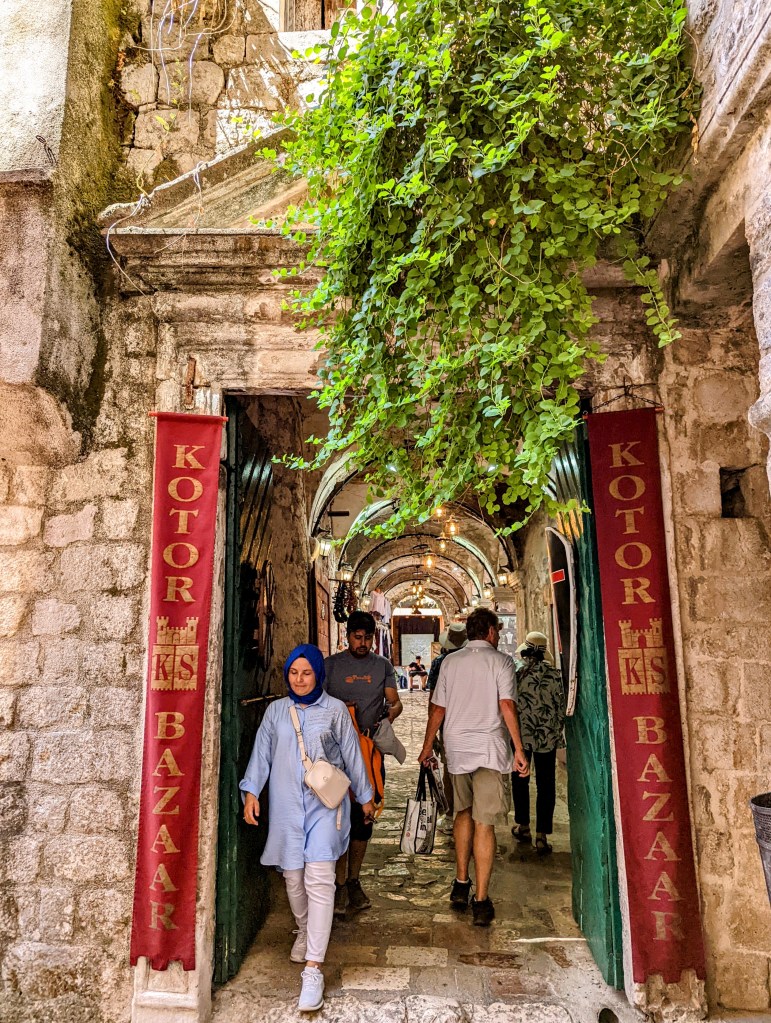
But the true charm of the Old Town is found meandering around and through the tiny streets. Here shopkeepers will gently encourage visitors to come and see their unique offerings.
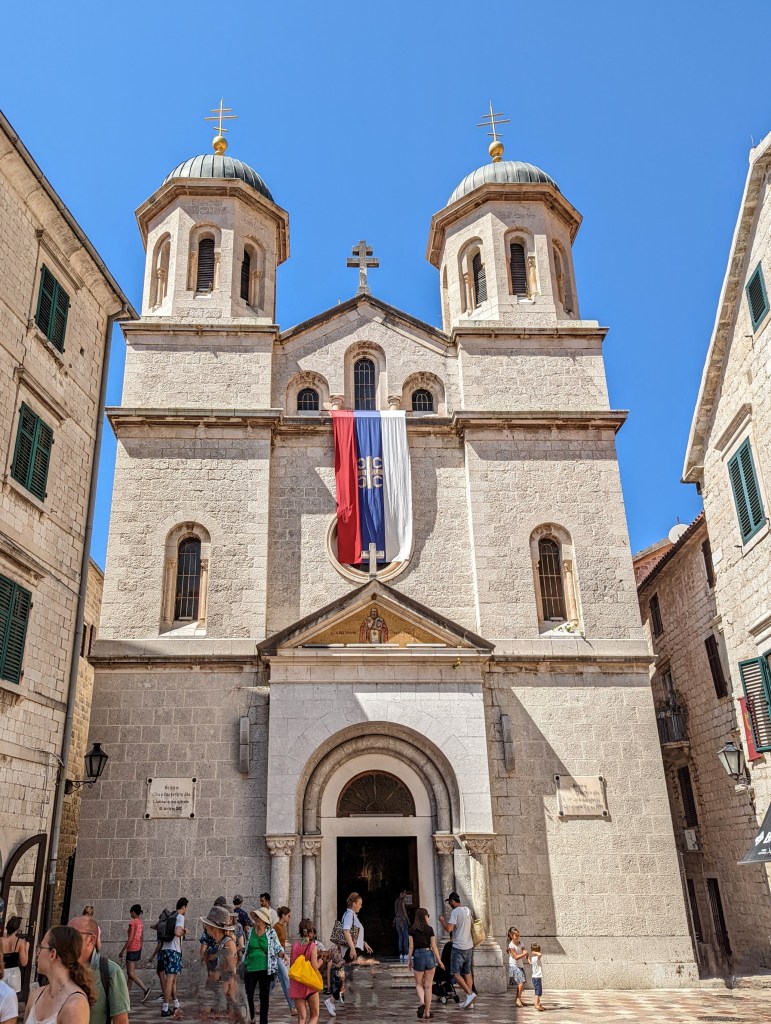
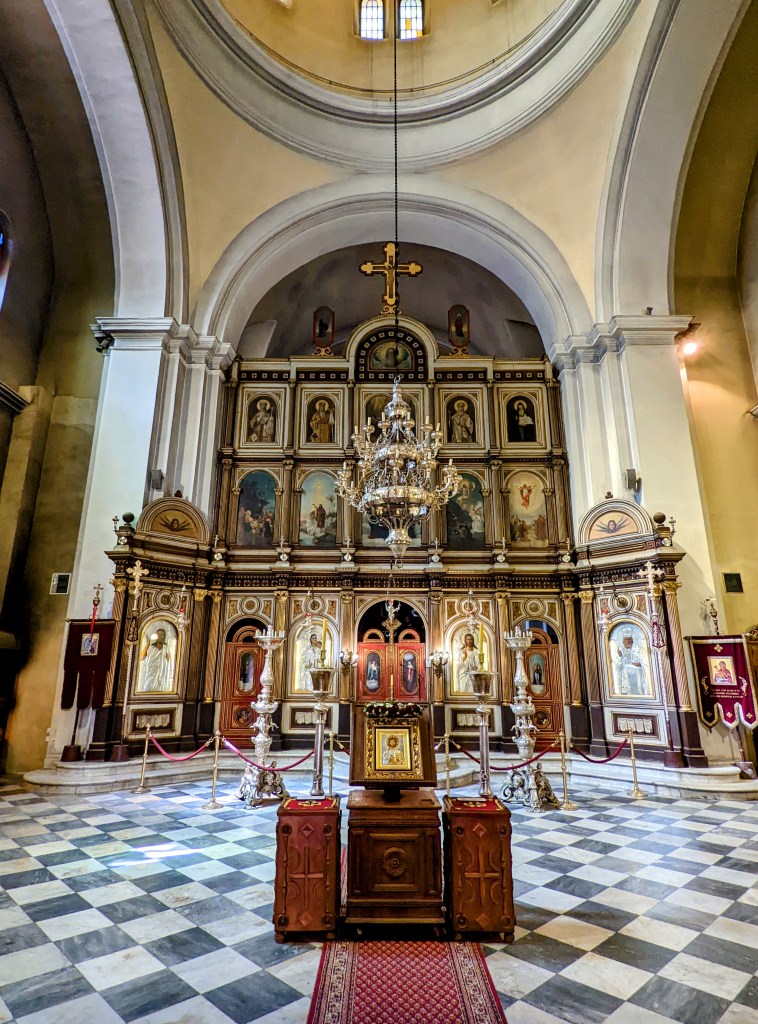
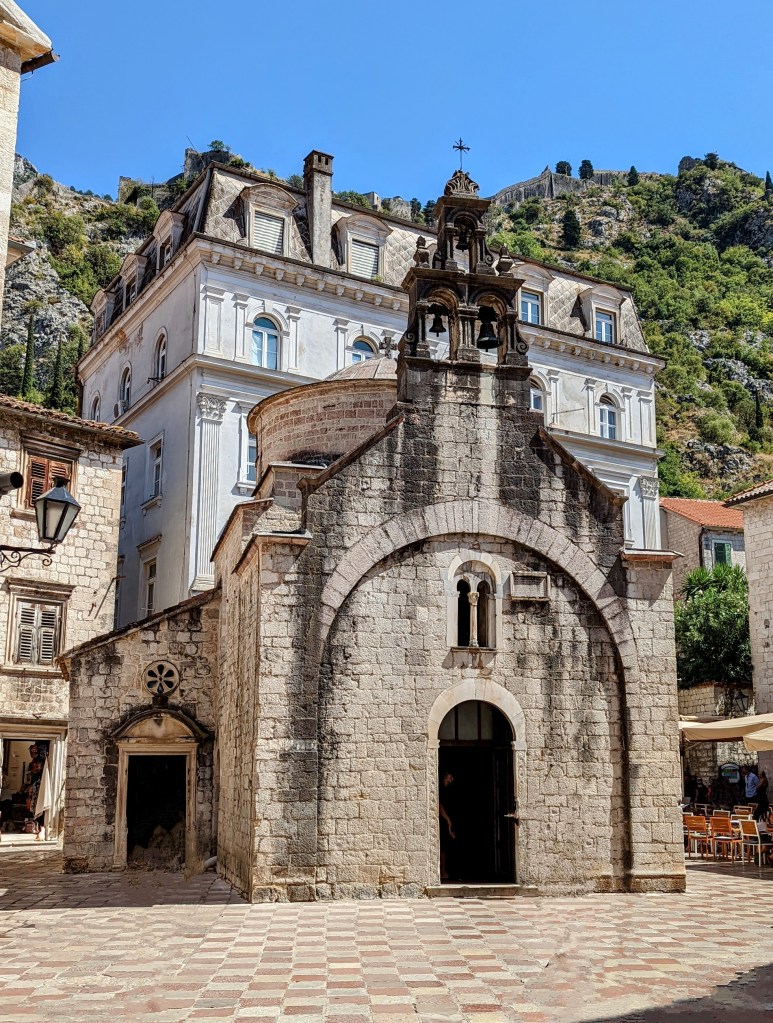
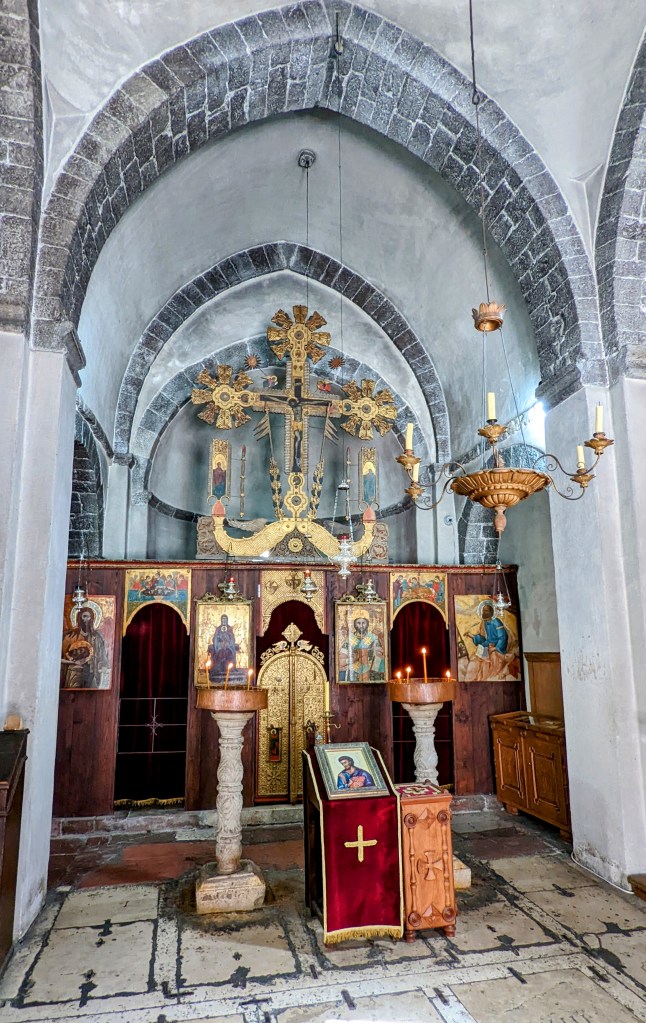
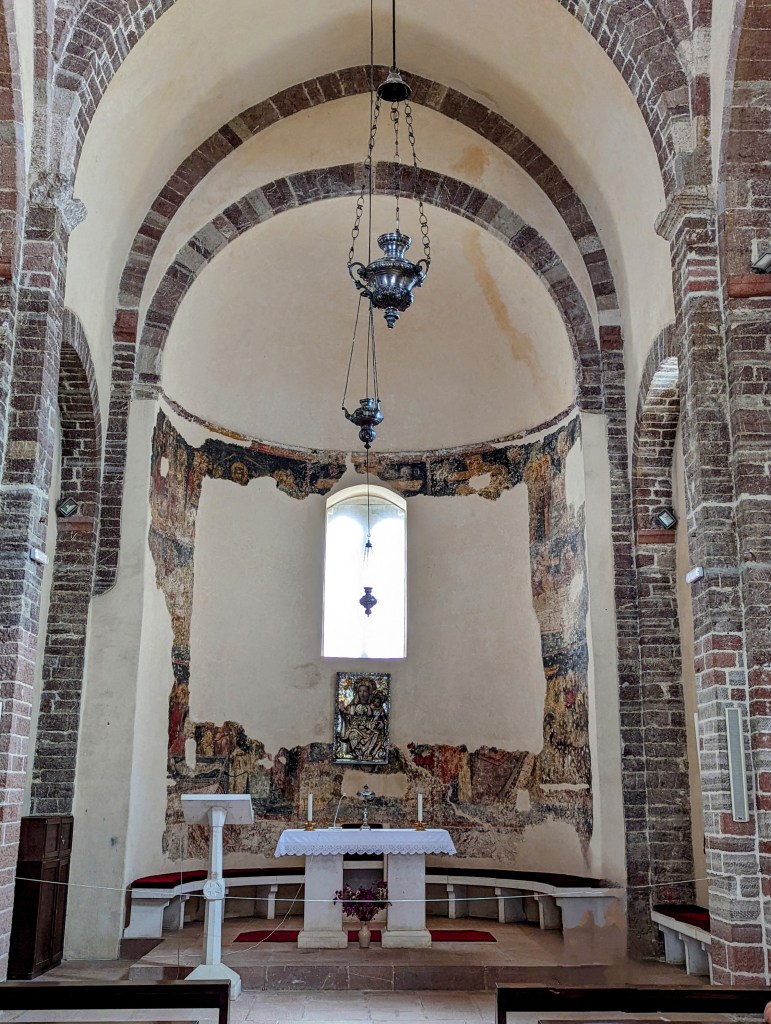
Old Town is also home to several beautiful churches large and small. Kotor Cathedral, originally built in 1166, is the largest. But the smaller, older churches, mostly Serbian Orthodox, are nonetheless charming.
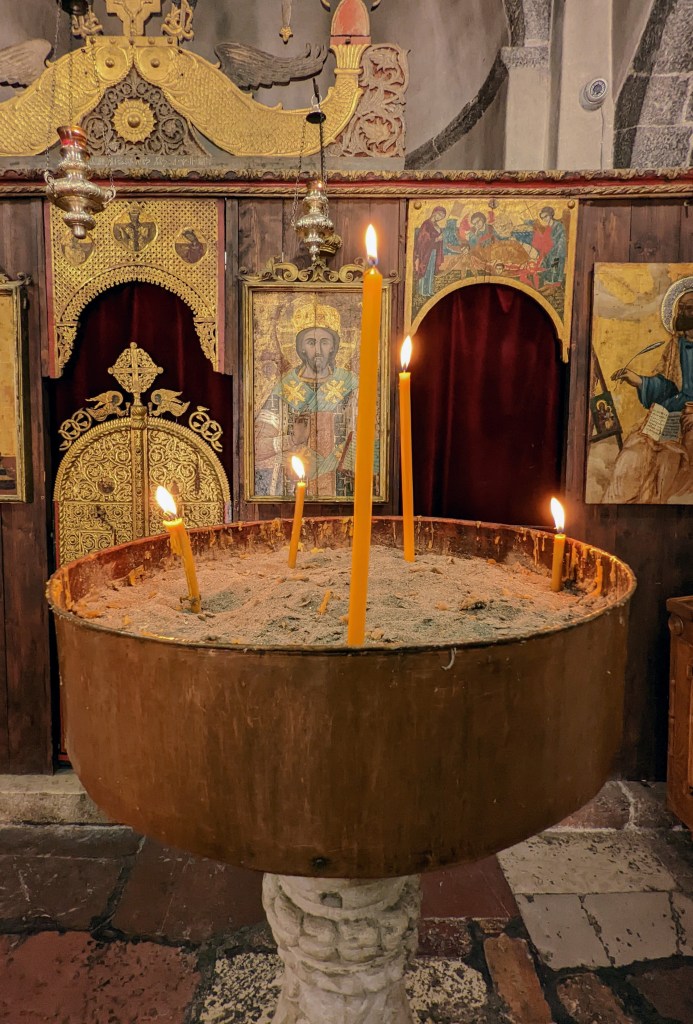
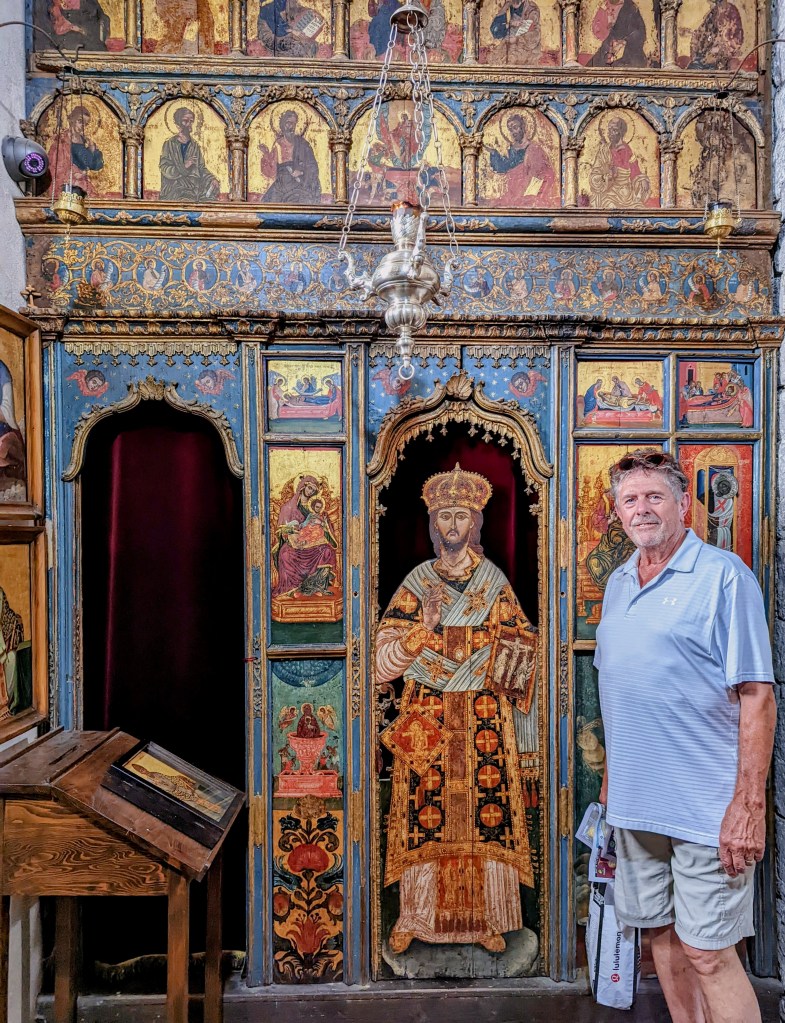
Kotor Cathedral Cathedral main altar Small church of Saint Luke, 1195Main altarA prayerConfessional This small image on the door of one of the churches said “welcome!” to meThe remnants of old icons can be seen all around the church
It’s well worth the white-knuckle drive to venture outside the Old Town to visit some of the outlying villages near Kotor. As described by our incredibly well-informed guide Vladimir, we were in for a thrilling drive along a 120 year-old road “with one lane only for two-way traffic!” There are 25 switchbacks along the steep climb to Njegusi, each numbered on the remaining bits of the stone retaining walls.
Switchback number 23
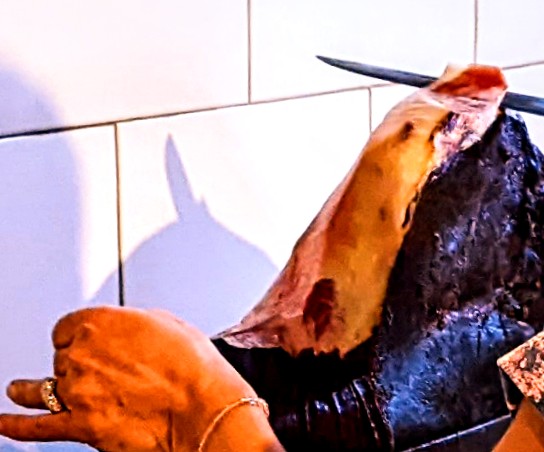
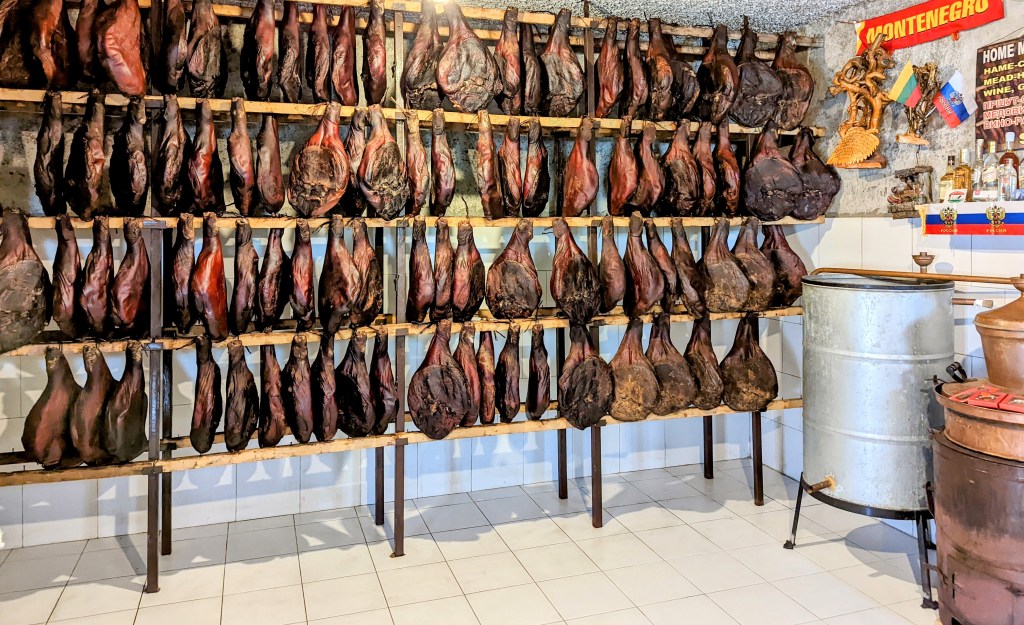
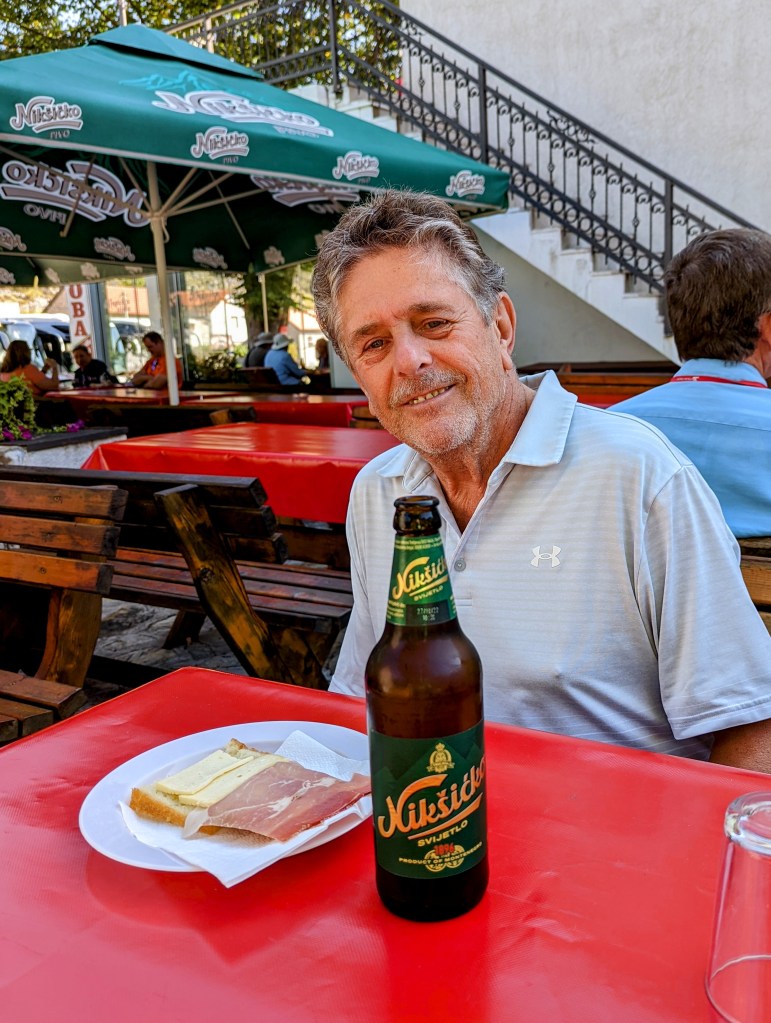
The main attractions in Njegusi are the Zipline (we passed!) and the local delicacies (we indulged!) The prosciutto is smoked and hand trimmed numerous times to produce a ham that has a mouthwatering flavor and texture. Cheeses, breads, wine, beer, and preserved fruits are just a few of the products made in this charming mountain town.
Montenegro’s prosciutto Doug enjoyed the beer with his snackDenise preferred the light red wine
After a short repast in lovely Njegusi, we were back on the road to Cetinje, the former royal capital of Montenegro. This town was once the “heart and soul” of Montenegro and celebrates the “golden age” of the reign of Nikola I who reigned as prince from 1860-1910 and king from 1910-1918.
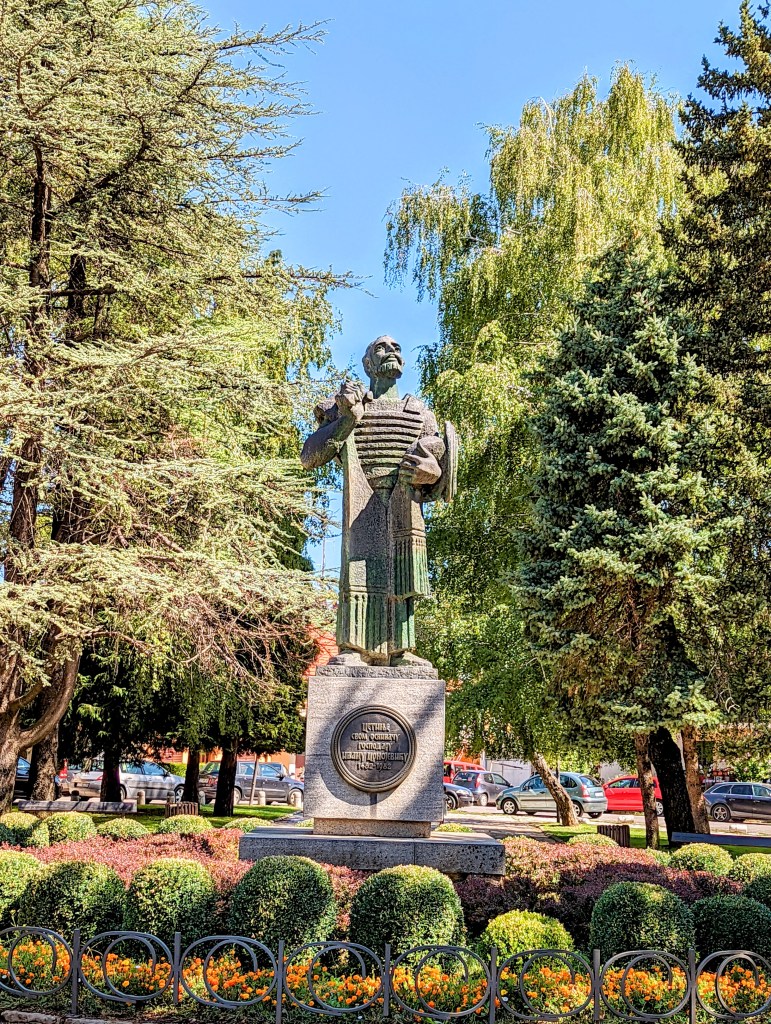
Cetinje was founded in 1465 by Ivan Crnojevic who was Lord of Zeta and the Serbian leader from 1465-1490 and moved the capital here. His monument stands in the middle of the city.
Ivan Crnojevic
Home to the Lovcen National Park, Cetinje is rich with history. The National Museum of Montenegro chronicles the regimes, battles, and challenges this small country has overcome. The Museum of King Nikola, the former royal palace, was originally built as a fortress in the 19th century. The museum provides a glimpse of what life was like for the royal family.
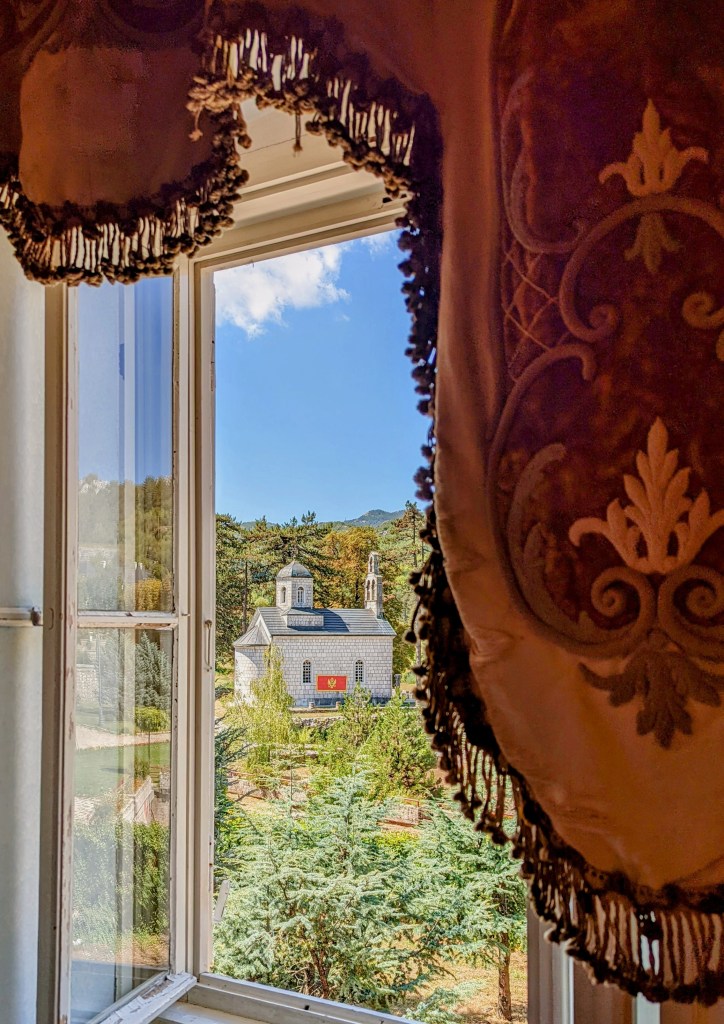
National Museum of Montenegro Museum of King NikolaA view of the Church of the Virgin Mary on Chipur from the palace. Built in the 15th century on the ruins of the original monastery. It contains the earthly remains of Nikola’s I, his wife Milena, and Ivan Crnojevic.
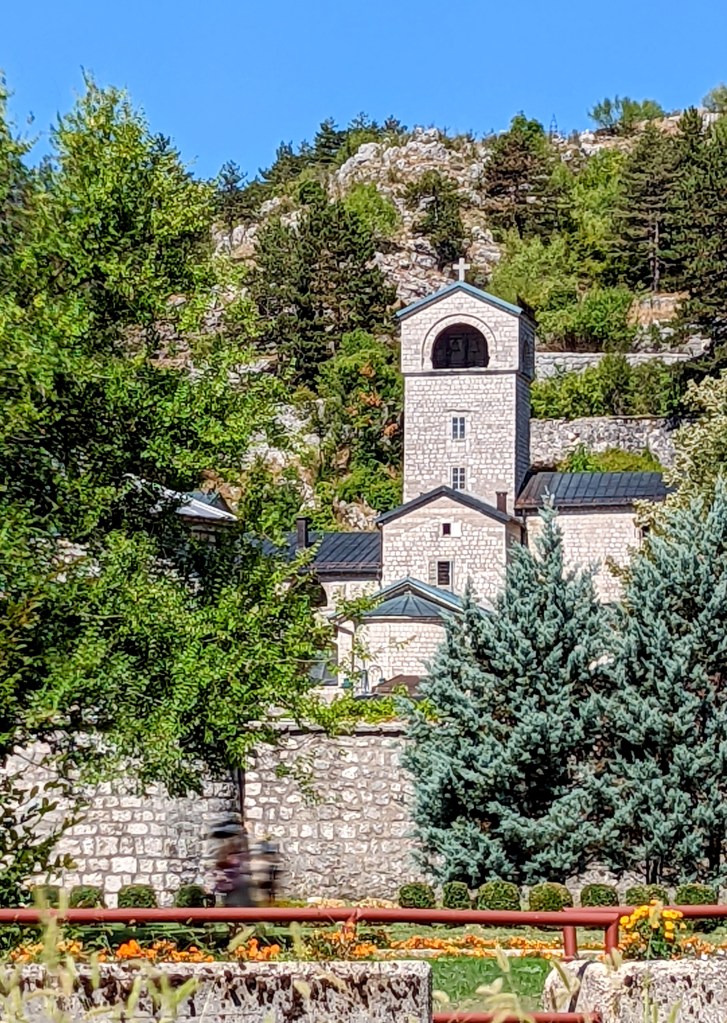
The Monastery of St. Peter is an Orthodox monastery which houses several important relics including the right hand of John the Baptist.
Monastery of St. Peter
At the very top of a hill overlooking the park is the masoleum of Petar Petrovic Njegos, a prince-bishop as well as a renowned power and philosopher.
Niegos’ Masoleum
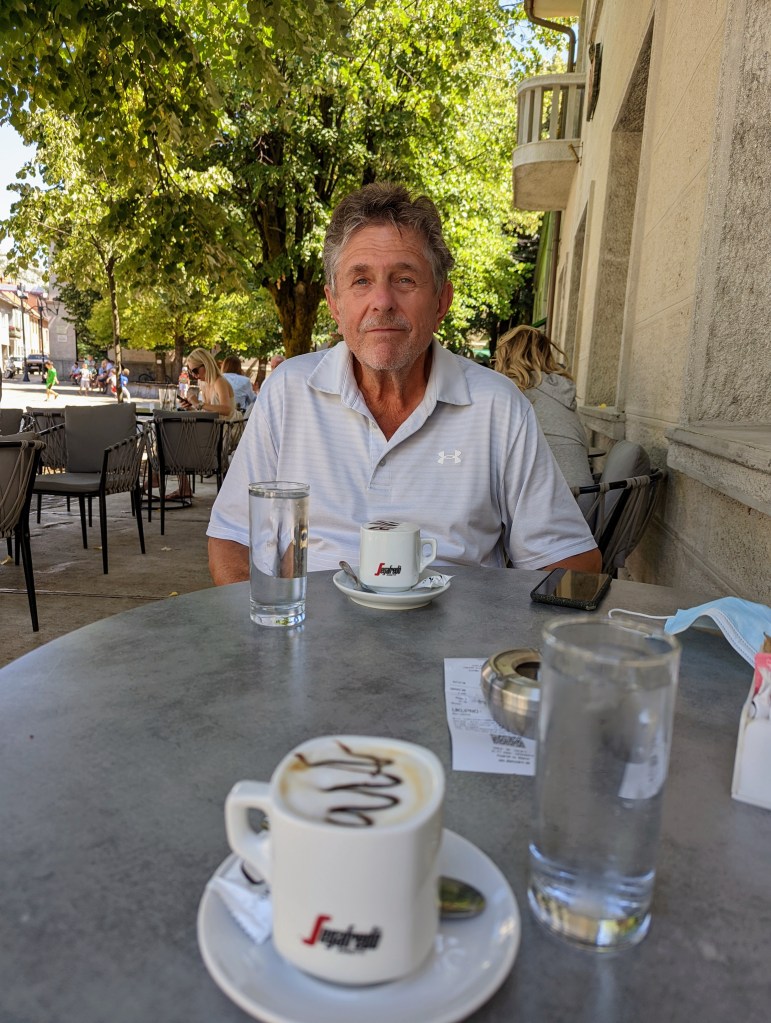
Our visit to Korfu was pleasant and educational. It truly left us wanting more time there. During a stop for coffee before boarding our ship for the return trip through the beautiful bay, we reflected on a day that took us from the fjord to the old town to the cliffs to the country and back again. We’ll remember this day for a long time to come.
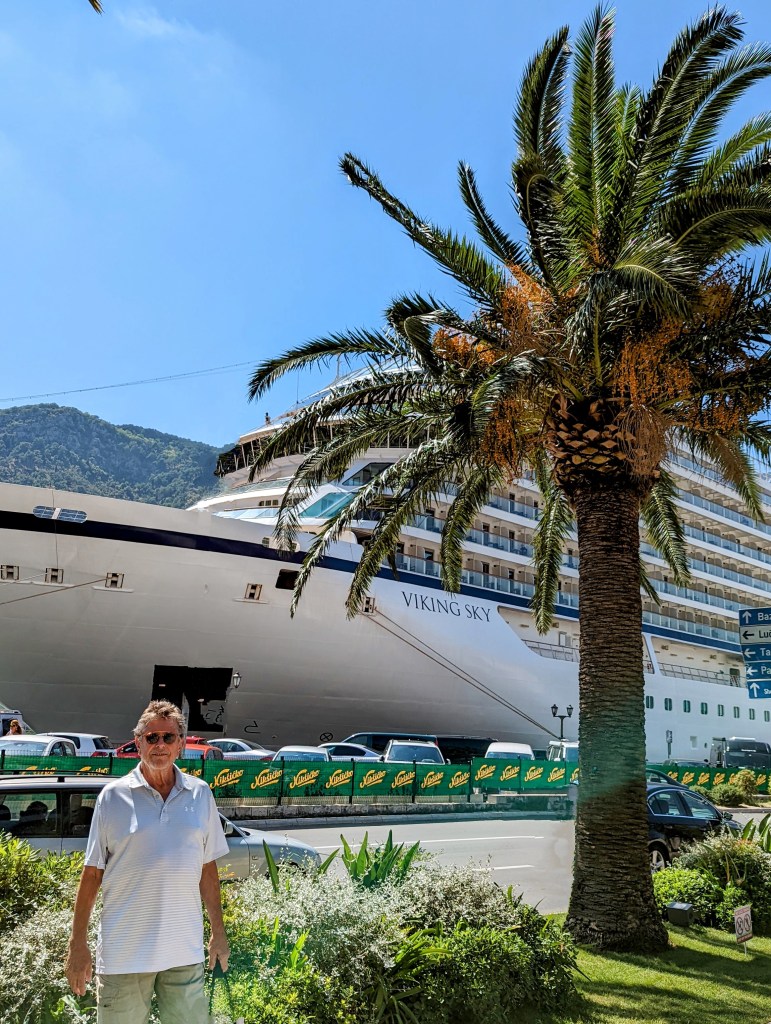
Tasty mocha lattes! Reminded us of our pup💖🐾Back to the Viking Sky
Dubrovnik is our third and last city to visit on Croatia’s Dalmatian Coast. While playwright George Bernard Shaw might have called Dubrovnik “paradise on earth,” we found it overwhelmingly congested and not nearly as inviting as our first two Croatian ports Sibenik and Split. Perhaps it’s the pent-up demand for post-covid travel that makes it seem as though everyone has come to Dubrovnik, and if that’s the case, it sure beats the alternative!
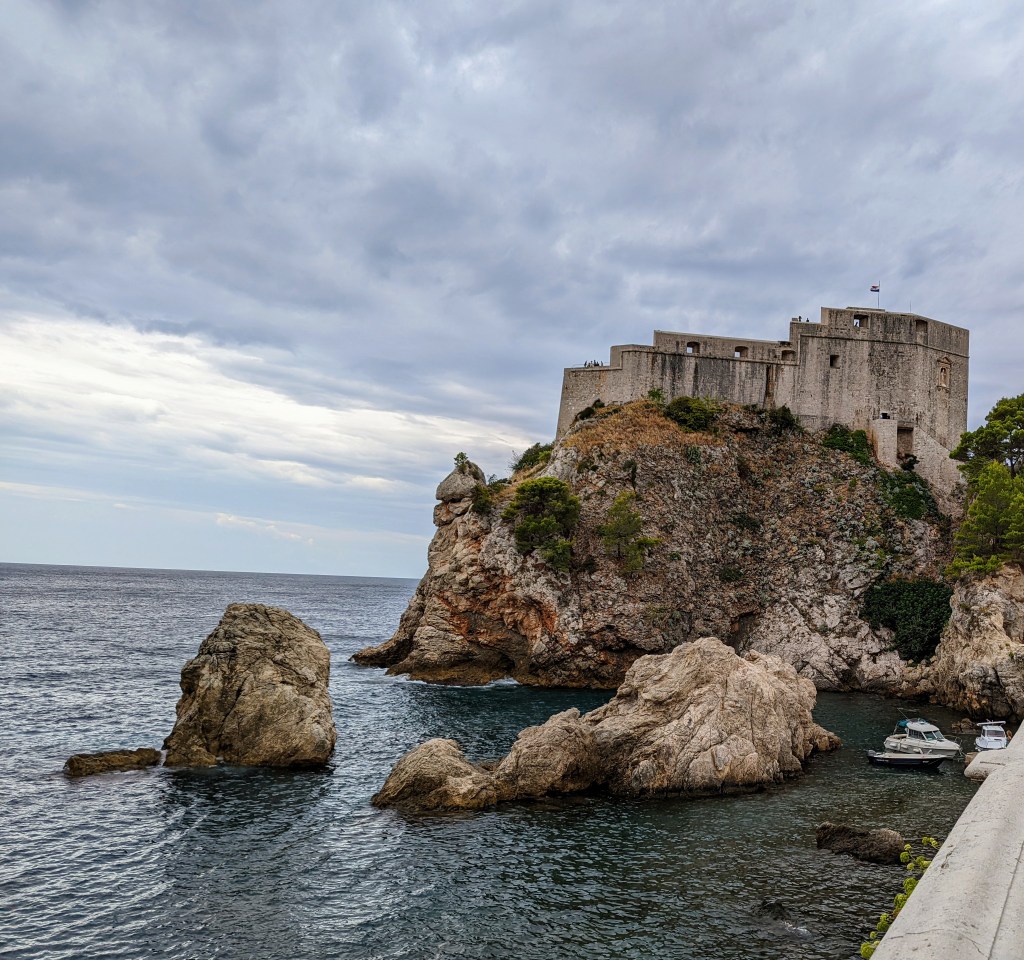
Our first stop was to view Fort Lovrjenac or St. Lawrence Fortress. Built around 1018, it is an impressive stone fort just outside the city walls. Its usefulness as a fortress has diminished over the years, and today it stands as a theater, museum, and a popular wedding venue.
Fort Lovrjenac
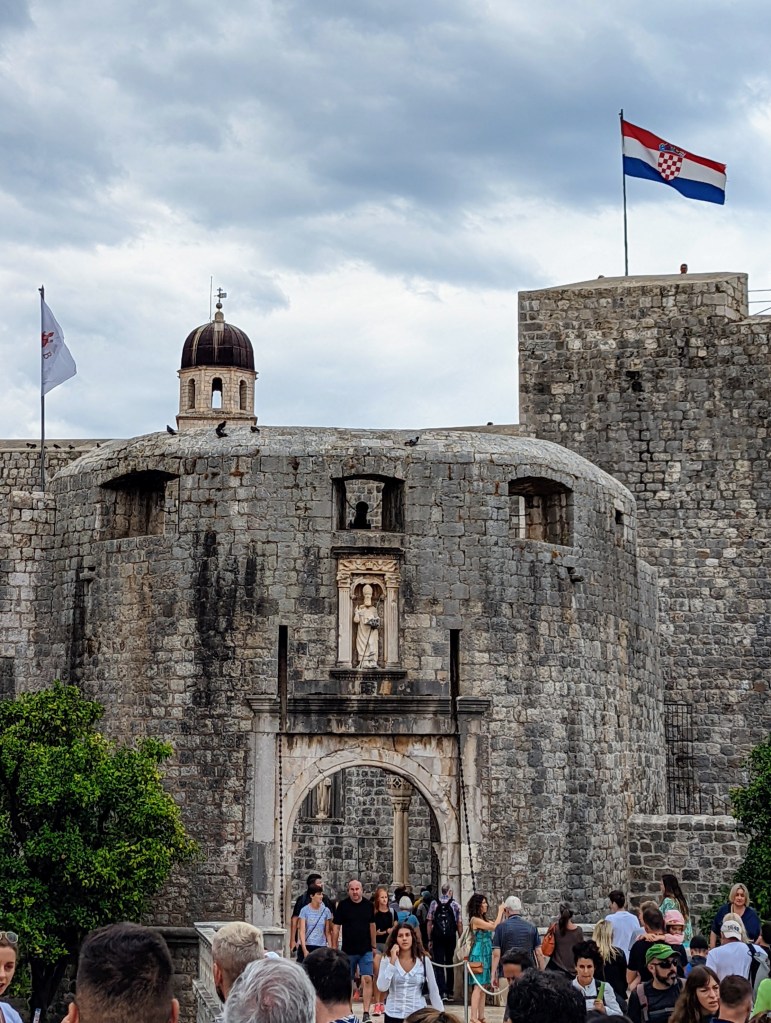
A short distance away is the Pile Gate to the Old Town. We were struck by how well the Medieval walls have been preserved. Although walking the walls is one of Dubeovnik’s most popular tourist attractions, we were discouraged by the long, crowded lines. Instead, we opted to take a leisurely walk around the fortified city, admiring its blend of Gothic, Renaissance, and Baroque architecture.
Pile Gate, one of two entrances to the Old Town
Immediately upon entering, we were greeted by a very tall friendly fellow offering “Hearts for Happiness” for 1€ apiece…a small price to pay for happiness!
Hearts for Happiness
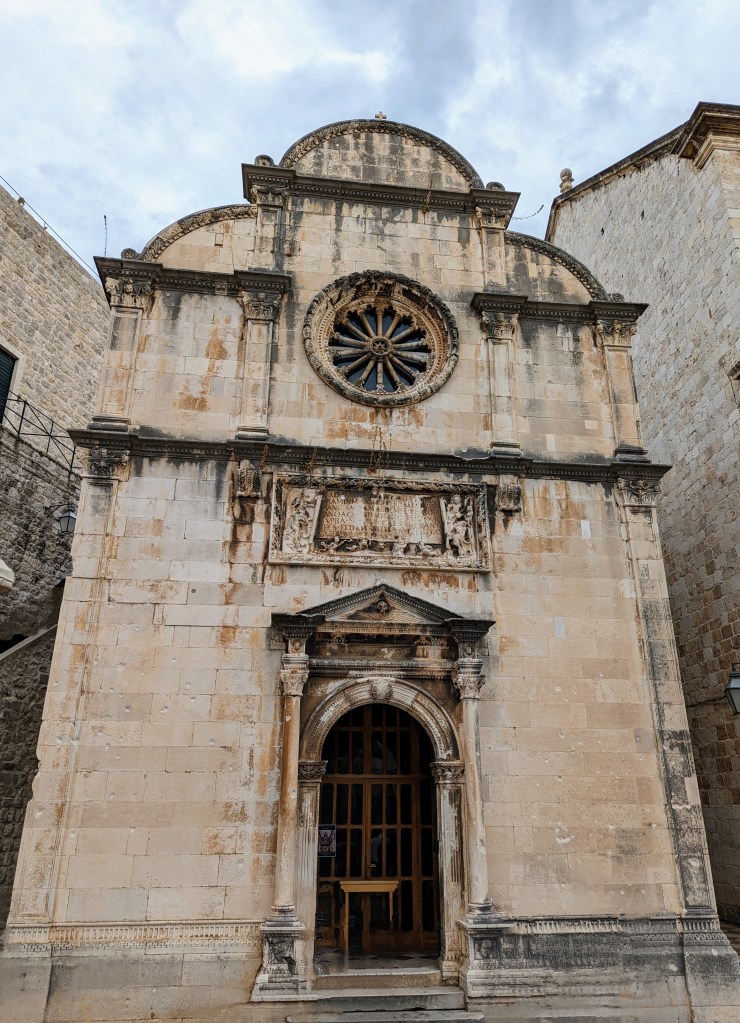
A few steps away are St. Saviour Church and Big Onofrio’s Fountain. We learned that all of Dubeovnik’s fountains offer clean filtered water that’s safe to drink. People can be seen filling water bottles at one of 16 sides of the fountain.
St. Saviour Church The dog on top of the fountain is called “Kuchak” which means fountain dog
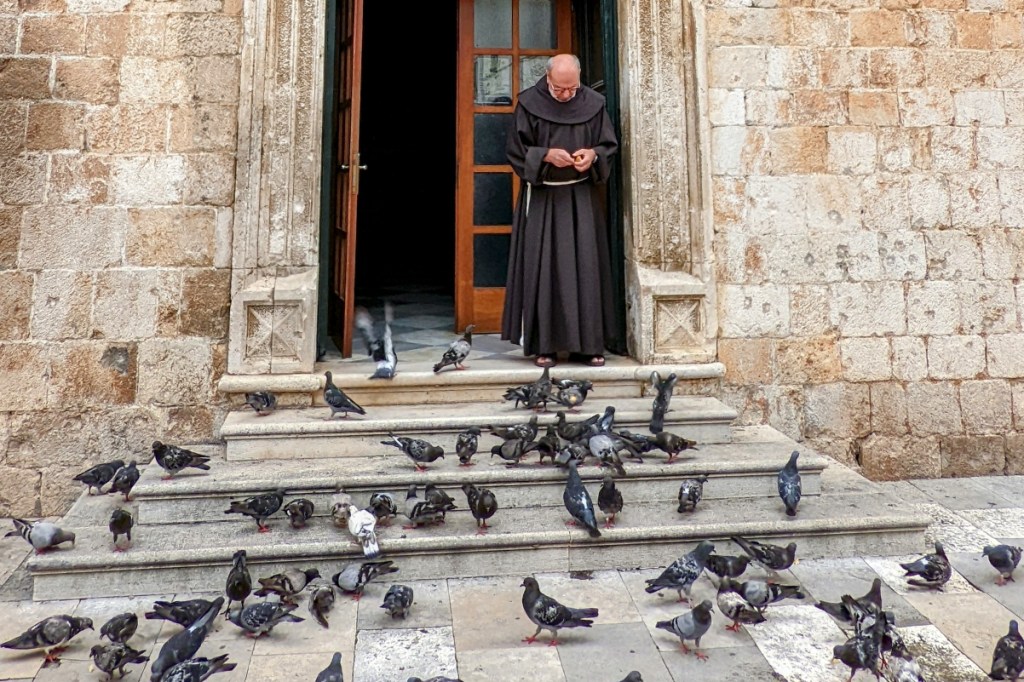
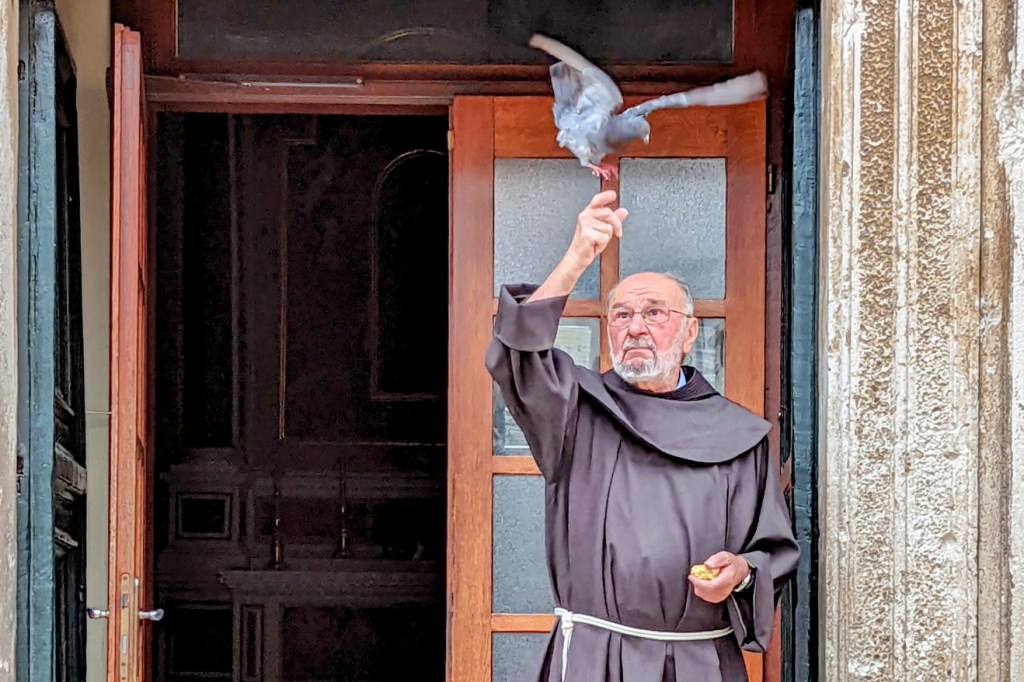
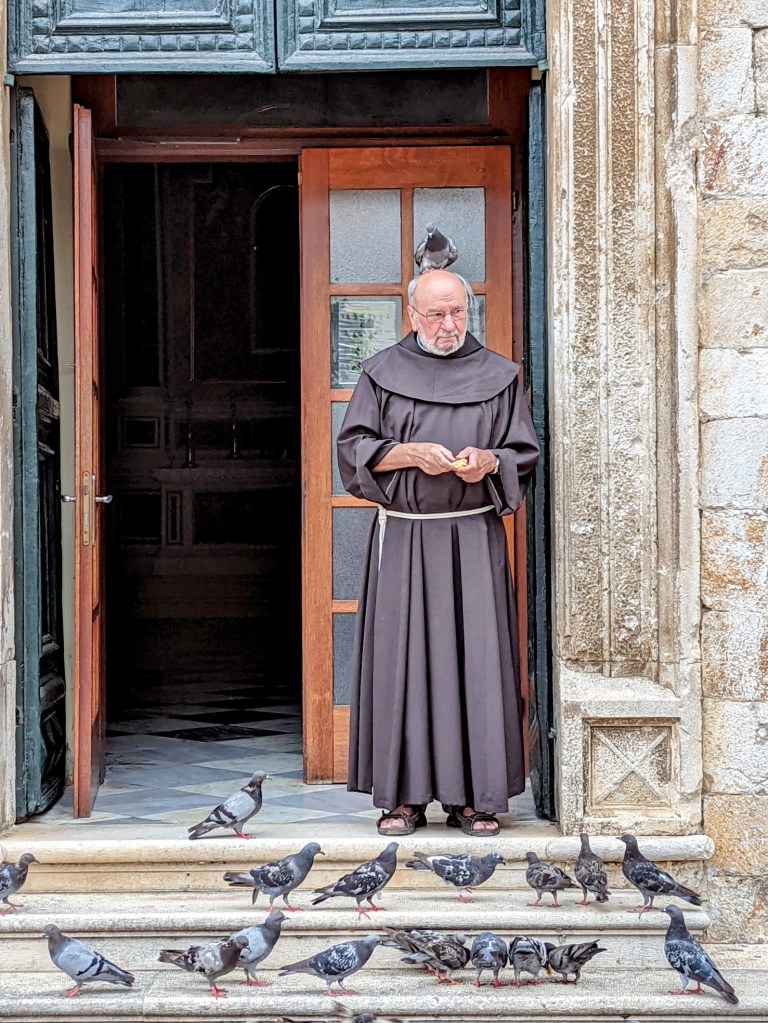
Just around the corner we approached a monk feeding the pigeons. Apparently it’s not a crime in Dubrovnik as it was in Venice!
Feeding the pigeons
Further along is Orlando’s Column, a well-known monument in the heart of Old Town. Built in 1418 and currently undergoing significant restoration, Orlando is an armoured knight. According to legend, Orlando helped the Ragusa (people of old Dubrovnik) defend themselves from invaders in the Middle Ages. Although I couldn’t get a full photo due to extensive scaffolding, the first step at Orlando’s base holds special significance. Before more standard measurements were developed, merchants used the length of the step as a common way to measure items for sale.
Orlando
Next stop is Luza Square, site of the Old Town’s clock tower. Originally built in 1506, the tower has been destroyed and re-built several times. Only the antique bell remains from the original tower. When the octopus hands reach the hour, the zelenci (green) twins Maro and Baro strike the bell.
Maro and Baro striking the hour
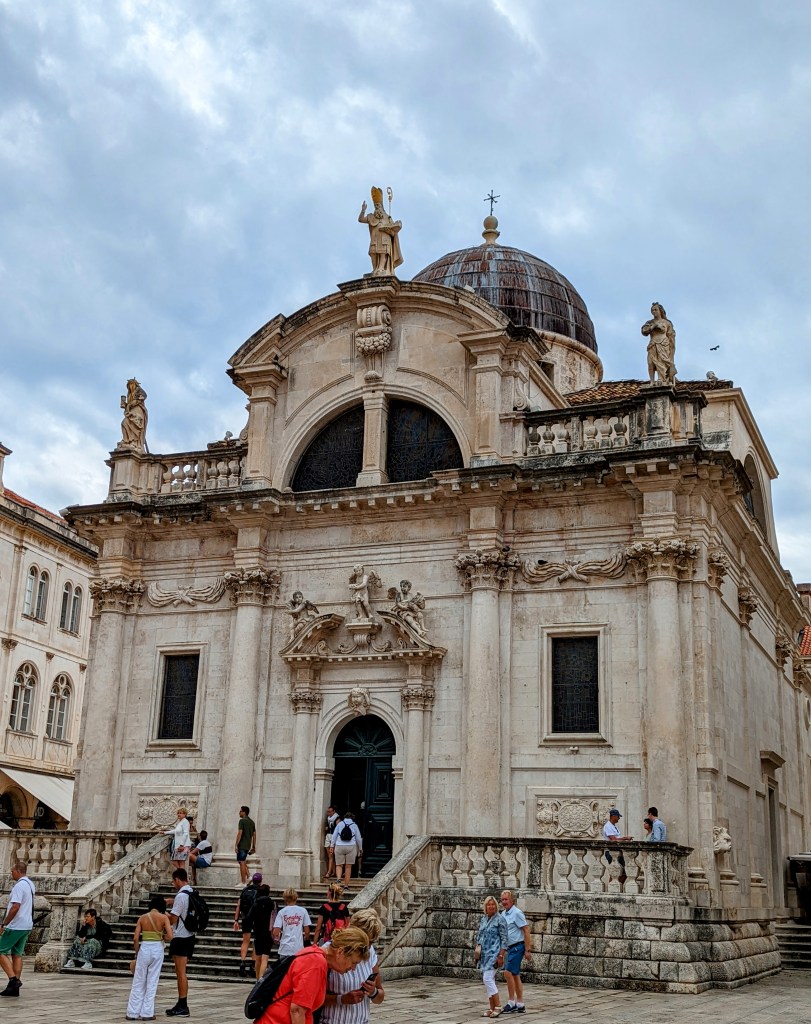
Saint Blaise Church, in honor of Dubrovnik’s patron Saint Blaise also occupies Luza Square. Every year on February 3, the Feast of Saint Blaise is celebrated with Mass, a procession, and blessing of throats. The regional holiday City of Dubrovnik Day is also celebrated on this day.
Church of Saint BlaiseMain Sanctuary of Church of Saint Blaise
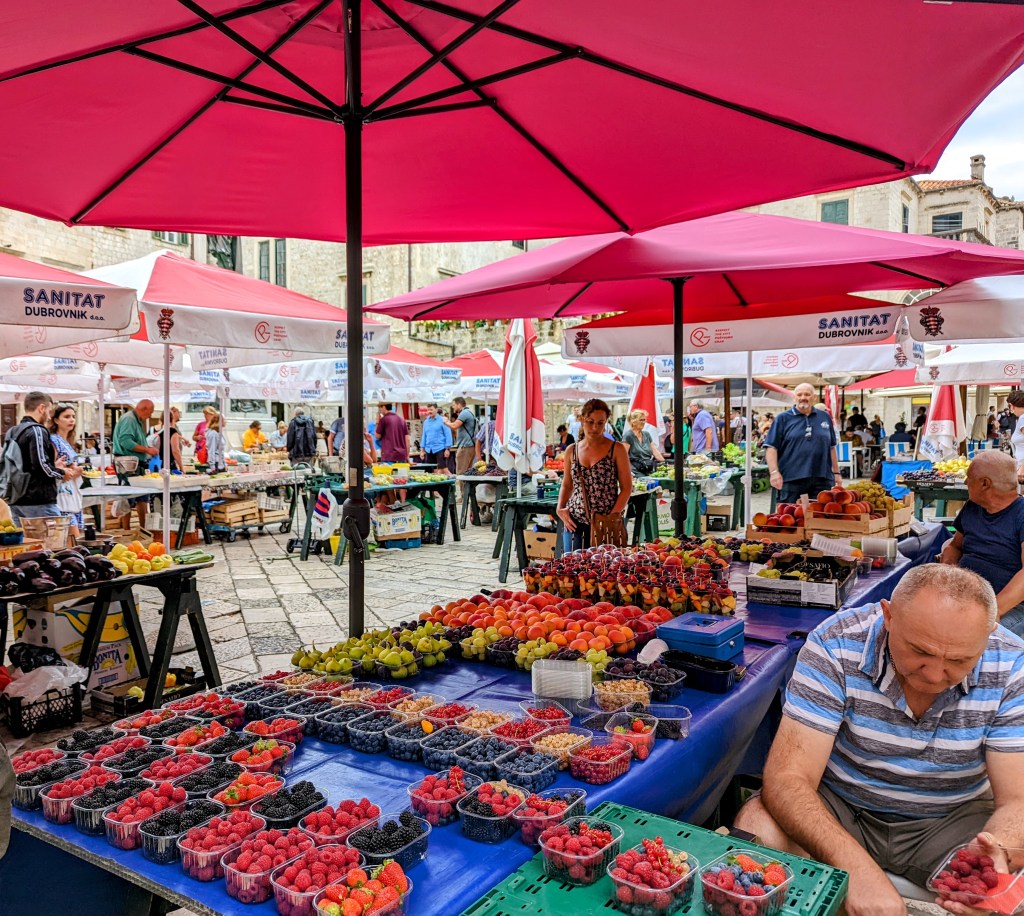
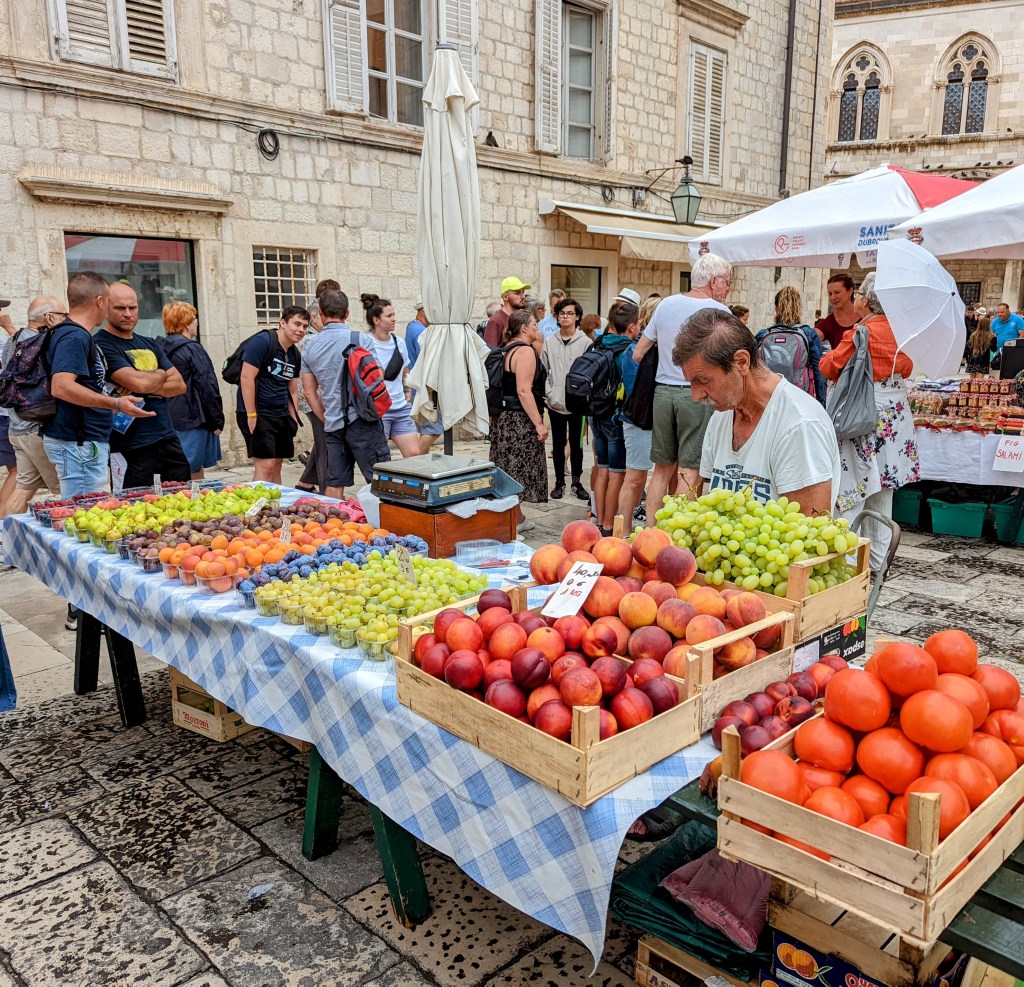
The fresh market offers fresh fruits, vegetables, local delicacies, and other local products such as soaps, lotions, and herbs.
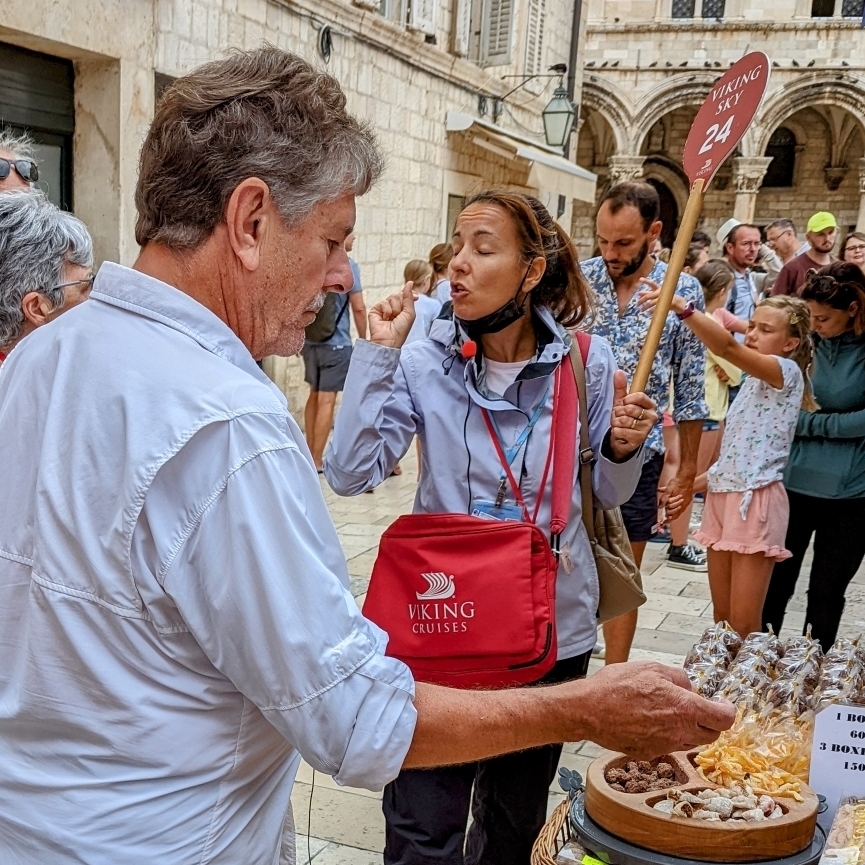
Fresh market finds, including free samples!
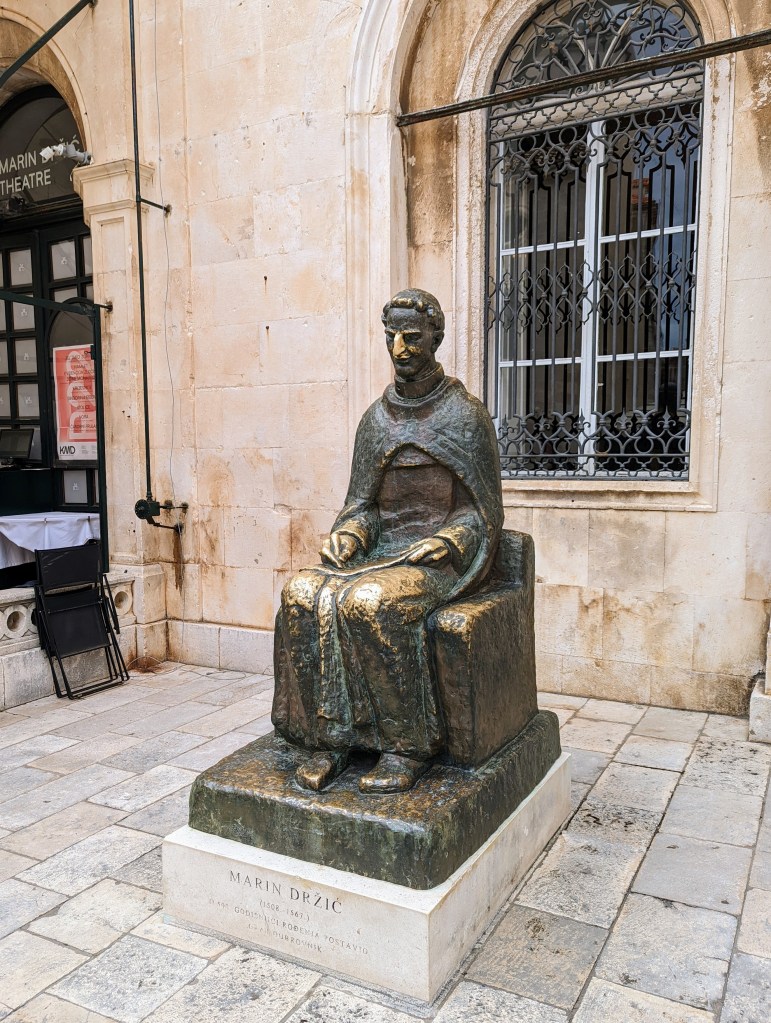
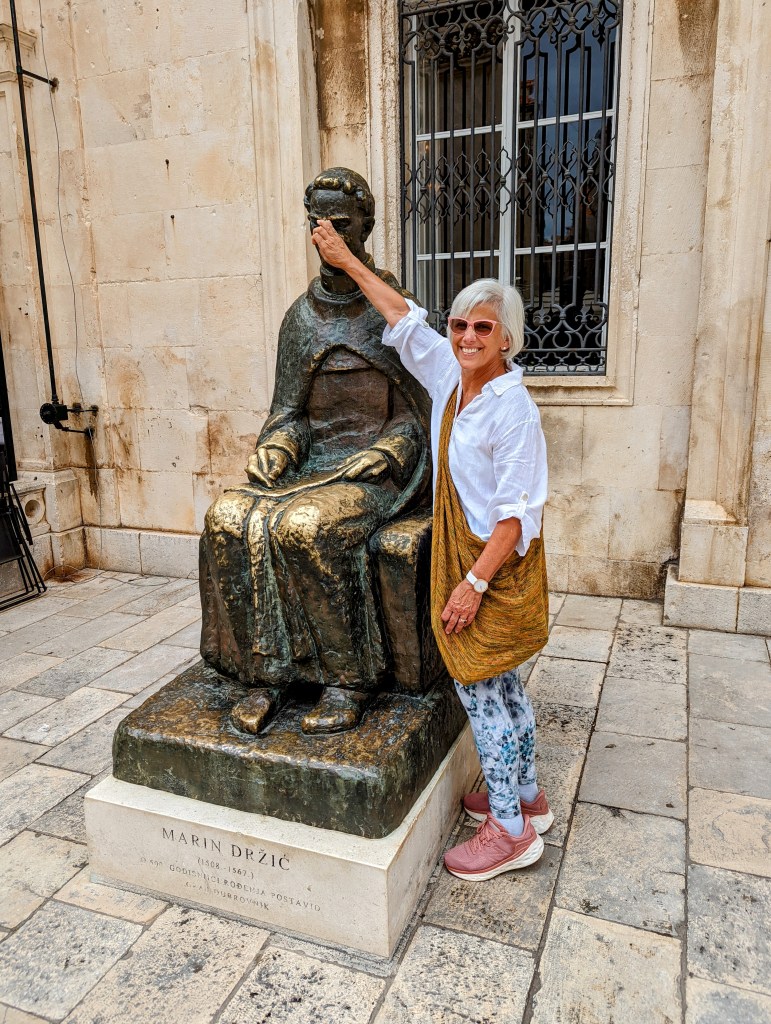
A large bronze statue of Croatian Renaissance playwright Martin Drzic, affectionately called “Dubrovnik’s Shakespeare,” sits next to Domino Church. His shiny bright nose is the result of a tradition of rubbing it for good luck.
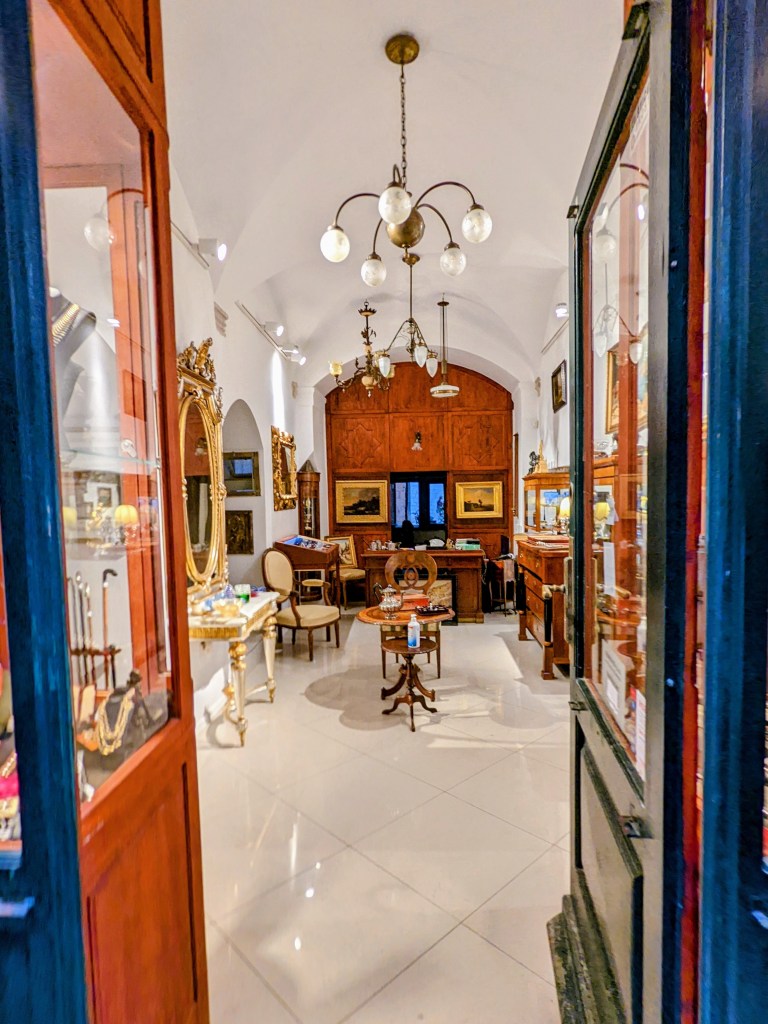
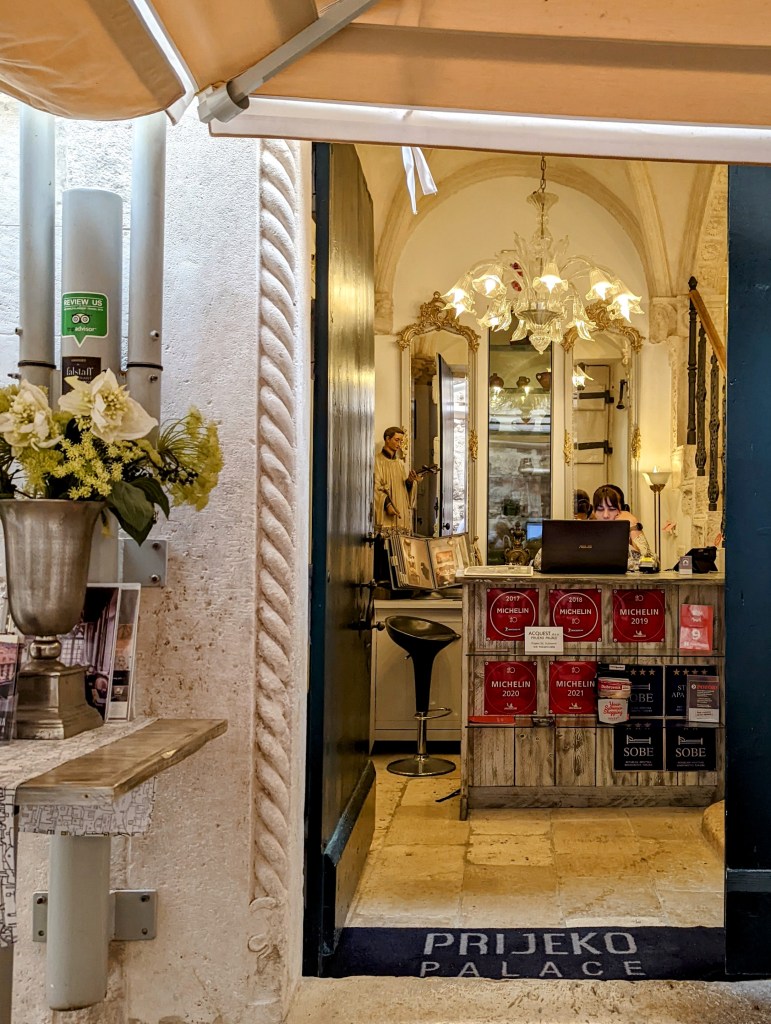
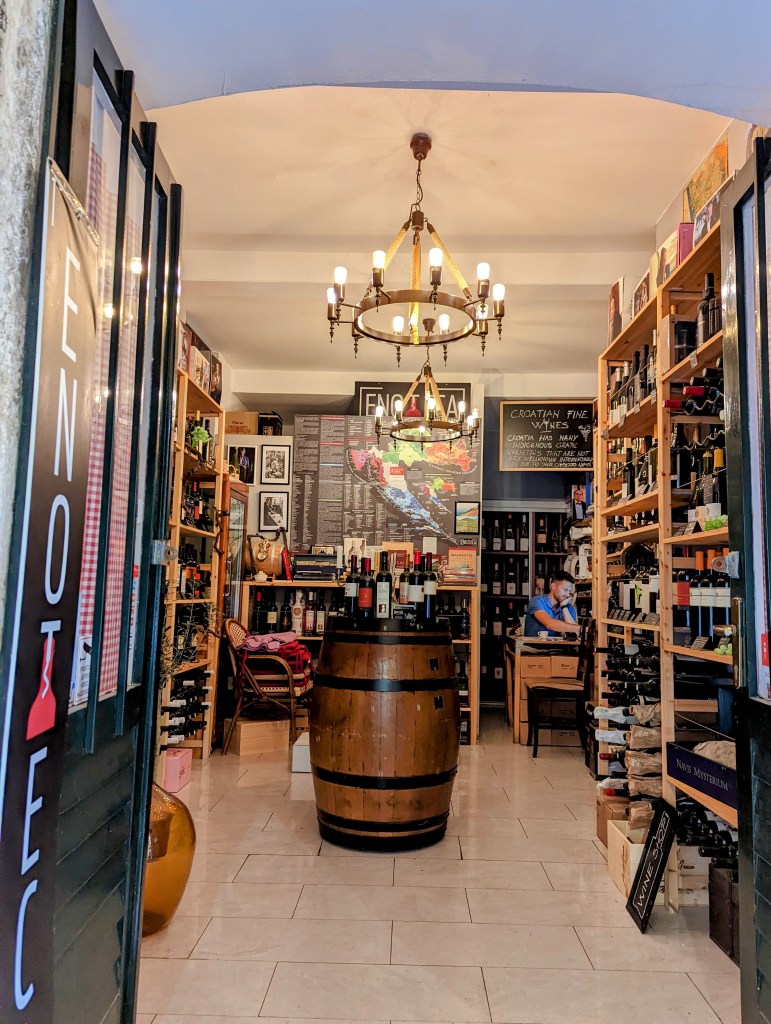
And Croatian hospitality is legendary. Warm, inviting shops and restaurants offering traditional dishes, wines, and other local products line the narrow streets and broad piazzas, welcoming locals and visitors to enjoy a meal, a snack, and other refreshments. The open doors provide a glimpse of the delights that await within.
Heritage of Dubrovnik
Dubrovnik has definitely come into its own as a popular tourist destination. Its well-preserved traditions and historic sites lure thousands of tourists from March through September. We were there at the height of the tourist season. We would love to return in the fall in order to be able to experience this city more fully.
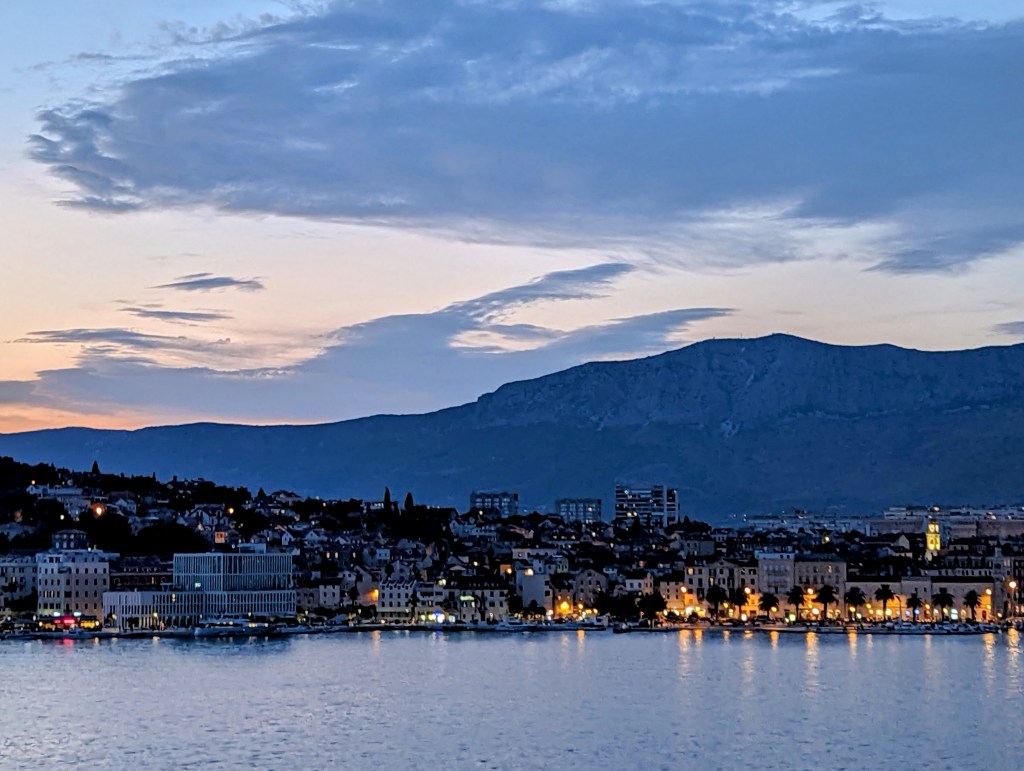
Built around the ancient Roman Palace of Emperor Diocletian, Split is a city that feels both old and new. Its lovely promenade, now a popular gathering place both day and night, offers majestic views over a bay that opens to the Adriatic Sea. The remains of its incredibly well-preserved palace have been seamlessly assimilated into a contemporary place to live, eat, shop, and gather. It also served as a filming site for the 4th season of Game of Thrones.
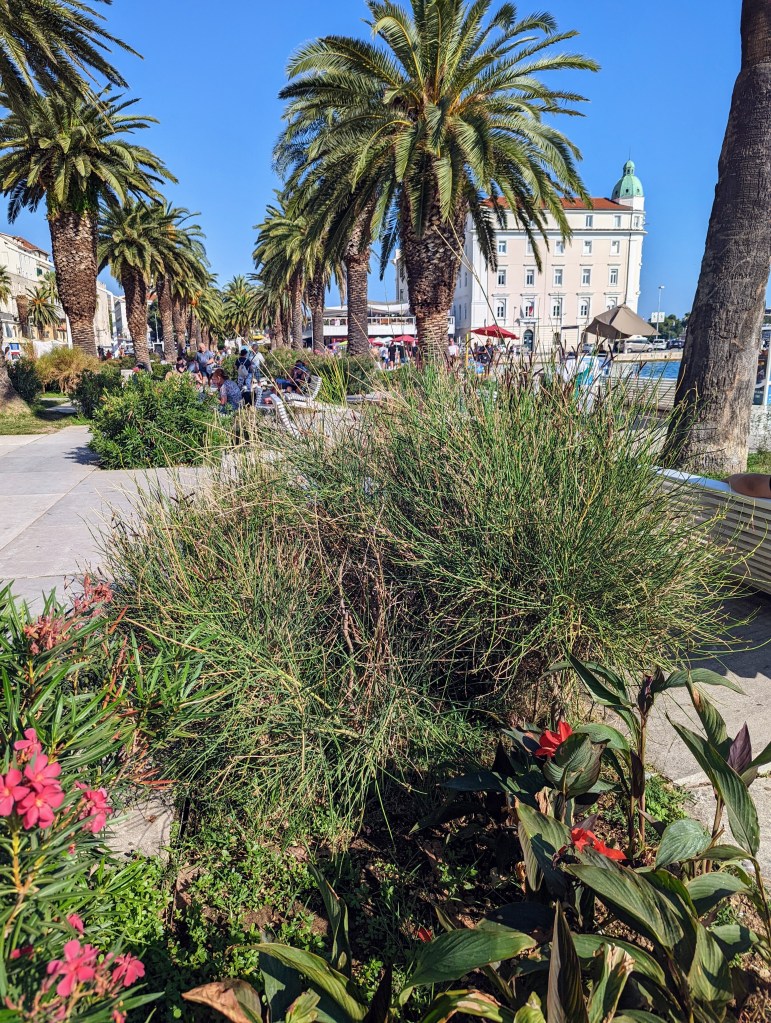
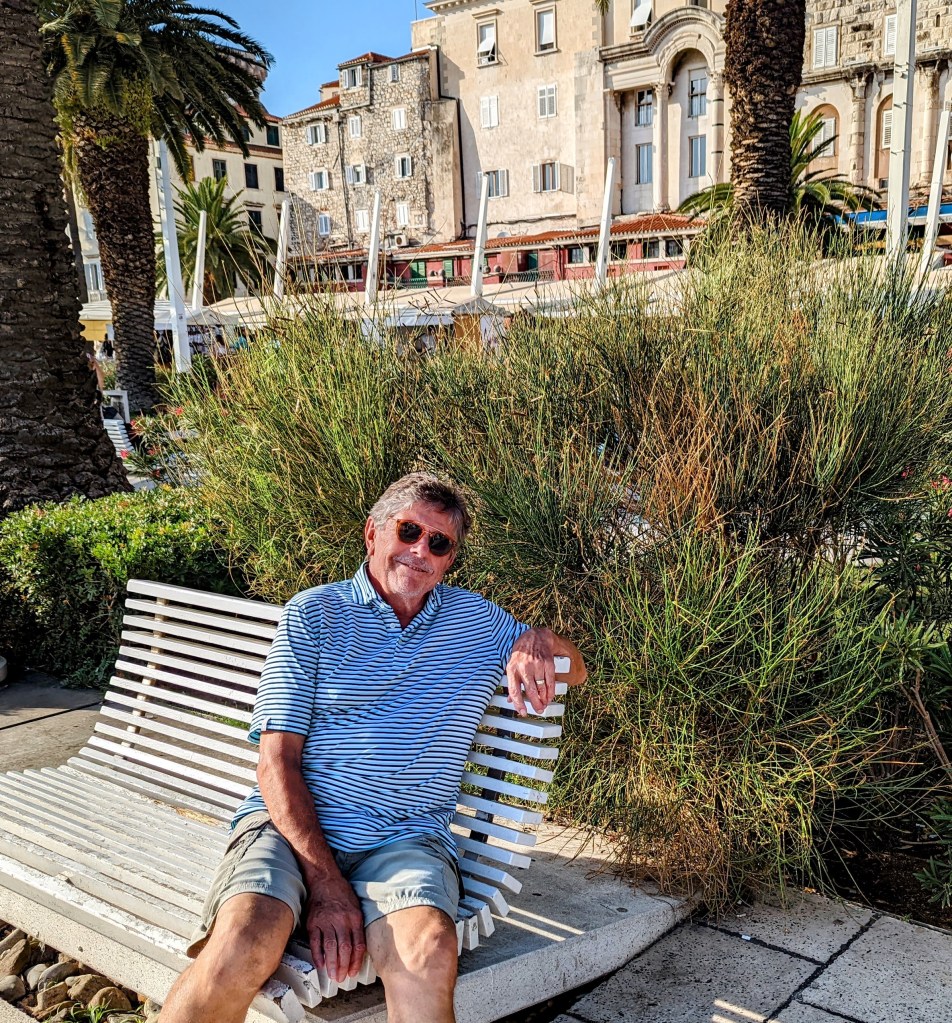
Split was named for a flowering shrub, calicotome spinosa. The shrub can be seen all over town, but its bright yellow flowers only bloom in May. I guess we’ll have to come back!
Ubiquitous Calicotome Spinosa
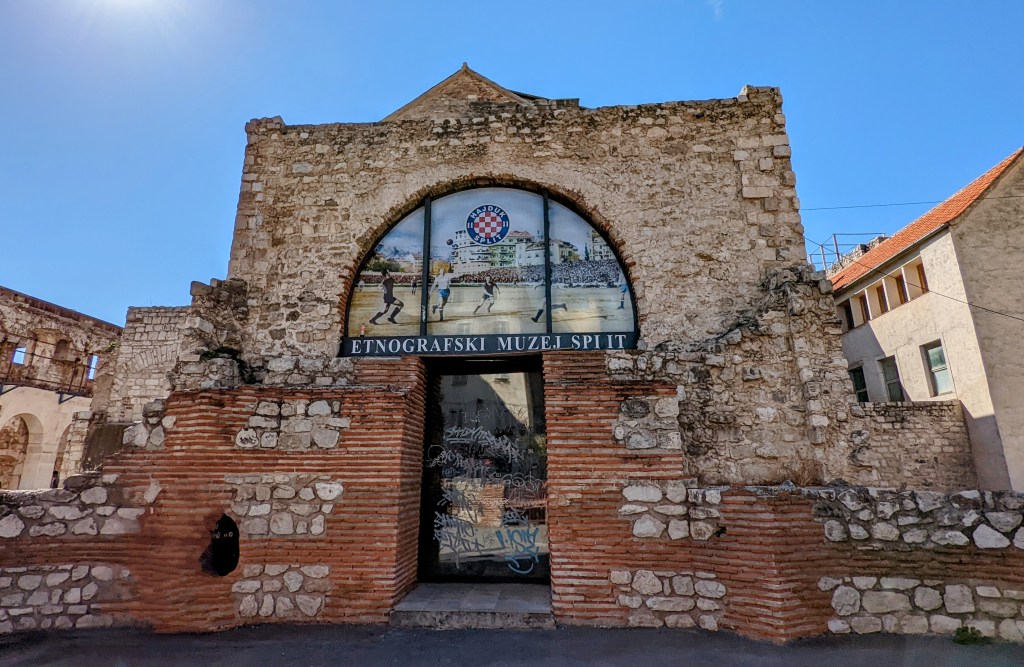
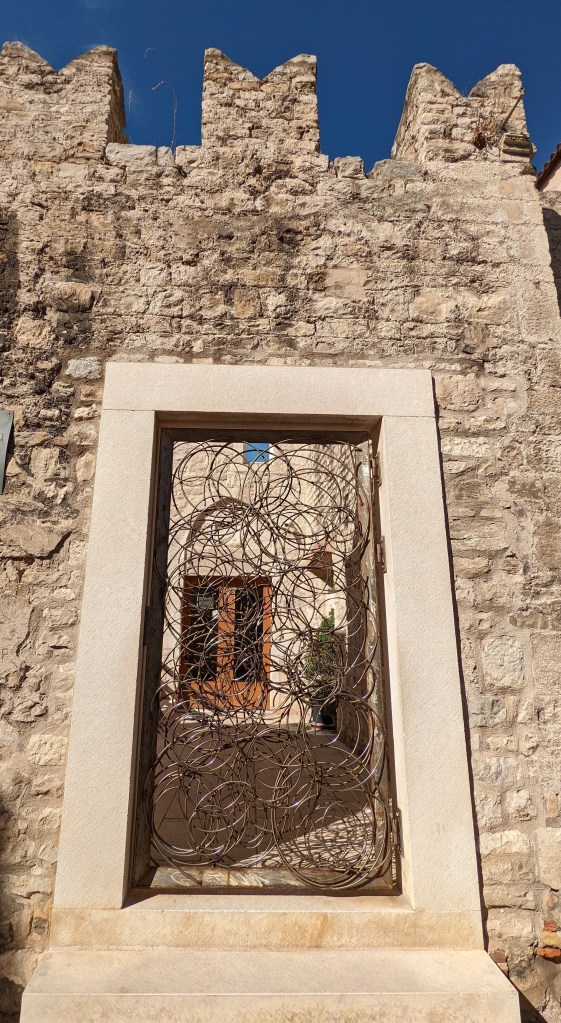
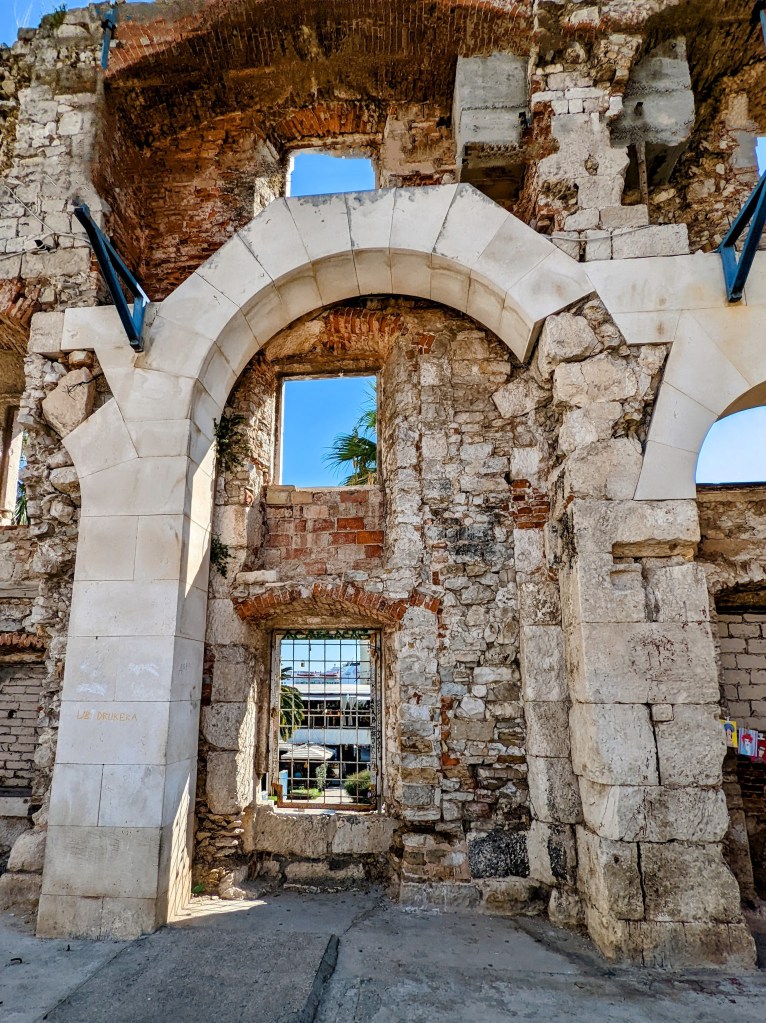
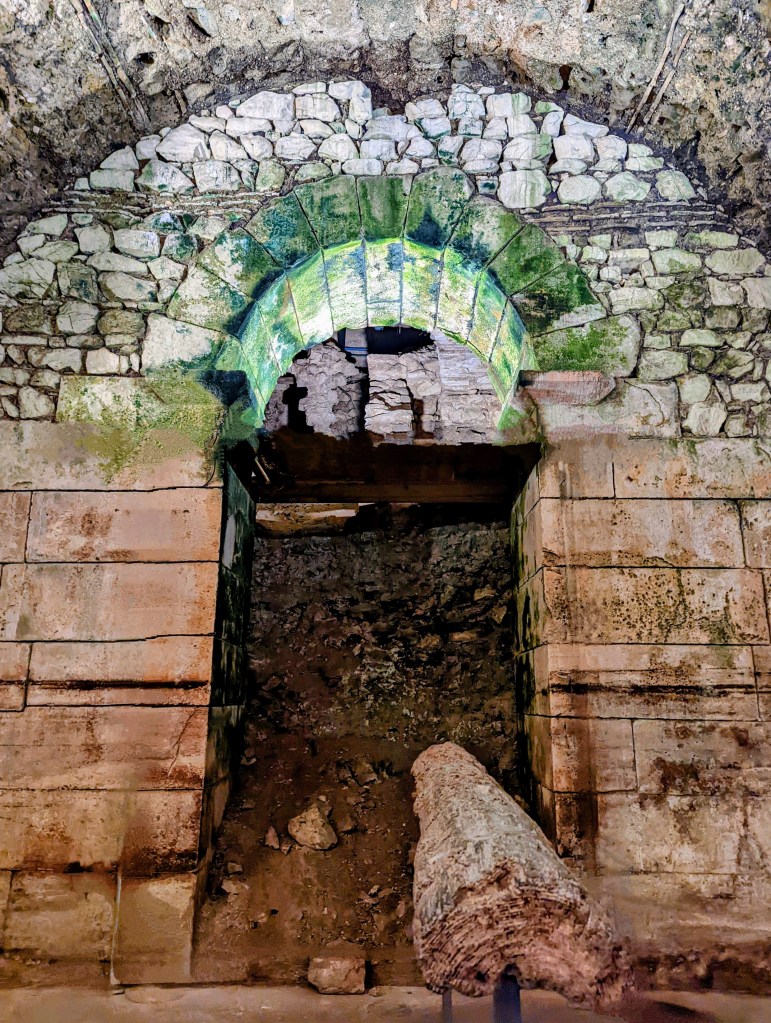
The palace, built by Diocletian in the 4th century as his retirement home after abdicating his role as Roman Emperor, took 10 years to build. Originally housing the royal residences, mausoleum, and military fortifications, the palace has been transformed into modern housing, upscale hotels, shops, museums, and various gathering places both above and below ground. There’s even a Michelin Star restaurant, Zoi. Although many of the original ruins remain above ground, the subterranean portions have been amazingly well preserved.
Zlatna Vrata (Golden Gate) – the main entrance to the palaceUpper floor ruins and a modern addition Football (Soccer) Museum Ethnographic Museum Portico overlooking the bayThe Paristyle, a popular gathering place for tourists and Roman soldiers, was the original entrance to Diocletian’s living quarters. A well-preserved Sphinx overlooks the mausoleum to the left.The ornate bell tower for Diocletian’s masoleum, now the Cathedral of St. Dominic, patron saint of Split
The barrel-vaulted stonework arches below ground enhance the many unique and charming spaces that are used for special events today.
A modern bust of Diocletian
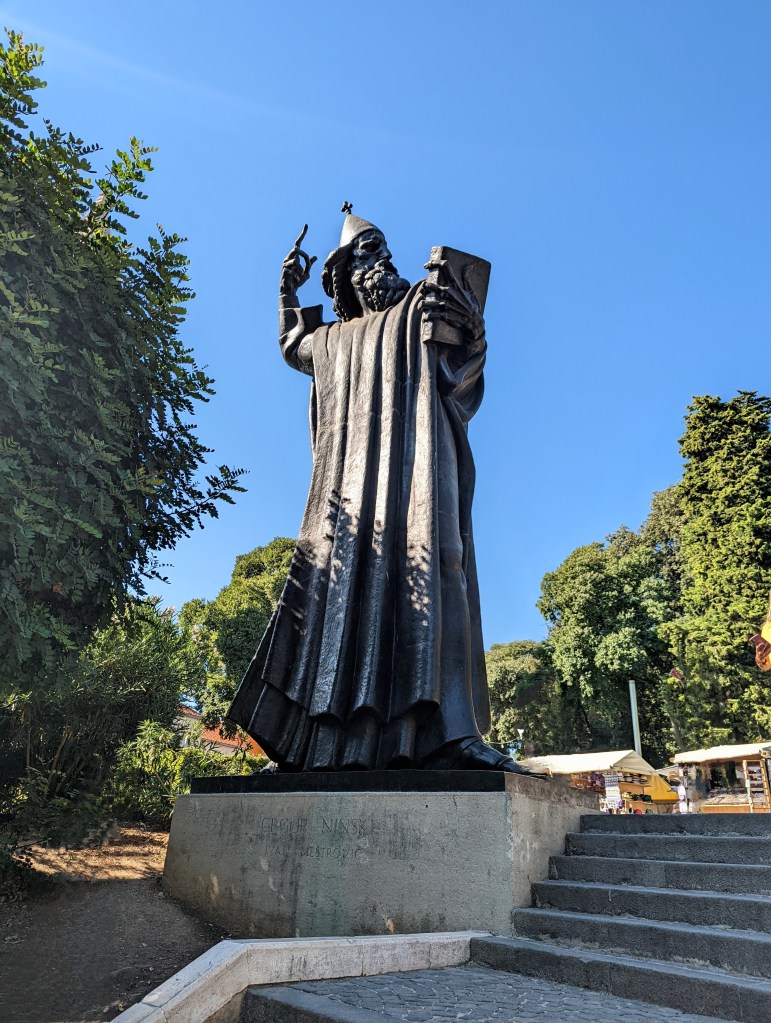
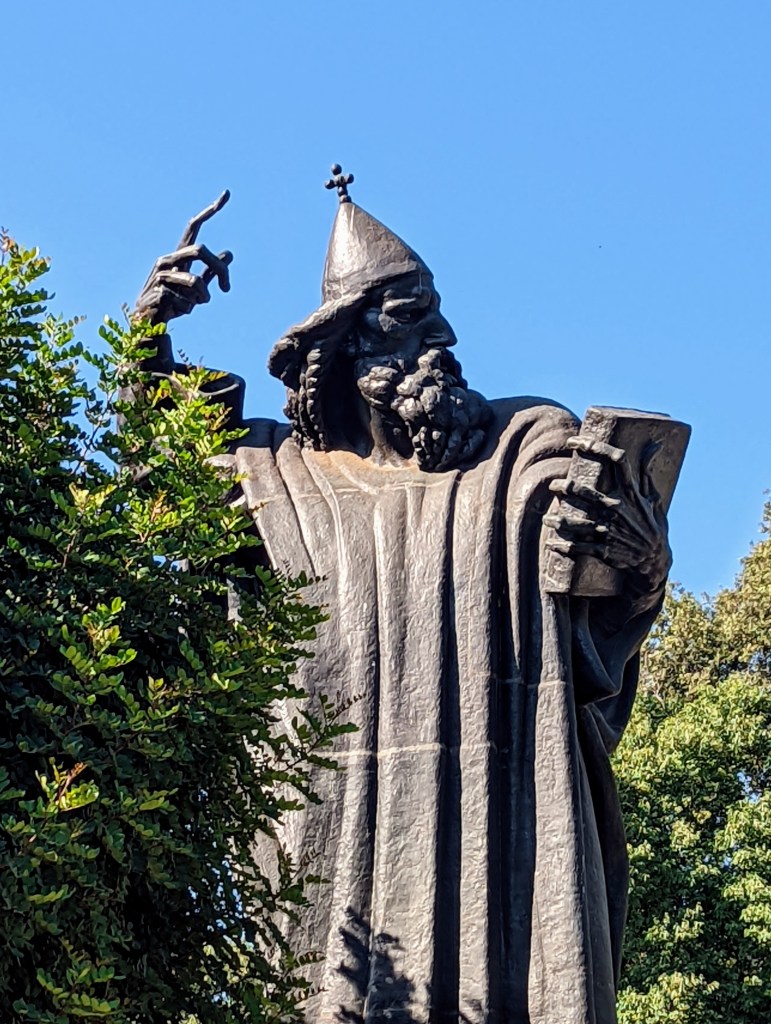
Just outside the palace is the imposing statue of Gregory of Nin, a Medieval bishop who is known for introducing the Croatian language into worship services. A radical concept in 926, the practice of replacing Latin with local vernacular in Roman Catholic services was one of the reforms of the Second Vatican Council.
Gregory of Nin…rub his gold toe for good luck!
Moving on to the old town area of Split, quaint cafes, shops, and outdoor patios provide warm hospitality and delicious Dalmatian culinary delights.
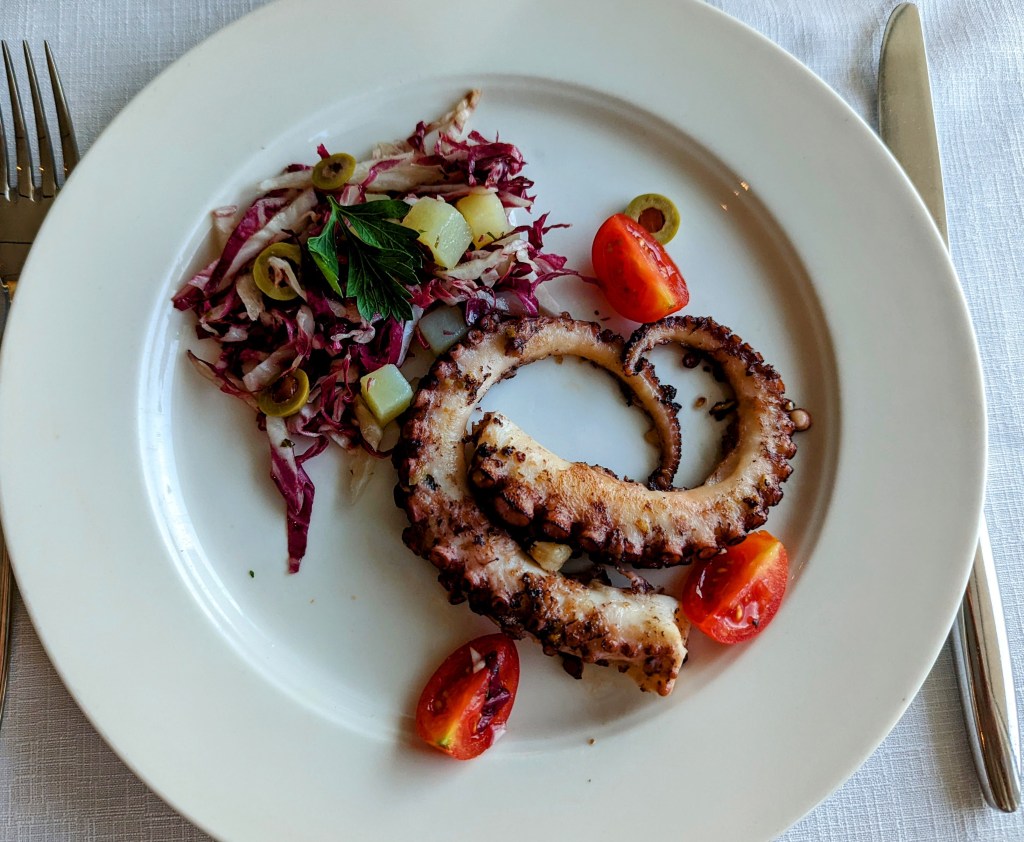
Today’s menuA delightful spot for lunchGrilled octopus didn’t disappoint We even had some puppy time with Rio, the resident Boston Terrier Barrels of tempting sweets
Charming Split is a relative newcomer to tourism, but we think it won’t be long before this gem becomes a popular travel destination!
































































































 Timeless Travelers